A Few Hours from France: This Country Lets You Observe Giant Sharks Up Close

Do you dream of seeing sharks up close? For that, you don’t need to travel to the other side of the world. Each year, an astonishing spectacle unfolds off the coast of Ireland. In a few bays, one of the planet’s largest fish ventures so close to shore that it can be observed from a boat or from the cliffs, offering a rare—and safe—experience for nature lovers.

Why Ireland has become a refuge for basking sharks

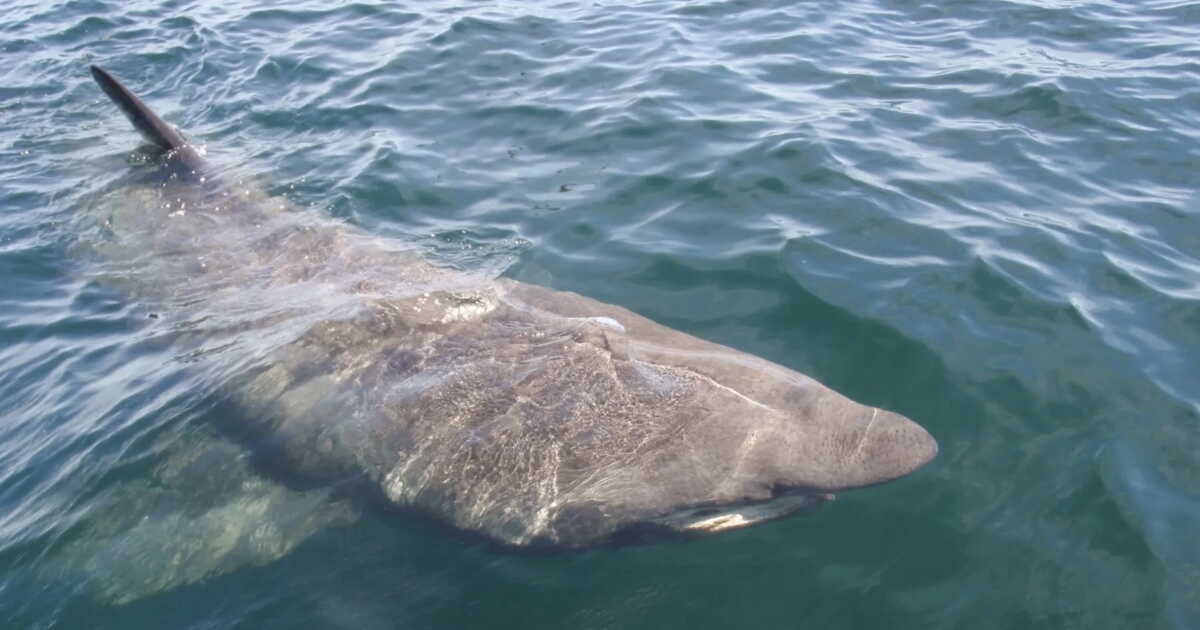
With a length of up to 10 meters, the basking shark is the second-largest fish in the world, behind the whale shark. And, despite its impressive appearance, it poses no danger to humans. Like the whale shark and the big-mouthed shark, it feeds solely on plankton and tiny copepods that it filters by swimming with its mouth open at the surface.

Between April and early July, then again in August and September, hundreds of basking sharks move to the west and southwest coasts of Ireland. The plankton blooms there are particularly abundant, favored by the shallow continental shelf. This concentration of food draws the animals into bays near the beaches, a phenomenon unprecedented on a global scale.

For biologist Chelsea Gray, a researcher with the Irish Basking Shark Group (IBSG), this proximity is what makes the country’s situation so unique. “Basking sharks are global citizens”, she told the BBC, adding that “Ireland is really unique, because they come so close to the shore”. A feature that allows them to be spotted both from the cliffs and during sea excursions.

Cette situation contraste fortement avec leur histoire. Dans les années 1950 et 1960, Achill Island – la plus grande île du pays, située à l’ouest – était le principal centre mondial de pêche et de transformation du requin pèlerin. Son immense foie, pouvant peser jusqu’à une tonne, était exploité pour produire de l’huile utilisée dans les cosmétiques, les lubrifiants industriels ou encore certains traitements médicaux. Ses nageoires étaient également recherchées pour la soupe d’ailerons de requin. La surpêche pratiquée en Irlande, mais aussi en Norvège, au Japon ou au Canada, a conduit l’espèce au bord de l’effondrement à la fin du XXe siècle.

A highly supervised encounter to protect an endangered species

Globally, the species remains threatened and has been listed on the International Union for Conservation of Nature (IUCN) Red List since 2018. But since the last basking shark caught in Ireland in 1984, the situation has gradually improved in Irish waters. Protection was further strengthened in 2022, when the basking shark was included in Irish wildlife legislation. It is now illegal to hunt, injure, or disturb its feeding and breeding areas.

Scientists now aim to turn the recommendations given to tour operators into a real legal framework. Concretely, boats should not speed toward the animals. When a shark is spotted within 50 meters, the engines must be put in neutral to let it decide how close it wishes to approach.

“Our priority is not to interfere too much with the animals. We typically stay well back and let them come to us. If we can intercept their path at a safe distance, they sometimes take a look and then move away”, explains Paddy Byrne, owner and captain of Sliabh Liag Boat Trips, to the BBC. He also notes that “they are wild animals, and we are privileged to see them”.

Exceptional Encounters

Observations are never guaranteed. Yet, outings regularly offer glimpses of seals, dolphins, seabirds, and sometimes small whales. But when basking sharks appear, the memory tends to be unforgettable. “We saw a baby basking shark even before leaving the first bay,” recounts Izzy Sharpe to the BBC, before adding: “On the way back, suddenly hundreds of basking sharks appeared. Wherever you looked, they were surfacing. It was incredibly special”.

Hazel Keegan, a regular on Achill Island, also recalls an extraordinary encounter. “They ended up swimming all around the boat. We could clearly see the white of the inside of their mouths. They kept passing under the boat! It was only then that I truly realized how long they are,” she tells the British media. Even when luck isn’t in your favor at sea, surprises can come from the shore. Laura Brown recalls finishing her stay without spotting a single shark during her excursion.

“On the last day, the weather was perfect and we decided to head back to Keem Bay one final time. We looked into the bay and there were about six to eight basking sharks! My son, his friend, and I ran to grab the paddleboard. They swam beneath us and around us. It was truly magical”, she tells the BBC. A reason to consider Ireland a top destination for those dreaming of observing one of the planet’s largest fish in its natural habitat.
We Are Here as Guests: Observe Without Leaving a Trace — The Daily Life of a Patagonia Guide

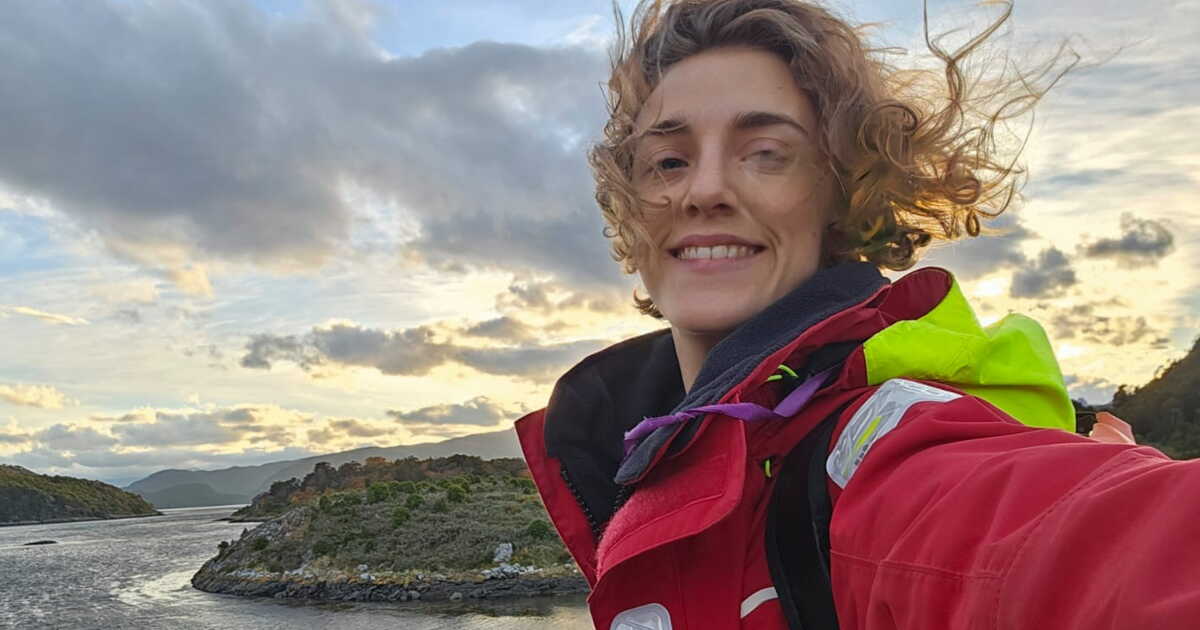
Angeles Rodriguez chose to live far from home for several months each year, in one of the most remote regions on Earth. Holding a PhD in Biology from the University of Buenos Aires, this 34-year-old biologist has made Patagonia her prime field of observation by becoming a guide for Australis, the Chilean expedition cruise company. From Wulaia Bay to Cape Horn, through a maze of fjords, glaciers and isolated islands, she accompanies travelers in the discovery of extraordinary nature.

A life in step with nature

What does life at the edge of the world look like? For Angeles Rodriguez, every day is unique. Between daily outings to accompany travelers in the field, on-board lectures, and assigning tasks to her team, the biologist divides her time among numerous missions. Two excursions are scheduled each day to allow travelers to explore the Tierra del Fuego archipelago, in the wake of the great explorers.

“I’ve always had a very strong connection with nature, and thanks to my training as a biologist, I bring a very particular approach to guiding”, explains her. Angeles wants above all to help passengers connect with the environment, teaching them to look closely at the world around them. “Too often, people are so excited to be in a place like this that they don’t know where to direct their gaze, nor what to pay attention to”, she adds.

Learning to Look

Across her expeditions, Angeles escorts travelers through some of Patagonia’s most spectacular landscapes. The Tuckers Islets, home to Magellanic penguins, the entrance to the Beagle Channel, and the discovery of the famous “Glacier Avenue” with its glaciers descending from the Darwin Cordillera, Cape Horn National Park and its lighthouse keeper, Wulaia Bay—a historic site that was one of the Yámanas’ largest villages—and the Magellan Forest. A beauty that overwhelms. So Angeles takes her time.

In Ainsworth Bay, the day begins with a walk through the subantarctic forest near the Marinelli Glacier. “I ask travelers to look at the glacier, this extraordinary natural phenomenon unfolding before their eyes. When they are truly present in the world before them, we can begin to reflect. Why does this cloud move around that mountain in such a way? What happens to the air? Is it warm or cold? How is this air linked to the glacier and the environment in general?”, asks Angeles.

And her job doesn’t stop at guiding on land. “Once back on board, we offer lectures on the history of the Magellan Strait’s discovery, on nature, glaciology or the different peoples of Patagonia”, she details. It’s an opportunity for the team to deepen certain topics but also to engage in conversations with passengers. “These are true moments of sharing and we have very interesting discussions”, she explains.

The boats on which Angeles Rodriguez works sail the hidden fjords of Patagonia

Protecting Patagonia from human activities

Yet the beauty of the landscapes cannot hide a darker reality. Patagonia is facing a large-scale threat: fish farms. A danger to local biodiversity in particularly sensitive natural areas. “A few years ago, a company attempted to establish such a farm in the Beagle Channel, which houses very rich marine ecosystems. Facing opposition from the Argentine and Chilean governments, the project was abandoned”, explains Angeles Rodriguez. Other farms are nevertheless still present elsewhere in the country.

The country is not spared from climate change either. Angeles observes this reality daily in her work. “Temperature changes affect the entire environment. Glaciers melt faster, and that also alters aquatic ecosystems”. This is also part of the messages she tries to convey to passengers. “We must strive to have as little impact as possible on the environment we visit. I remind them that we are guests here. We can observe, but we must leave no trace”, she insists.

An ever-new eye

Despite the years, Angeles does not tire of her working setting. “What strikes me most are always the whales. At each encounter with these giants of the sea, I feel the same emotion: when facing a creature of such size, you feel incredibly small”, the guide confides.

Observation of glaciers, which represents a major part of her journeys, also holds a special place in her heart. “I like to think each glacier has its own personality. They are all unique and, as they continually evolve, they never quite look the same from one visit to the next,” exults Angeles, before adding: “The most spectacular moments, however, remain the great calvings: when huge blocks of ice detach from the glacier and plunge into the water. Witnessing such a scene is always a striking experience.”

Emotions that, far from fading over time, still fuel her passion for these extreme territories. “This is a very special line of work, one in which you commit for the long term and build deep connections with this environment. It truly marked a turning point in my life”, concludes Angeles.

Discover the fjords and hidden trails of Patagonia

  • How to get there: Access via Santiago, Chile or Buenos Aires, then flights to Punta Arenas or Ushuaia.
  • Cruises operated by Australis, with zodiac excursions.
  • Main itineraries: Sailing between Punta Arenas and Ushuaia, crossing the Beagle Channel, exploring Tierra del Fuego and Cape Horn.

This interview was made possible by the Chilean expedition cruise company Australis.