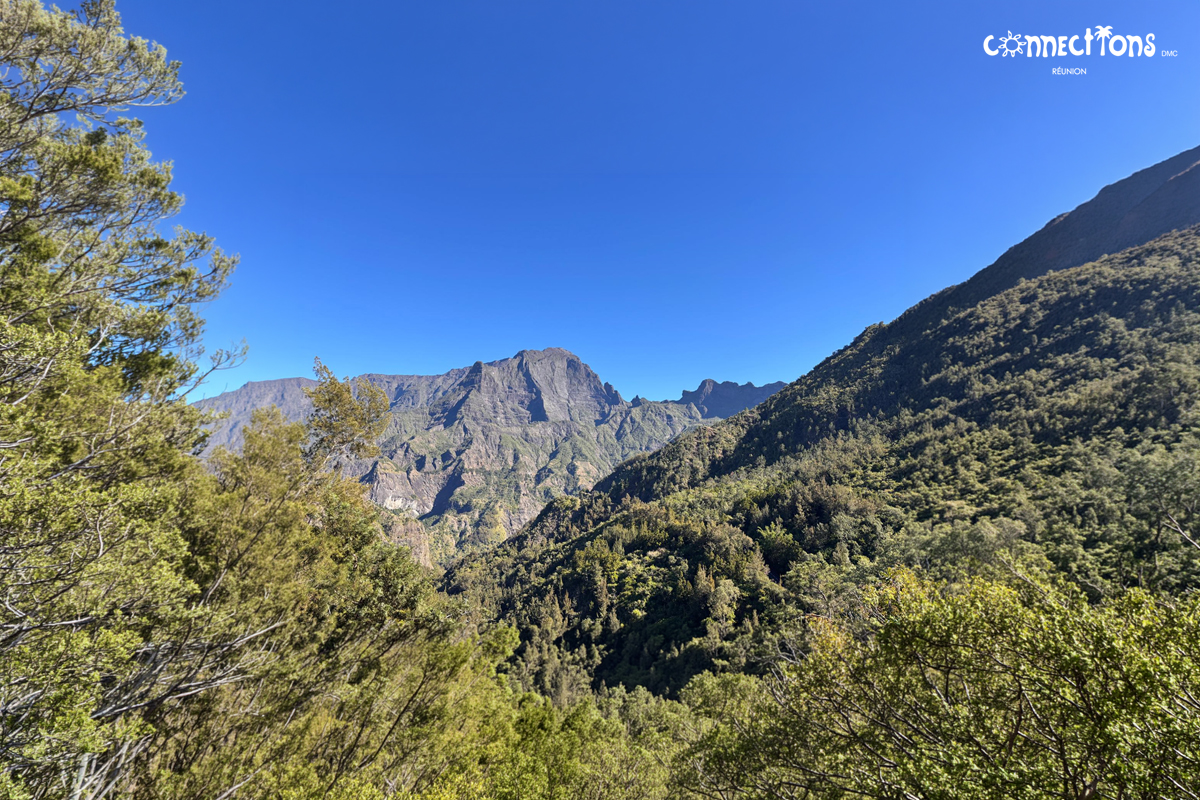
To walk on the Moon, you meet no soul. “When you are in a natural setting, if you want to give even more power to the moment you are living, you must feel alone! That is precisely what I feel here”, breathes our guide, who has taken care to clothe himself in a micro-down. We have arrived at one of the ends. Here, the Plain des Sables gives way to one of the cliffed ravines, also called “broken”, which follow the tumultuous path of the lava all the way to the sea. The next stroll awaits!
2/ The spray along Réunion’s wild southern coast
- Very easy
- From 500 m to 4 km per circuit (1h30 max)
- 50 m of ascent and the same amount of descent
Blue, black, green: a palette of elemental colors. At the crossroads between the ocean, dense forests, and ancient lava flows, far from the gentleness of the West beaches or the tranquillity of the cirques, “the wild South” unveils the raw beauty of a primal nature. Walks in this region, the last part of the island to be urbanized, present no technical difficulties while offering spine-tingling panoramas. This is due to the stubborn swell, coming from the fortieth parallel, which meets the basalt tongues born from successive eruptions. The crash of waves and the caress of spray: a delicious contrast.
Many short trails allow a gentle stroll along this stormy coastline. At Cape Méchant, families come to settle on the grass and enjoy the shade of vacoas, these indigenous pandanus with curious aerial roots, which share the coast with the filaos.
Further on, from the Arab Well, the path leading to the Table Point partly follows the lava flows that spilled in 1986, expanding the island by twenty-five hectares where it touched the ocean. One can see rivers of rock, basaltic columns: an entire pyrotechnic display, under a spray of spray. The eruptions, being true artists, also carved an odd ochre palagonite cliff in a place called “Terre-Rouge” or “Cap Jaune”, as you prefer.
In Réunion, toponymy is poetic and mysterious. “Here, you truly understand how much we are on an island shaped by fire and water”, admires Didier Cologni, our guide.
3/ Through the primary forest
- Easy
- 9 km (3 hours)
- 250 m of ascent and the same of descent
Like semaphore beacons watching over successive waves of green, the tree ferns raise their heads. These very old plants that the Creoles call fanjan stand tall, sometimes over ten meters, and are emblematic of the humid upland forests. The two most famous ones are Bébour and Bélouve, which you reach from Saint-Denis thanks to a forest road built only half a century ago.
We decide to venture to Bélouve, the smaller of the two (9 km2), which conceals a mythical trail: The Iron Hole. Located on the island’s eastern side, exposed to the trade winds, the plateau where this forest spreads is among the wettest places on the planet: it receives nearly 5,000 mm of rainfall annually. That is why the ONF has installed on most of the route (4.5 km one way) wooden bridges and stairs to spare the walker the muddiest zones and prevent damage to the roadside. “This trail is the best way to immerse oneself in a primary forest, or rather a semi-primary one. For although it still shelters a high proportion of endemic species (tamarin des Hauts, red tan, mapou, mahot…), it has been colonized by several exotic species”, explains the guide, Didier Cologni, who slipped an umbrella into his bag. He points to the tree ferns. They grow ten centimeters per year; the tallest are therefore over a century old.
In the early morning, it is not yet raining. We walk with ease on this “family trail”, which opens a doorway to a dreamlike world. Here, the trees are draped with all kinds of mosses and epiphytic plants, notably orchids, giving them a fantastical appearance. One must take the time to observe this vegetal symbiosis, to stroke these soft or rough leaves, to watch the humidity cling to the trunks. Also to be on the lookout for the tec-tec (tarier), a fluffy little bird that mischievously follows hikers, and the brick-colored plumage of a handsome zoizo la Vierge (tchitrec des Mascareignes). Listen for the strange meow of the merle péi and the bells of dogs that accompany the tangue hunters, the local name for the tenrec, a peculiar animal that looks like a hedgehog. After an hour and a half of immersion in the forest, a wide wooden balcony opens onto a clear horizon. Here is the famous Iron Hole, a 725 m waterfall—the highest in France—though you can see only one of its four drops. On the slopes of the surrounding ramparts, another forest clings to the vertical. A marvel where no human will ever set foot.
4/ Taking on the high-altitude maquis
- Fairly easy
- 11 km (3 hours)
- 500 m of ascent and the same of descent
For this hike under the auspices of Piton Maïdo (2,200 m), you must head for the heights of the western coast. The ideal is to arrive in the area very early in the morning, before the clouds. After enjoying the splendid view over the Mafate circus from the panoramic platform, follow the signs toward Grand Benare, the island’s third summit (2,898 m). One follows the Grand Bord trail, which fully lives up to its name: for hundreds of meters, it travels along the vertiginous natural cliff that overlooks Mafate, a thousand meters below.
The further you move from Maïdo, the fewer people you meet. This allows you to fully enjoy the vertiginous view, but also the high-altitude environment: a maquis in a thousand shades of green and yellow, very pleasing to the eye. “Altitudinal forest vegetation is dominated by the branle vert and the branle filao, endemic heathers, but also the ambavilles, another local plant with yellow or white flowers, and European gorse, a highly invasive plant”, explains Rodrigue Doré of the ONF (National Forestry Office). Occasionally small tamarins appear, a species of sophora also known as Fountain Tree for its ability to capture occult rain, i.e., ambient moisture, with its hairy leaves. Lichens, or “barbe de Saint Antoine” in common parlance, give them a supernatural look. The walk on this maquis is easy and not very dense.
After about an hour, you leave the Grand Bord path to head toward La Glacière. In the 19th century, ice produced in this natural cave during cold winter nights was highly prized. Stored in pits away from light, then broken into 25-kilogram chunks, it was carried on the backs of slaves to the wealthy plantations far below. The Desbassayns woman, renowned for her piety and her cruelty, was known to serve cold drinks and sorbets to her guests. After a rest in the shade of the cave, we content ourselves with the water in our canteen. At this late morning hour, as on almost every day, the return takes place in a thick layer of clouds, turning the moor into a haunted world.
5/ Mafate, the inhabited heart
- Demanding
- 13 km (5 hours, with an overnight stay)
- 800 m of ascent and the same of descent
What is this cirque? In Réunion, this is how one names the valleys carved by volcanic collapse and torrential erosion, surrounded by towering cliffs. There are three of them, like petals of the earth opened at the heart of the island. Mafate is the most inaccessible. There are no roads to reach it! One must choose a path, lace up one’s shoes, and take the time to brave the chaotic relief to reach one of the hamlets, called îlets. We head toward Marla (“many men” in Malagasy), one of the most charming and most isolated, starting from Bois des Boeufs Pass (1,956 m), 300 meters higher, which is one of the shortest and least technical entry trails into Mafate.
That remains the most demanding of our six walks, due to the elevation gain. From the first steps of this steep trek, you witness landscapes of “pikes, cirques, and ramparts”, listed as UNESCO World Heritage. Entering this magical world requires some legwork. The trail often takes the form of steps. It divides into three segments: two steep sections separated by a flat trek across the Tamarins plain. The twisted shape of Réunion’s iconic tree and its lichens give this crossing an epic moment.
In a clearing, hikers pause for a picnic. All around them, the cliffs cling to the clouds. Located in the Réunion National Park, Mafate is its “inhabited heart”. The nine îlets host about 900 residents year-round, resupplied by helicopter. “Mafate is an emblematic place, with a unique history since it was first occupied by maroons, escaped slaves. It had its rightful place in the national park,” says our guide, Didier Cologni. “It is a perfect synergy between a way of life to preserve and a biodiversity to protect.” We enjoy Mafate at the end of the day, when the buzz of tourism helicopters subsides. In one of the many guesthouses, the traditional meal (rougail sausages) is accompanied by a salad that includes local flowers (violets and nasturtiums). Our hostess, Yolande Hoareau, shares how much she loves this life apart from the world. Above the ramparts, the moon pierces the clouds.
6/ Dusk on the savanna
- Very easy
- From 1 to 10 km (15 minutes to 3 hours)
- 50 m of ascent and the same amount of descent
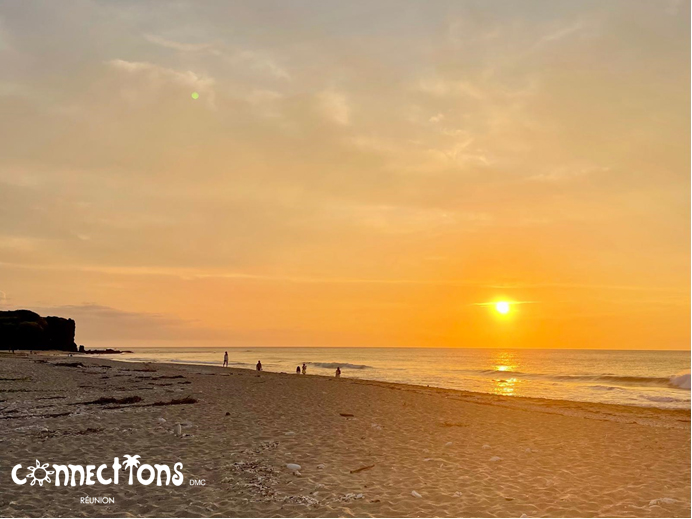
We descend to the west coast for a final stroll, entirely flat, to rest our legs a little after Mafate, we promise! Each day, the La Houssaye cape welcomes its regulars just before sunset. The heat cools, a gentle breeze wafts. This is the moment when fishermen sit facing the Indian Ocean, while walkers and joggers set off along gently sloping trails. On this 600-hectare savanna, there is an old paved road and many dirt paths. The stroll may be short and aimless, or it may take a full three-hour loop. It all depends on one’s desire. This ecosystem is found only on the West Coast, Réunion’s windy western littoral, dry for most of the year. The savanna then wears a straw color. During the rainy season, it takes on a soft green with a touch of yellow. Among these tall grasses dominates the one locals call “cheeky grass” (Heteropogon contortus), due to its tendency to snag anything that passes, including our trousers. Only shrubs, small acacias, and blades of black basalt emerge from this golden sea. Its charm also lies in its overhang, which allows a 180° view of the ocean as dusk settles.
Suddenly, from the top of a hill, three riders approach under a warm light, mounted on appaloosas with spotted coats. At the head of the caravan is Manou Bougnoux, owner of the Shai Ena Ranch, located on the savanna edge. For twenty years, he rides here like a Sioux on the Great Plains. “I never tire of it. The savanna changes color throughout the day, the clouds redraw the landscape. And between June and September, we can watch whales just in front of us.” Night falls. On the horizon, sailing ships return to port. Quail take off beneath our feet, weavers join their nests, and crickets begin their concert. Yet another world to explore on this island that holds so many different landscapes.
With whom to travel
Air France offers up to 14 flights per week to Réunion, operated exclusively from Paris-Charles de Gaulle Airport. A streamlined travel experience from anywhere in France thanks to the Train + Air service. High-speed Wi-Fi is now free aboard Air France aircraft: airfrance.fr
Book your trip
This report was prepared with the logistical support of the Regional Tourism Committee. Its website is full of information and ideas to plan excursions on the island: www.reunion.fr
➤ Article published in GEO HS magazine issue n°133, “France, our favorite walks for the summer,” June-July 2026.
➤ Do you love GEO? Then to miss nothing, discover our subscription plans to receive GEO every month at your home with ease.