

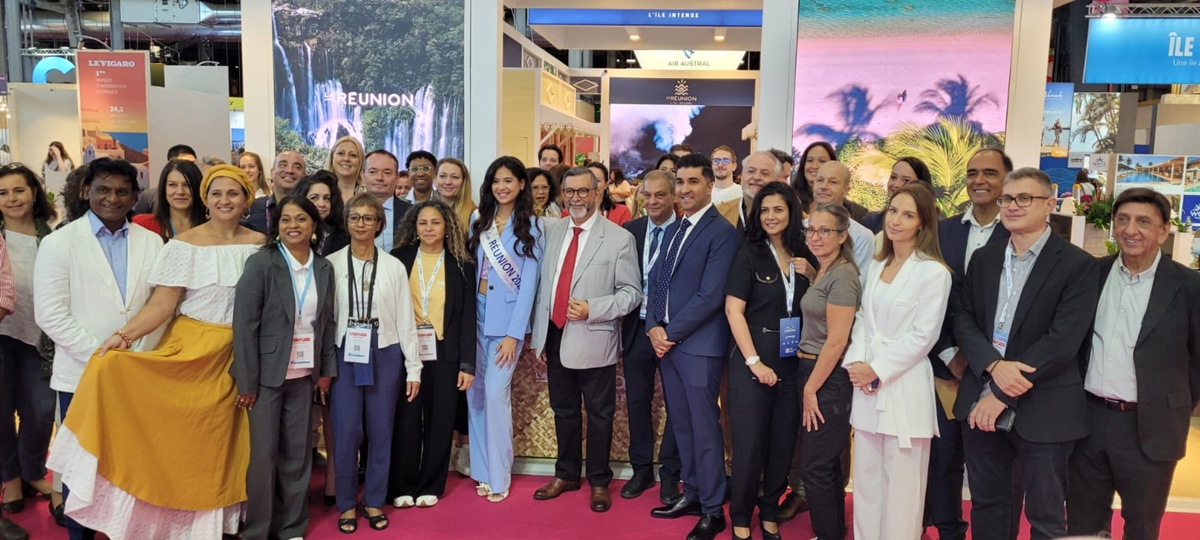
Réunie sous une varangue créole de 200 m², la délégation réunionnaise est venue en force à l’IFTM 2026, du 15 au 17 septembre dernier.
Avant même l’ouverture des portes, le mardi 15 au matin, le président du tout jeune Comité réunionnais du tourisme (CRT), Patrick Lebreton, annonçait devant les acteurs de la destination et la presse, les grands projets de l’île intense pour les prochains mois.
L’occasion aussi de dresser un premier bilan. Car, après une année 2025 record en termes de fréquentation touristique, 2026 s’annonce sur la même lignée. ” Our island welcomed 269 153 external visitors in the first half of 2026, a stable figure (-1%) compared with 2025, in a context marked by geopolitical tensions in the Middle East ” a indiqué le président de CRT.
Des chiffres qui laissent augurer une année similaire à la dernière et ses quelque 580 000 visiteurs métropolitains et internationaux, bien au-delà des niveaux pré-Covid.
“La valeur avant le volume”
Pour autant, si le CRT observe de près la progression des chiffres, l’objectif des 600 000 visiteurs, brandi comme l’objectif ultime depuis plusieurs années, ne semble plus être la priorité n°1.
“Nous avons aujourd’hui une ligne directrice simple : chercher la valeur avant le volume“, a poursuivi Patrick Lebreton, prônant l’engagement du CRT dans le développement touristique durable de l’île et dans “le vivre ensemble”, entre population locale et visiteurs.
En témoigne la volonté du CRT de relancer le concept des “Villages Créoles”, qui s’est étiolé au fil des années. “Nous voulons renouer avec une démarche qui a marqué l’histoire touristique de la Réunion, tout en la réinventant pour répondre aux attentes des voyageurs d’aujourd’hui. Ces villages permettront de mieux raconter la diversité et l’âme de notre île“, a-t-il ajouté.
Mettre en avant la créolité
En février prochain, un hackathon sur 2 ou 3 jours, organisé dans chacun des 13 villages concernés – situés principalement dans les hauts de l’île – et réunissant les acteurs de chaque projet doit permettre de faire ressortir ce qui fait la singularité de ces territoires.
Ce brainstorming va “nous permettre de structurer une boîte à outils, une ingénierie et un accompagnement que nous allons pouvoir proposer aux communes, aux intercommunalités, aux offices de tourisme“, indique Caroline Pain, responsable du service de développement des produits pour le CRT.
Néanmoins, le projet ne repart pas de zéro. “Villages Créoles de l’époque nous a donné une méthode, des référentiels, des chartes, de la communication, beaucoup de supports, etc. Nous avons déjà tout ce bagage-là“.
Un à deux projets par village devrait être retenu et mis en place d’ici fin 2027. Cela pourrait prendre la forme, par exemple, de paniers pique-niques élaborés par des artisans ou restaurateurs du village. “On va pouvoir venir chercher son panier pique-nique et déguster des produits qui sont spécifiques à cet endroit-là“, illustre Caroline Pain.
“Autre idée : l’aménagement de bancs et chaises longues pour contempler les étoiles aux Makes. Car cette initiative a pour but de rendre le voyageur acteur, grâce à des parcours mis à sa disposition“, ajoute Caroline Pain.
Des petits aménagements sont prévus : signalétique, supports mobiliers légers mais identitaires, exposition des habitants, podcast, etc. Avec un objectif à terme : “proposer une formule entre le produit expérientiel et le circuit en autotour“, poursuit Caroline Pain.
Des produits qui devraient aussi intéresser les tour-opérateurs et les agences réceptives.
Attirer davantage de touristes à fort pouvoir d’achat
Bien plus proche, le Comité Réunionnais du Tourisme a profité de l’IFTM pour lever le voile sur sa nouvelle identité visuelle, accompagnée d’une campagne promotionnelle, structurée autour de trois piliers : le territoire et sa verticalité spectaculaire, la rencontre et la culture créole, et enfin l’émotion et les éléments.
“Nous lançons un nouveau spot publicitaire, des affiches et des déclinaisons digitales qui font la part belle au patrimoine exceptionnel de la Réunion. Les pitons, cirques et remparts, sa reconnaissance à l’UNESCO, son lagon, sa verticalité, mais aussi sa culture, son maloya“, a développé Patrick Lebreton.
La campagne se décline sur trois volets : un film TV porté par la Réunionnaise Fleur Lafosse, “construit comme une ascension visuelle du battant des lames aux sommets des montagnes” précise le CRT ; une série de huit visuels d’affichage et des formats digitaux portés par un message déclinable autour de la notion de “Montez en émotions”.
Des initiatives qui doivent à la fois permettre à la Réunion de se distinguer et d’attirer davantage de “touristes à fort pouvoir d’achat”, a ajouté Patrick Lebreton.
Les chiffres du 1er semestre 2026 semblent confirmer cette stratégie, avec 250,9 millions d’euros de recettes touristiques enregistrées, en hausse de 9,5%. “Cette performance est portée par une clientèle d’agrément en forte progression (+17%), tandis que la clientèle affinitaire recule (-16%)“, analyse le CRT dans un communiqué.
Une stratégie plus agressive sur les marchés européens
Si le marché hexagonal représente 83,6% des visiteurs, les marchés européens progressent (+4 %), et notamment la Belgique (+10,3%), l’Allemagne (+13,2%) et la Suisse, alors que les clientèles en provenance de l’océan Indien reculent (-18%).
A noter que le tourisme local a permis d’enregistrer plus de 2,4 millions de séjours et près de 9,9 millions d’excursions à la journée, générant 400 millions d’euros de retombées économiques.
“L’Hexagone reste un marché socle pour nous, mais plusieurs marchés européens portent beaucoup notre croissance. L’idée est donc d’avoir une stratégie un peu plus agressive sur ces marchés, comme la Belgique ou l’Allemagne. Nous serons également au WTM de Londres, étant donné que le Royaume-Uni est un marché assez porteur”, a ajouté Sarah Lhéritier, directrice marketing et communication du Comité réunionnais du tourisme.
“Nous devons continuer sur cette lancée. C’est le cœur de la stratégie que nous avons co-construite ces derniers mois avec le cabinet MKG et les acteurs de l’interprofession”, a souligné, pour sa part, Patrick Lebreton.
La destination discute notamment avec les compagnies aériennes pour transformer l’essai. Dernier exemple en date : des discussions avec la compagnie allemande Condor, afin que cette dernière puisse poser ses appareils à l’aéroport Roland Garros de Saint-Denis, avant de repartir vers Maurice. Pour l’heure, la compagnie assure des vols Francfort-Maurice, tandis que le dernier tronçon vers la Réunion est assuré par Air Austral.
D’ici là, le CRT – qui fêtera son premier anniversaire en octobre – s’attend à connaître une nouvelle année touristique record pour la Réunion. Et planche sur une nouvelle idée : proposer aux Européens, lassés des canicules à répétition, de se laisser tenter par l’hiver austral et ses 23°C…


 Published by Amelia Brille






 But resident populations are not the only ones elbowing their way through crowds and queuing for hours in shops.