

SNCF Connect & Tech: Julien Nicolas Named CEO


SNCF Connect & Tech : Julien Nicolas nommé directeur général - Photo SNCF

Aer Lingus


Julien Nicolas est nommé directeur général de SNCF Connect & Tech à compter du 1er octobre 2026.

Il succède à Anne Pruvot, qui quitte ses fonctions après plus de cinq ans à la tête de la filiale de SNCF Voyageurs pour se consacrer à de nouveaux projets à l’extérieur du groupe.

Diplômé de l’École Supérieure de Commerce de Pau et de la Leeds University Business School, Julien Nicolas, né en 1976, a rejoint le groupe SNCF en 2005, après une première expérience dans le digital, la relation client et la communication, notamment au sein du groupe TF1.


The Career Path of Julien Nicolas

Au sein du groupe ferroviaire, Julien Nicolas a occupé plusieurs fonctions dans le numérique et la relation client. Il a notamment dirigé successivement la Business Unit Europe, puis les équipes France et Europe de Voyages-sncf.com.

Entre 2018 et 2021, il a été directeur général adjoint de e.Voyageurs SNCF, devenue SNCF Connect & Tech en 2022. À ce poste, il a notamment supervisé OUI.sncf, l’Assistant SNCF et le programme MaaS.

En 2021, il devient directeur numérique du groupe SNCF et président de 574 Invest. Depuis mars 2025, il supervisait également la stratégie IA du groupe et dirigeait e.SNCF Solutions.

Il retrouve donc aujourd’hui la direction de SNCF Connect & Tech, avec laquelle il avait déjà travaillé à plusieurs niveaux de responsabilité.

La plateforme revendique 4,5 millions de visites quotidiennes en 2025, tandis que son volume d’affaires a progressé de 40 % en quatre ans, selon le groupe.
Travel Tech: How DIGITRIPS Simplifies Travel Distribution

© DIGITRIPS et Adobe Stock

Climats du Monde


With its new series “Travel Tech Inside,” DIGITRIPS Tech, the tech backbone of the DIGITRIPS group, aims to make the technologies that enable searching, connecting, distributing and selling travel more accessible. The objective: explain simply what lies behind a booking, without multiplying acronyms — and to reaffirm a belief: technological complexity should stay in the background so that the experience itself remains simple.

This pedagogy does not stop at this article: DIGITRIPS Tech is applying the same explanatory effort on the blog digitrips.com, where every topic addressed here is revisited and explored in depth through dedicated content.


Behind a hotel booking, an ecosystem that has become complex

Dozens of players and data to connect

What kind of players lie behind a search that takes only a few seconds on a booking site? Hotels, chains, bed banks (also called bed banks, those wholesalers who pool hotel stock), tour operators, online agencies, TMCs, booking platforms and other distributors must move large volumes of data: availability, rates, cancellation terms, descriptions, visual content, or payment rules.

Historically, these exchanges relied on well-known professional tools: the GDS (Global Distribution System), which centralizes the offering for agencies; the channel manager, which synchronizes a hotel’s rates and availabilities across all its sales channels; or the PMS, the management software used at the hotel reception. Travel tech today complements or modernizes these traditional building blocks rather than replacing them.

With this diversity of players, there is also a multiplication of content sources. A distributor can now combine direct hotel contracts, several third-party providers (notably bed banks) and its own commercial agreements. Each connection has its own technical and contractual rules, and must be integrated, maintained and steered over time.

See the guide to hotel distribution by DIGITRIPS.

Accessing the offer is no longer enough

The challenge is therefore no longer merely to access the offer: it must be made truly usable. How to aggregate contents, harmonize data, limit duplicates, compare rates, and apply the right distribution rules? That is the real work, often invisible.

What is at stake for hoteliers? It is different, but equally strategic: being able to distribute more broadly their negotiated contracts, without multiplying technical connections or losing control over their commercial terms.

These operations never appear on the end-user side. Yet they play a direct role in the speed of a search, the relevance of results, price competitiveness, and the reliability of the booking. Travel tech is therefore not merely a technical layer: it has become the indispensable infrastructure for modern travel distribution.


DIGITRIPS Tech, the connector for hotel and travel distribution

DIGITRIPS Tech links the different links in the travel distribution chain, with a simple role: to facilitate the flow of inventory between suppliers, producers, and distributors through connectors, tools developed by the Group’s teams.

What is a connector in travel distribution? A connector is a technological solution that enables the systems of suppliers and distributors to communicate with one another — a kind of next-generation GDS, but designed to talk also with channel managers, the PMS, and direct contracts. The connector ties availabilities, rates and bookings together, while harmonizing data, to make a complex offer directly exploitable by travel professionals.

The group relies on a dual culture to build its connectors: historically a travel trader, DIGITRIPS, through DIGITRIPS Tech (formerly Koedia) also develops its own distribution technologies. This hybrid model allows approaching travel tech from concrete problems: how to faster integrate new content sources? How to enrich a hotel inventory? How to better manage distributed content while preserving margin?

Connecting travel content sources

A crucial step is to simplify access to the different travel content sources (air, land). A centralized integration enables distributors to connect to multiple providers without multiplying technical developments, often time- and resource-intensive. This approach also facilitates linking hoteliers who want to distribute their rates with professionals seeking new content.

Orchestrating distribution rules

Connecting sources is not enough: you must decide which content to display, under what rules, and for which markets. Orchestration allows you to govern the selection of providers, display priorities, commercial rules or distribution conditions. The technology becomes a control tool, not merely a means to access more offers.

Valuing available content

Connectivity must finally serve a business objective. An enriched, better-structured inventory that is easier to steer helps distributors strengthen the relevance of their offer: valorize negotiated contracts, broaden sales channels, adapt the distribution model to each company’s objectives. The goal is not to add another layer of technology, but to reduce the visible complexity for users.


In plain terms: the words of hotel distribution

Some simple landmarks to help you navigate beyond jargon — and which are developed in more detail on the blog digitrips.com:

• GDS: the historical system that centralizes hotel and air offerings for travel agencies.

• Channel manager: the tool that real-time synchronizes an hotel’s rates and availabilities across all its sales channels.

• PMS: the software used at reception to manage rooms, arrivals and departures.

• Bed bank (bed bank): a wholesaler that buys hotel stock in volume to resell to distributors.

• Direct contract: a commercial agreement negotiated directly between a distributor and a hotel, with no intermediary.

• Connector: the technology that links all these systems together and harmonizes their data and travel content.


Hotel distribution: combining third-party providers and direct contracts

Combining bed banks and direct contracts

For travel distributors, centralizing multiple sources allows expanding the available offering without managing each connection separately. A hotel aggregation platform can bring together bed banks and direct contracts within the same environment.

These two models complement each other more than they oppose. Bed banks provide broad, quickly accessible coverage. Direct contracts offer greater control over rates, commercial terms, and the relationship with hotel partners. A hybrid approach enables combining their advantages according to markets, destinations, and the objectives of each company.

Read the article: bed bank or direct contract, which hotel distribution strategy should you choose?

TravelPlugz: aggregating and steering all your suppliers

TravelPlugz centralizes content derived from the client’s contracts with its third-party suppliers (DMCs, Wholesalers, Bedbanks, etc.) and thus provides access to a broad and constantly updated inventory:

• Aggregate all housing contracts of distributors

• Optimize prices and the relevance of the offering

• Enrich distribution platforms.

A tool designed to master and structure a multitude of feeds.

Hotel Direct Access: exploiting direct contracts in real time

Hotel Direct Access focuses on direct contracts negotiated by the distributor with hotel chains or independents: secure access to negotiated rates, real-time availabilities, centralized stock management… A major competitive advantage for players with exclusive and differentiating contracts.

Complementary, these two solutions offer an aggregation power and full control of direct contracts, for richer content, greater relevance, and above all a complete price comparison across providers.


Turning complexity into an advantage


A sales team at your service

The members of the DIGITRIPS Tech team are at your disposal to accompany you. You can contact them at the following email address: [email protected].

To learn more about the DIGITRIPS group and its solutions, visit our site www.digitrips.com


IFTM 2026: Tech Zone Unveils Its Immersive Space


L’Espace Immersif de la Tech Zone proposera 11 expériences autour de l’IA et des technologies immersives à IFTM 2026 - Visuel : IFTM

Hurtigruten


The Immersive Space of the Tech Zone returns to IFTM 2026 with a program featuring 11 experiences dedicated to new technologies.

Located at Stand A075 and led by Travel Tech Factory and KaviAR Tech, this space aims to demonstrate in a concrete way how AI and immersive technologies can transform reception, guidance, destination discovery or even the planning of a trip.

Among the experiences offered, visitors will notably be able to create a postcard using AI, test virtual agents capable of exchanging in more than 50 languages, or discover an immersive 3D and 360° travel agency.

Other devices will enable attendees to experience mixed reality, to virtually visit destinations, or to exchange live with a professional located at the other end of the world.

The Immersive Space will also offer virtual reality headsets, an augmented reality exhibition, and solutions blending technology with artistic creation.


AI-Focused Training Sessions

In parallel, free 20-minute micro-trainings will be offered over the three days of the show by KaviAR Academy and 360 Sharing. They will cover, among other topics, yield management, customer relations, management and the everyday uses of AI in daily life.

The Immersive Space will also host a presentation dedicated to Rambouillet Tourist Office, which is deploying an embodied agent across its territory.

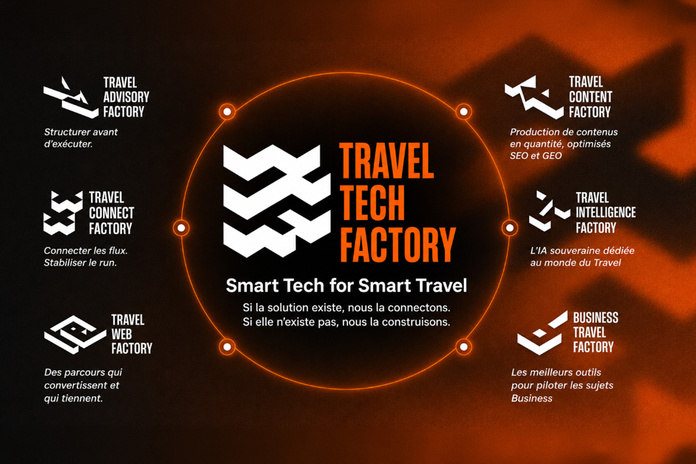
Travel Tech Factory: Six Specialized Factories, New SEO & GEO Offering, and a Sovereign Travel AI


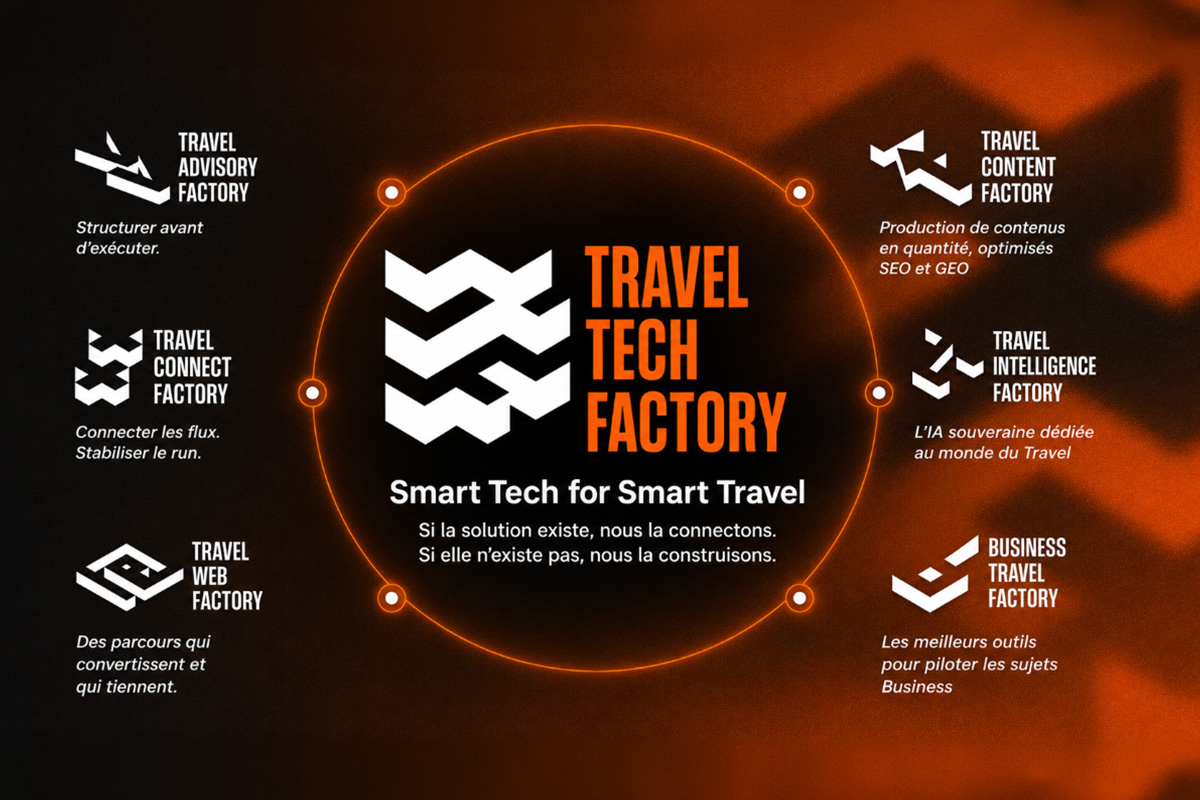
Six Factories, a Single Logic

© Travel Tech Factory

Top of Travel


Travel Tech Factory has structured ten years of expertise into six specialized Factories: Advisory, Connect, Web, Content, Intelligence, and Business Travel. Each Factory acts as an independent entry point: a crisis-hit NDC-powered tour operator activates Travel Connect Factory; a stagnating OTA engages Travel Web Factory. We enter through the urgent need, assess, and scale if it holds. Travel Advisory Factory shapes the trajectories of transformation. Travel Connect Factory stabilizes GDS and NDC integrations without a mandated overhaul. Business Travel Factory leads compliance and the duty of care.


TA’I: the sovereign AI that handles bookings

With TA’I, its sovereign travel AI, Travel Tech Factory addresses the limits of generic LLMs (price hallucinations, ignorance of IATA rules). TA’I is trained on travel-specific data under native business governance. A major difference: connected to GDS, Orchestra, and distribution platforms, TA’I can carry out the reservation. It marks the transition from an AI assistant to an operational AI agent — governed, traceable, validated. Adoption is measurable. Productivity gains are verifiable.


Travel Content Factory: SEO and GEO content

The new Travel Content Factory offering industrializes the production of travel content that is 100% original, optimized for traditional SEO and for GEO — search engine optimization via generative AI. The base catalog is not the same as the web catalog: Travel Content Factory delivers dozens of descriptions in record time, with human validation, for tour operators, agencies, hoteliers, airlines, and DMCs. In a sector where Google deploys its own travel AI tools, this dual optimization becomes strategic.


Industry expertise, ROI as the guiding principle

A decade in travel creates reflexes that generalists do not possess. Knowing IATA rules, understanding where flows break, anticipating exceptions — this is the industry expertise that Travel Tech Factory’s clients buy. And behind each Factory, a single motto: ROI. Measured before, during, and after. Not magicians — practical, effective professionals with ten years of real-world travel projects, at airlines, travel agencies, hoteliers, and tour operators.


Learn More About Travel Tech Factory


Travel Tech Factory : Six Factories spécialisées, une nouvelle offre SEO et GEO et une IA Travel souveraine
Website: https://traveltechfactory.com

Email: [email protected]

linkedin