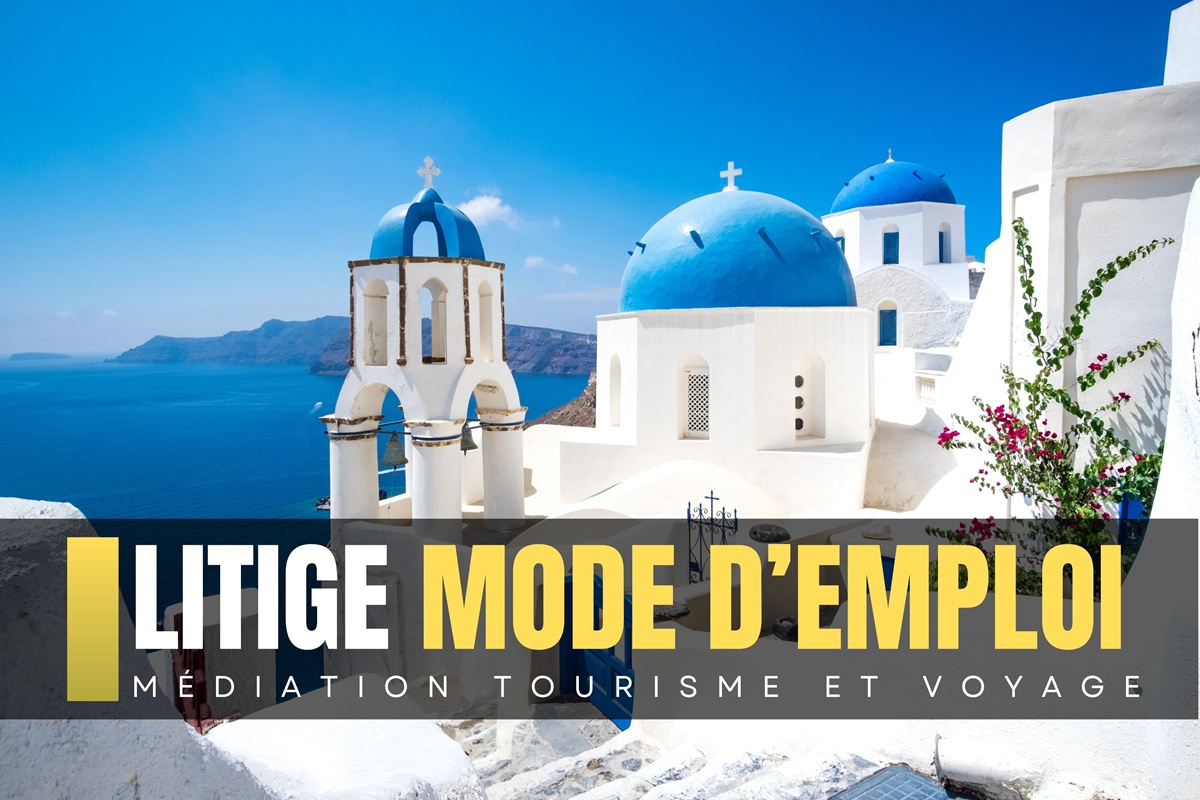


Two travelers referred the Mediation after a trip to Greece organized by a travel agency. They believed that several services provided did not correspond either to the announced descriptions or to the price they had paid before departure. They were seeking a refund of €2,700.
The trip included several legs through the Cyclades. Upon arrival, the travelers noted various non-conformities: a room in Santorini they deemed different from the one shown at the time of booking, a hotel in Paros that did not match the advertised description, and a discrepancy between the price of certain services charged by the agency and the amount shown on the documents provided on site.
They notably found that the amount paid for their accommodation in Sifnos was higher than the price shown on the establishment’s bill.
The same observation was made for the boat crossings, whose rate actually paid to the companies was much lower than the amount billed within the framework of the trip.
The agency had proposed a first commercial gesture of 235 € to compensate for some differences noted during the stay, an offer the travelers had refused, deeming this amount insufficient.
The trip included several legs through the Cyclades. Upon arrival, the travelers noted various non-conformities: a room in Santorini they deemed different from the one shown at the time of booking, a hotel in Paros that did not match the advertised description, and a discrepancy between the price of certain services charged by the agency and the amount shown on the documents provided on site.
They notably found that the amount paid for their accommodation in Sifnos was higher than the price shown on the establishment’s bill.
The same observation was made for the boat crossings, whose rate actually paid to the companies was much lower than the amount billed within the framework of the trip.
The agency had proposed a first commercial gesture of 235 € to compensate for some differences noted during the stay, an offer the travelers had refused, deeming this amount insufficient.
Ce que disent les textes :
 On the legal front, the Mediation notes that Article L. 211-16 of the Tourism Code places full liability on the seller of a package tour for the proper execution of the contracted services.
When the services do not conform to what was agreed, the professional must remedy them or, failing that, compensate the traveler.
Moreover, the case file elements do not call into question the price agreed at booking. However, they highlight a significant gap between the sums paid to the agency and the actual cost of certain services, notably the Sifnos accommodation and the maritime crossings.
Ce que préconise la Médiation Tourisme et Voyage :
In the interest of fairness, the Mediation considers it justified to retain half of these price differences, while taking into account the commercial gesture already offered by the agency.
At the end of its analysis, it therefore recommends the payment of an additional compensation of €277.96, to be added to the €235 already proposed, in order to amicably settle the dispute.
At the end of its analysis, it therefore recommends the payment of an additional compensation of €277.96, to be added to the €235 already proposed, in order to amicably settle the dispute.
Find all the practical cases from the Tourism and Travel Mediation by clicking HERE.