Hotels and Taxis: The Hidden Price Women Pay for Safety When Traveling Alone

When you’re a woman, traveling alone can sometimes be pricey. More expensive than for a man. In London, BBC journalist Lorin Bozkurt recounts that she was offered two types of capsules in a Piccadilly Circus hotel, those small design spaces where a bed simply fits in. The ones reserved for an exclusively female clientele were priced at 45 pounds (about 52 euros) per night, while the others, mixed, were priced at 35 pounds (about 41 euros).

Yet no extra comfort accompanied the first offer, aside from a corridor accessible only by card and, above all, the promise of feeling safer for an extra 10 pounds. This difference illustrates what some specialists call the “avoidance tax”, akin to its marketing cousin, the “pink tax”. Female travelers do not necessarily pay more for the same trip than their male counterparts, but they often make different decisions, motivated by safety, which can end up increasing the bill.

The luxury of having peace of mind

Better-located hotels, a taxi rather than public transport, travel insurance or an extra charge for an earlier early check-in during the day… Expenses pile up. And they aren’t necessarily the same for men. Carried by the British broadcaster, a study from the Safer Tourism Foundation shows that “64 % of women avoid walking home alone at night abroad”, compared with 43 % for the opposite sex.

Nearly half of women also forgo wandering the backstreets of an unfamiliar city at night. “They don’t travel less because they are less adventurous than men. They operate in an environment where the risks are different”, explains Stephanie Boyle, director of the Safer Tourism Foundation’s She Travels Safe campaign.

Safer, therefore more expensive

For women accustomed to traveling solo, these precautions eventually become reflexes. Jen Kaarlo, who has 53 countries under her belt, tells the BBC she plans all her movements in advance. After experiencing several troubling incidents, including being drugged without her knowledge in a bar in Paris, the young woman avoids “any risky situation”. In Panama, she even preferred to pay nearly $200 extra (about €173) to ensure she wouldn’t have to share her sleeping arrangements with strangers during a trip to the San Blas Islands.

Jodie Hughes, who has been traveling alone since the age of 19, makes the same point. She says she used to favor youth hostels to save money, but now chooses other options because a women-only dorm can be more expensive than a mixed dorm. “I’d rather travel less often, but when I travel, I want to be safer”, she says. At Generator Hostels, whose Bruges property has been singled out, it is explained that women’s rooms are “in high demand” and that their prices reflect that demand.

“Safety should not be a competitive element. It shouldn’t be something that lets companies think they can charge more because they are safer”, replies Stephanie Boyle. Beyond the price of rooms or transport, these precautions also carry a less visible cost. They force travelers to plan more, sometimes give up going out, or choose a more expensive option rather than a spontaneous one. The question is therefore no longer only whether one can afford an extra expense, but whether one can afford not to spend it. “The mental load, I think, is the heaviest of all”, confesses Jen Kaarlo.


From Female Travelers to Influencers: We Women [ABO]


Des voyageuses aux influenceuses : nous les femmes !  - Depositphotos.com  Auteur Nadezda_Grapes

CroisiEurope


… The idea struck me suddenly to glance at the great pens of the Beat Generation, those of Kerouac, Ginsberg, Ferlinghetti, Jack London… which to this day remain references in literature dedicated to the “road” and all its symbolism of counterculture waging war against an “american dream” that no longer answered the aspirations of the sixties.

And what did I discover? Simply, that not a single female writer had the luck to be retained by literary history! Not one! While, at the same time, many young American women were traveling on unlikely roads through Asia, South America, and the Middle East!

In Europe at the same time and particularly in France, as the “backpackers” followed in the footsteps of their North American contemporaries, the landscape was equally bleak. With only a few very small exceptions (Muriel Cerf’s L’Anti Voyage), it was mainly the women engaged in the feminist struggle who were making the headlines.

“Stand up, women” shouted the newcomers coming of age, demanding sexual freedom, the right to abortion, contraception and other rights to education indispensable to the fulfillment of half of humanity!


The Pioneers!


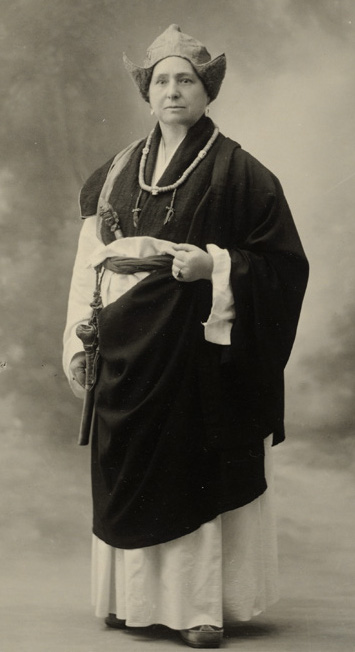
Alexandra David-Néel - CC Wikipedia

To believe that the road and the journeys it permitted were surely the realm of these young women whose appearances were made uniform by roughly cut hair and embroidered shirts.

To believe that travel, being synonymous with learning and knowledge, was closed to women still confined to their kitchen and their children.

Some names, however, began to circulate and to serve as references. It was the grand Alexandra David-Néel who began her first work with the words “Obedience is death,” explaining her thirst for travel whose culmination in 1912 was her arrival in Lhassa where she finally approached the Dalai Lama!

Reaching the age of 101 years before passing away in Dignes, Alexandra was indeed accompanied by a young servant whom she regarded as her adopted son. For all that, this icon of travel has always shown a curiosity and a courage perfectly indispensable for wandering on Asian roads where more than once she had to pass herself off as a man to move forward!

This disguise tactic is, moreover, well known to female travelers. In 1766, for instance, a certain Jeanne Barret embarked on Bougainville’s around-the-world expedition. Disguised as a sailor, she used the voyage to develop her passion for botany and collected thousands of plant samples. Unmasked in Tahiti, she returned to France some ten years later and was absolved of her fault.

We can also recall through her writings of “La monja Alferez,” this young Spanish woman who deserted her convent at the start of the seventeenth century to embark on conquest ships, disguised as a soldier. That’s Catalina de Erauso!

We also mention the one who commanded the largest pirate fleet in history. A Chinese woman born in 1775… “Innumerable, humble and extraordinary, these survivors have been swallowed up,” write Alexandra Lapierre and Christel Mouchard in their book: “They Conquered the World.” Editions Arthaud.


Georges Sand, from Venice to Majorca

Encouraged by the development of maritime and land transport, the traveling women of the nineteenth and twentieth centuries are therefore not pioneers in the strict sense. They embody, without realizing it, an evolution in the status of women which, though long and full of obstacles, is undeniable. But, in France as well, these writers—“travelers”—were not numerous.

And few remember them. Flora Tristan in South America leaves a name, while Isabelle Eberhardt (born in 1877) also disguises herself as a man, leaving writings: “In the Warm Shadow of Islam.” A narrative about Algeria where she spent many years.

Among the writers of the era, the best known, Colette, was not a great traveler. A few returns between the provinces and Paris sufficed. By contrast, George Sand, a child of the nineteenth century (born in 1804), besides her travel between Paris and Nohant, experienced the hardship of travel abroad.

Majorca in the company of Frédéric Chopin during the winters of 1838 and 1839 has been mentioned by the writer in her diary with a vitriolic pen against the natives for whom she showed an unacceptable intolerance. In her book “A Winter in Majorca,” she nevertheless exercises her talent into a kind of narrative already akin to travel guides.

And, conversely, after a few months in Venice in the company of Alfred de Musset, she leaves in her correspondence lines that are both romantic and realistic about the Serenissima and its inhabitants. Lines perfectly romantic and realistic at once!


Ella Maillart, Margaret Mead… Edith Wharton!

A product of Europe in the thirties, grew tired of her gilded cage in Switzerland. After a journey across the Caucasus, she nonetheless published writings on Russian youth. Then came China, where she travels in 1934 and takes the opportunity to publish her first reports for Le Petit Parisien.

Iran, Turkey, Afghanistan, India—where she eventually settles—pass before her eyes and inspire all sorts of writings. Then, back in Europe where she dies in 1997, she brings the concept of cultural travel, spiritual travel, lectures, and yoga classes. Very active, also the American Margaret Mead who used her journeys to exercise her anthropologist’s skills among the tribes of New Guinea and the surrounding region.

Highlighted by the unforgettable film “Out of Africa,” the Danish Karen Blixen also contributed to the quality of women’s travel literature. Blazing, these narratives about Africa nearly earned her the Nobel Prize.

A few more words on these superb voices who were the novelist Edith Wharton, who, in the twenties, published accounts of her travels in France, Italy, Morocco… A passionate traveler, she also used her books to offer a historical, cultural, artistic description of the countries she visited. All of this with a voice often laced with humor.

And again, we are not far from a travel guide. Finally, what about Vita Sackville-West? Born in 1892, she was a poet, gardener, journalist. Wife of a British diplomat, she stayed in the Middle East, notably in Iran, India, Egypt… from which she drew inspiration to write both novels and popular science works.