

New York Targets the French Market and Expands Its Air Services


New York mise sur le marché français et renforce son offre aérienne - Depositphotos.com Auteur petrkurgan

CroisiEurope


New York broadens its accessibility from France.

According to New York City Tourism + Conventions, the city welcomed 725,000 French visitors in 2025, making France its fourth international market, behind the United Kingdom, Canada and Italy.

For 2026, the tourism body foresees 65.4 million visitors, including 738,000 French nationals, representing a 1.7% year-on-year increase.

To meet this demand, airlines are strengthening their schedules between France and the two main New York airports, John F. Kennedy (JFK) and Newark Liberty (EWR).


Paris – New York: 5,000 additional seats

For winter 2026-2027, French bee plans up to seven weekly flights between Paris-Orly and Newark, i.e. 5,000 additional seats compared to the previous winter.

In the summer period, seven carriers currently offer up to 22 direct daily flights between Paris and New York, equating to around 5,000 seats per day departing from Paris, according to estimates from New York City Tourism + Conventions.

From Paris-Charles-de-Gaulle, Air France and Delta Air Lines operate services to JFK, while Air France and United Airlines also run connections to Newark. American Airlines and JetBlue complete the JFK offerings.

From Paris-Orly, French bee provides up to ten weekly flights to Newark in peak season.

La Compagnie also serves Newark from Orly, with a daily flight operated exclusively in business class.


Nice and Marseille: new direct flights to New York

Beyond Paris, the southern part of France is also benefiting from the growth of direct links to New York.

Nice already has seasonal routes operated by Delta Air Lines to JFK and United Airlines to Newark. The airline extends its Newark service through winter 2026-2027, with two weekly flights.

On May 7, 2027, American Airlines plans to launch a daily service between Nice and JFK. The route will be operated with an Airbus A321XLR featuring 155 seats. With this opening, four airlines will offer a direct connection from Nice to New York.

Marseille-Provence should also join the transatlantic network. United Airlines will inaugurate, on June 5, 2027, a daily nonstop service between Marseille and Newark.


JFK continues its modernization

The growth of air links goes hand in hand with investments in New York’s airport infrastructure. JFK’s New Terminal One is entering a modernization program valued at nearly $19 billion, supported by the Port Authority of New York and New Jersey.

The first phase of the terminal is expected in the first quarter of 2027.

Air France plans to relocate all of its flights there. The airline is also set to open a lounge exceeding 2,700 m², which will become the largest in its international network. The lounge is planned to be spread over two levels, with more than 400 seats and dining spaces highlighting French gastronomy.
TED Advisory Services: Three Areas of Expertise for Tourism Stakeholders


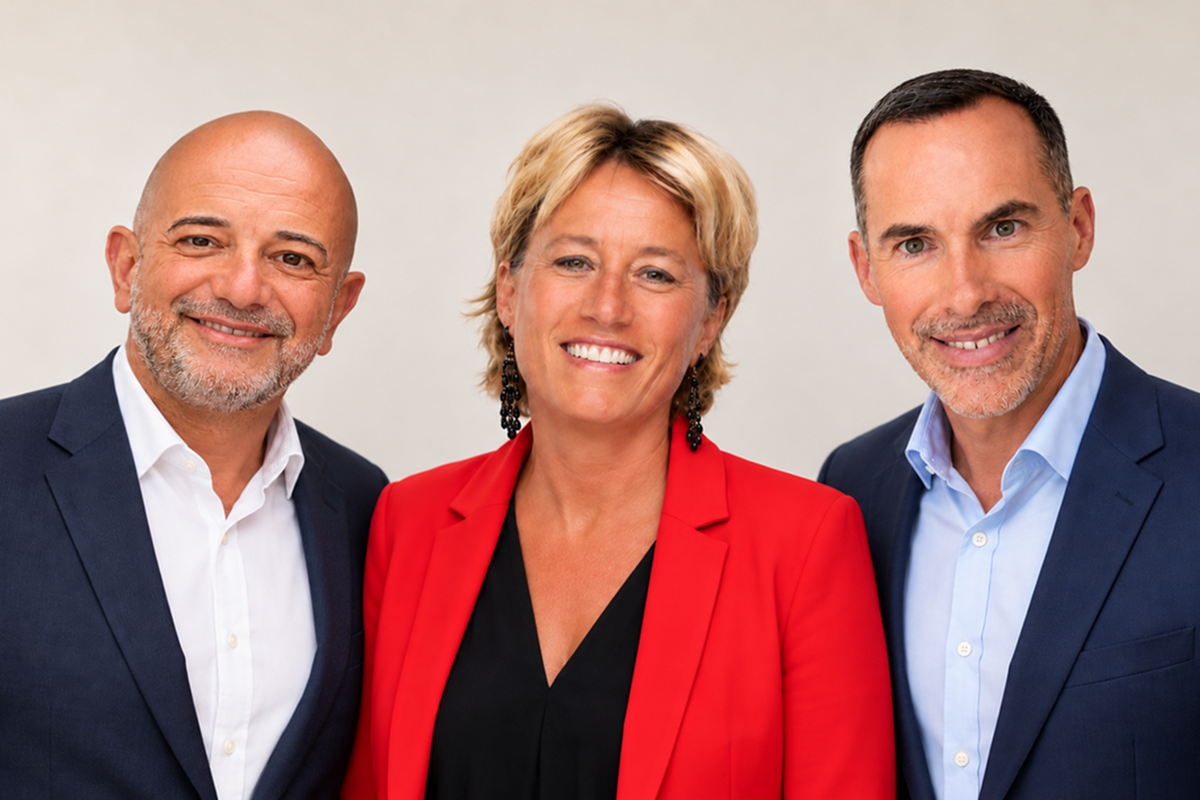
Eric Didier, Laurence Deblonde-Buisson et Yannick De Maria ont lancé, début 2026, TED Advisory Services, un cabinet de conseil dédié au transport, au voyage, à l’hospitalité et à la mobilité - Photo : ED

Aer Lingus


After more than 30 years in air transport, Eric Didier is launching himself into a new entrepreneurial venture.
With Laurence Deblonde-Buisson and Yannick De Maria, he created TED Advisory Services, a consulting firm aimed at companies in transport, travel, hospitality and mobility.
The name TED refers to three words that summarize their approach: Transport, Efficiency and Disruption. « We want to have a 360° approach, explains Eric Didier. The idea is to be able to look at a company as a whole and not only at a single issue.”
The firm addresses issues such as market development, commercial performance, distribution, customer experience, organization, and transformation.
It can also support very concrete operations, such as opening a stopover, launching a route, setting up a charter flight or an operation in sensitive environments.
The philosophy can be summed up in a few words: challenge, structure and accelerate. “We are not a large firm; we are small and reactive,” insists Eric Didier.
A distinction that the three partners also want to emphasize in their way of working. “It’s nice to say ‘you just have to do it,’ that’s easy. We’re not taking that approach.” The firm aims to accompany its clients all the way to the implementation of the recommendations.


Eric Didier, aviation expert

The first pillar is air transport and commercial development.
An entrepreneur and sector specialist, Eric Didier began his career with British Airways, before taking part in the launch of the Oneworld alliance in France.
In 2001, he joined Qatar Airways to create and develop the company’s activity in France. He spent nearly 17 years there, building teams and supporting the development of several European markets. He later continued his career at Air Astana.
“I have always been involved in development, recruitment, distribution, alliances, opening and closing routes,” he summarizes.
At TED Advisory Services, he works on commercial strategy, market development, alliances and partnerships, distribution, and issues related to air transport.


Three complementary profiles

Laurence Deblonde-Buisson brings more than 25 years of experience in marketing, communications and digital within major players of hospitality, tourism and leisure.
Her career has taken her to Choice Hotels Europe, Disneyland Paris and US Airways.
She now focuses on subjects such as marketing, communication, digital, positioning and commercial performance.
“The idea is really to cross our expertise, explains Eric Didier. Each has their own domain, but we can also work together on a global issue.”
Yannick De Maria brings 27 years of experience in aviation, airport assistance, hospitality and international customer relations.
His contribution rests on two axes. The first concerns customer experience and training of ground staff, notably on behaviors and handling difficult situations. The second is much more operational, with support for opening stopovers, charter flights, temporary operations or repatriations in sensitive areas.
“We can go very far in operations,” emphasizes Eric Didier. This approach should enable the firm to move from advisory work to execution, with direct knowledge of field constraints.


From air transport to tourism in the broad sense

Beyond their individual areas of expertise, the three partners share a common vision for the sector.
For Eric Didier, companies operate in an increasingly complex environment and must gain agility.
“We must be agile today. We must anticipate, be a little paranoid, have a plan B and a plan C”, he says.
In his view, three major factors will continue to transform tourism: demographics, artificial intelligence and robotics, as well as geopolitics.
These developments can alter traveler behaviors, organizations and business models.
This need to anticipate is also tied to how businesses evolve. His experience in air transport has convinced him that the accumulation of procedures can slow down organizations.
“Too many processes, too many procedures, too many controls kill the company”, he states. He advocates instead for structures that grant more responsibilities to teams and shorten decision-making pathways.
This is precisely the terrain on which TED Advisory Services intends to position itself: between strategic vision and operational reality. “When you are inside a company, you often have your head down on the wheel. We can offer that helicopter view while staying very close to the ground,” sums up Eric Didier.
For the three partners, the challenge will now be to turn this complementarity into concrete assignments, while keeping a deliberately lean structure. “We first want to prove ourselves, be efficient and stay agile,” concludes Eric Didier.


Caroline Lelievre
Published by Caroline Lelievre Journalist – TourMaG.com
See all articles by Caroline Lelievre

  • picto Twitter
  • picto Linkedin
  • picto email
Add TourMaG to your Google News feed Google Actualités icône

Beyond Postcards: How Tahiti Travel Services Redefines the Customer Experience in French Polynesia


© Ura

Climats du Monde


Quand l’image ne suffit plus

Depuis plusieurs saisons, les professionnels du secteur observent un glissement dans les attentes des voyageurs haut de gamme : la villa sur pilotis et le motu privatisé restent recherchés, mais ils ne constituent plus, à eux seuls, le motif du voyage. Les clients veulent comprendre où ils sont, avec qui ils partagent ce territoire, et ce que leur présence signifie pour les communautés locales.

« Le client d’aujourd’hui a déjà vu mille photos de lagon avant même de réserver. Ce qui le décide, ce n’est plus l’image, c’est la promesse d’une rencontre qu’il ne pourra pas vivre ailleurs », explique-t-on à la direction de Tahiti Travel Services. Ce constat oriente une part croissante du travail de conception chez TTS, dont le rôle de DMC consiste précisément à traduire cette attente en programmes concrets, faisables et sécurisés pour les agences émettrices qui font confiance à leur réceptif local.


L’immersion culturelle comme fil rouge

Concrètement, l’immersion culturelle prend des formes multiples selon les archipels. Aux Marquises, elle passe par la rencontre avec des sculpteurs et tatoueurs qui expliquent la portée symbolique de leur art plutôt que de simplement la vendre en souvenir. Aux Tuamotu, elle s’incarne dans la visite d’une ferme perlière familiale, où le producteur détaille lui-même les étapes de la greffe et de la récolte. À Tahiti et dans les îles Sous-le-Vent, elle peut prendre la forme d’un atelier de tressage de pandanus avec une mama locale, ou d’une sortie de pêche traditionnelle au filet avec des pêcheurs qui partagent leur lecture du lagon.

Ce qui distingue ces expériences d’une simple activité touristique, c’est la place laissée à l’échange. Le guide ou l’artisan n’est pas un figurant : il est l’auteur du moment vécu. Cette exigence demande un travail de fond que peu d’acteurs extérieurs au territoire peuvent reproduire : connaître les familles, entretenir la relation dans la durée, s’assurer que la prestation reste authentique même lorsque la demande augmente.


© Ura


Un réseau de partenaires bâti sur la durée

Cette capacité à proposer des rencontres qui ne soient ni artificielles ni surjouées repose sur un réseau de partenaires locaux construit sur plusieurs années : artisans, guides culturels, pêcheurs, agriculteurs, associations de valorisation du patrimoine. TTS revendique une logique de fidélité réciproque avec ces partenaires, plutôt qu’une simple relation prestataire-fournisseur.

« Nous ne travaillons pas avec des acteurs que nous rencontrons pour la première fois la veille d’un départ. Ce sont des relations qui se construisent, parfois sur plusieurs saisons, et qui reposent sur la confiance autant que sur le contrat », précise Loic Troupel .Cette continuité permet d’ajuster les programmes en fonction des retours clients, mais aussi de préserver l’équilibre des communautés hôtes, un point sur lequel les agences partenaires interrogent de plus en plus systématiquement leur réceptif.


Storytelling et conseil pratique : deux leviers complémentaires

Pour les agences de voyages, la difficulté n’est pas seulement de trouver l’expérience juste, mais de savoir la raconter et la vendre sans la galvauder. TTS accompagne ses partenaires sur ce point à travers des fiches produits qui associent un récit (le contexte, l’histoire, la personne rencontrée) à des informations opérationnelles précises : durée réelle de l’activité, niveau physique requis, météo saisonnière, capacité d’accueil, et limites à ne pas dépasser pour préserver le caractère intime de l’expérience.

Ce double niveau d’information répond à un besoin très concret des conseillers en agence : pouvoir inspirer leur client par le récit, tout en étant capables de répondre avec précision aux questions logistiques qui suivent presque toujours l’enthousiasme initial. « Une belle histoire qui ne tient pas la route sur le terrain se retourne contre l’agence et contre la destination. Notre rôle est de garantir que le récit correspond exactement à ce qui sera vécu », souligne-t-on chez TTS.


© Nobiaphotos


Une tendance de fond, pas un effet de mode

Cette évolution vers des séjours plus immersifs s’inscrit dans une tendance observée plus largement sur les destinations insulaires du Pacifique, où la clientèle haut de gamme recherche désormais un équilibre entre confort hôtelier et ancrage local. En Polynésie française, cette demande rencontre une réalité géographique favorable : cinq archipels aux identités culturelles distinctes, une population dispersée sur l’ensemble du territoire, et une tradition orale encore vivante qui permet de nourrir un tourisme de rencontre plutôt qu’un tourisme de simple contemplation.

Ce virage pose toutefois une question de fond, largement débattue dans le secteur : celle du tourisme durable et responsable. Multiplier les rencontres avec des familles ou des artisans suppose de calibrer les flux pour ne pas transformer une relation authentique en simple attraction reproductible à l’infini. TTS indique intégrer cette limite dès la conception des programmes, en plafonnant volontairement certains groupes et en refusant de dupliquer certaines expériences sur plusieurs points du territoire simultanément.


Perspectives : vers une offre encore plus documentée


Au-delà des cartes postales : comment Tahiti Travel Services réinvente l'expérience client en Polynésie
[email protected]

www.tahititravelservices.pf

>> Tahiti Travel Services in the DESTIMAG Directory


Airbnb Expands Its Offerings in France with Three New Services


Airbnb enrichit son offre en France avec trois nouveaux services - Depositphotos.com @lucidwaters

Hurtigruten


Airbnb continues to broaden its offering in France.

The platform now provides three new services directly from its app: luggage storage, car rental, and private airport transfers. The stated aim is to simplify the organization of the stay, going beyond merely booking accommodation.

With these new features, Airbnb seeks to address several logistical constraints that travelers may encounter before, during or after their stay.

The platform relies on three specialized partners for this: Bounce for luggage storage, CarTrawler for car rental and Welcome Pickups for airport transfers.

According to a study conducted by Airbnb with Focaldata, 53 % of travelers report having needed a luggage storage service in the past twelve months. In France, 96 % of travelers who have already used this type of service consider it very useful.


A luggage storage service offered in several French destinations

Airbnb now allows you to book a luggage storage directly from its app, thanks to its partnership with Bounce.

The service grants access to more than 24,600 drop-off points spread across more than 800 cities worldwide, representing a 350 % increase since its official launch in May.

In France, the offer is notably available in the Alpes-Maritimes, the Aude, the Calvados, Cannes, Côte-d’Or, Finistère, Haut-Rhin, Hendaye, Lille, Montpellier, Nancy and Metz, Nantes, Pyrénées-Atlantiques and Pyrénées-Orientales, as well as Reims and the Sarthe.

Travelers can reserve a space for a few hours or several days to drop off their luggage before arriving at their accommodations or after departure. For eligible bookings, an automatic 15 % discount is applied.


Car rental integrated into the app

Another novelty: car rental. Airbnb has partnered with CarTrawler to enable travelers to compare and book a vehicle directly from the platform, anywhere in France.

According to the study conducted by Focaldata for Airbnb, 84 % of travelers find the ability to book a rental car alongside their lodging to be useful. This share reaches 44 % for French travelers who rate this option as “very useful.”

On their first eligible booking, users can receive an Airbnb credit equal to 20 %, usable later for certain stays, experiences, or services offered on the platform. Discounts up to 20 % are also available with some rental partners.


Private transfers from several airports

Airbnb completes its offering with private transfers from airports, in partnership with Welcome Pickups. The service allows you to book your trip ahead of time. The ride is confirmed in advance and a driver is arranged upon the traveler’s arrival.

In France, this feature is currently available in the Pyrénées-Atlantiques, as well as Lille, Montpellier, Nantes, Rennes, and Strasbourg. Depending on the destination, discounts of up to 20 % may be applied.


Amelia Brille Published by Amelia Brille TourMaG.com Editor
See all articles by Amelia Brille

  • picto Linkedin
  • picto email
Add TourMaG to your Google News feed Google Actualités icône  

Greece Trip: Non-Conforming Services and Price Discrepancies – Should the Agency Pay? [ABO]


Séjour en Grèce : prestations non conformes et écarts de prix, l’agence doit-elle payer ? - Depositphotos.com  Auteur martinm303

TAP Air Portugal


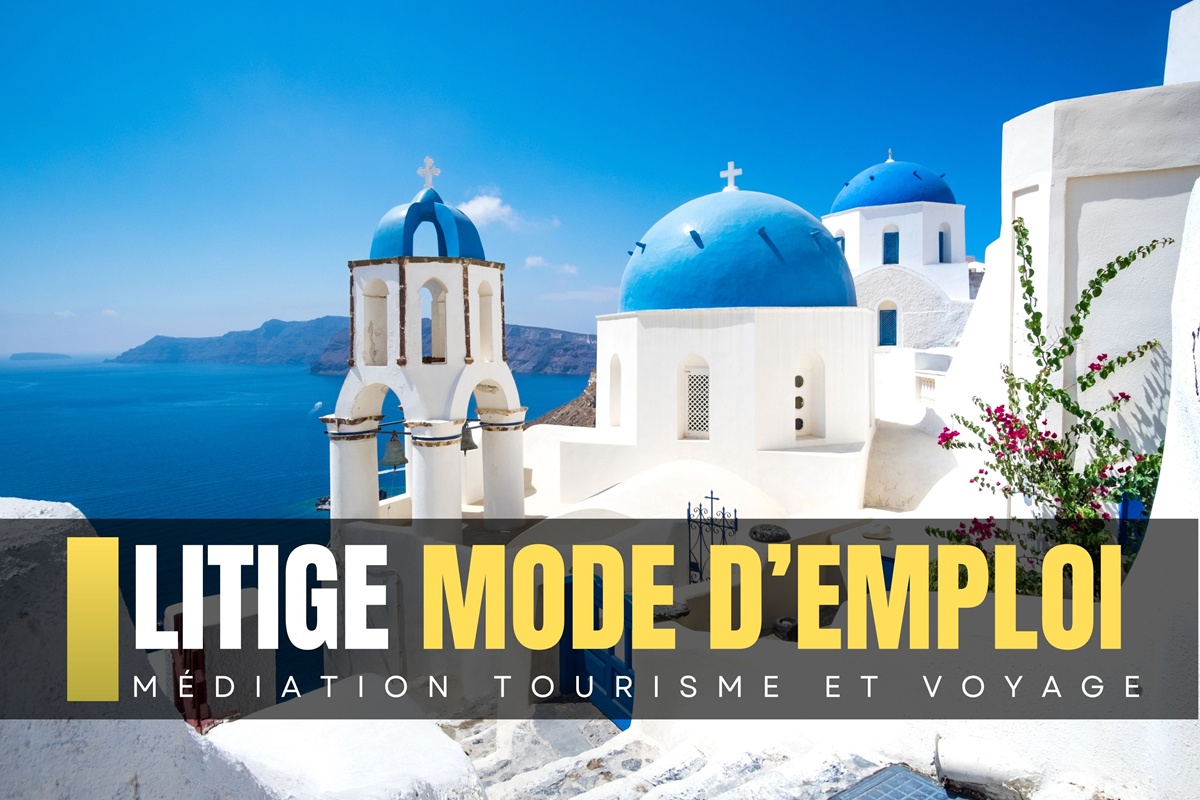
Two travelers referred the Mediation after a trip to Greece organized by a travel agency. They believed that several services provided did not correspond either to the announced descriptions or to the price they had paid before departure. They were seeking a refund of €2,700.

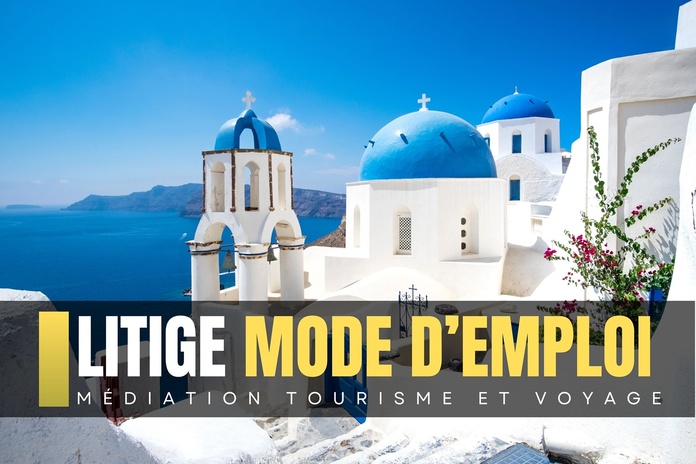
The trip included several legs through the Cyclades. Upon arrival, the travelers noted various non-conformities: a room in Santorini they deemed different from the one shown at the time of booking, a hotel in Paros that did not match the advertised description, and a discrepancy between the price of certain services charged by the agency and the amount shown on the documents provided on site.

They notably found that the amount paid for their accommodation in Sifnos was higher than the price shown on the establishment’s bill.

The same observation was made for the boat crossings, whose rate actually paid to the companies was much lower than the amount billed within the framework of the trip.

The agency had proposed a first commercial gesture of 235 € to compensate for some differences noted during the stay, an offer the travelers had refused, deeming this amount insufficient.


Ce que disent les textes :

On the legal front, the Mediation notes that Article L. 211-16 of the Tourism Code places full liability on the seller of a package tour for the proper execution of the contracted services.
When the services do not conform to what was agreed, the professional must remedy them or, failing that, compensate the traveler.

Moreover, the case file elements do not call into question the price agreed at booking. However, they highlight a significant gap between the sums paid to the agency and the actual cost of certain services, notably the Sifnos accommodation and the maritime crossings.


Ce que préconise la Médiation Tourisme et Voyage :

In the interest of fairness, the Mediation considers it justified to retain half of these price differences, while taking into account the commercial gesture already offered by the agency.

At the end of its analysis, it therefore recommends the payment of an additional compensation of €277.96, to be added to the €235 already proposed, in order to amicably settle the dispute.


Find all the practical cases from the Tourism and Travel Mediation by clicking HERE.


ChatGPT, Claude, AI Agents: CDS Connects Its Services to the Global AI Ecosystem


Selon CDS, "ce qui nécessitait auparavant plusieurs recherches et validations peut désormais être réalisé à partir d'une simple conversation" - Illustration : CDS

Costa Rica


CDS devient l’une des premières plateformes mondiales de Business Travel à connecter ses services à l’écosystème mondial de l’intelligence artificielle.

“Les entreprises clientes peuvent désormais réserver un hôtel, appliquer leur politique hébergement ou centraliser un paiement directement depuis ChatGPT, Claude ou leur propre environnement IA par une simple demande en langage naturel“, précise le groupe dans un communiqué.

En s’appuyant sur l’IA conversationnelle, voyageurs, travel managers, acheteurs et agences bénéficient d’un accès naturel, instantané et sécurisé à leur environnement professionnel, sans rupture de parcours ni complexité d’usage“.

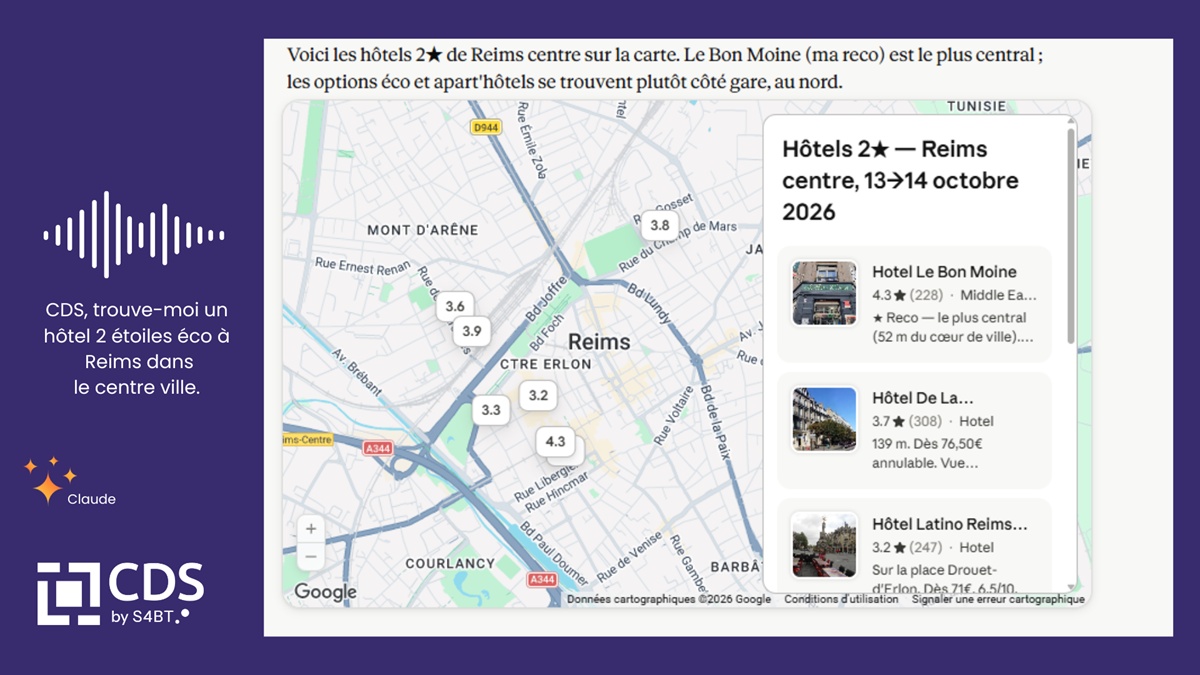
A partir d’une conversation – par exemple : “CDS, trouve-moi un hôtel 3 étoiles à proximité de mon rendez-vous à Paris, conforme à ma politique voyage, avec paiement centralisé et facture dématérialisée” – la plateforme analyse la demande, applique les règles de l’entreprise, vérifie les plafonds tarifaires, identifie les meilleures options et finalise la réservation, en quelques secondes.


An Open, Secure Architecture Built for the Enterprise

Avec cette innovation, CDS souhaite “mettre l’intelligence artificielle au service de l’expertise métier, pour une expérience plus intuitive, plus conforme et plus efficace. Chaque recherche, chaque recommandation et chaque réservation bénéficie simultanément de la puissance de l’IA et de plus de vingt-cinq années d’expertise développées par CDS“.

L’ouverture de l’écosystème CDS repose sur le protocole MCP (Model Context Protocol), “un standard émergent qui permet aux assistants IA, copilotes métiers et agents autonomes d’interagir avec les applications d’entreprise de manière sécurisée et standardisée“, poursuit CDS.

L’entreprise garantit à ses clients un accès durable à leurs services Business Travel depuis n’importe quelle intelligence artificielle qu’elle soit développée par les grands acteurs du marché ou conçue en interne.

Côté sécurité, “toutes les données demeurent hébergées, administrées et gouvernées par CDS. Aucune donnée sensible n’est transférée, répliquée ou exposée aux modèles d’IA“, assure le Groupe.


L’accès repose sur des mécanismes d’authentification forte, de double authentification, de contrôle des habilitations et de traçabilité répondant aux exigences des grandes organisations internationales.

Chaque requête continue d’appliquer les politiques voyages, programmes hôteliers, règles de conformité et processus de validation définis par l’entreprise, qui conserve la maîtrise exclusive de sa gouvernance des données.”


An Innovation Ready to Spread

D’ailleurs, CDS et le Groupe S4BT invitent développeurs, éditeurs, intégrateurs et partenaires technologiques souhaitant explorer les usages du protocole MCP appliqués au Business Travel à les contacter, “afin de construire ensemble la prochaine génération de services de voyage d’affaires alimentés par l’IA“.

Déployée aujourd’hui chez CDS, cette innovation a vocation à s’étendre progressivement à l’ensemble des solutions du groupe : hôtellerie d’affaires, réservation multimodale, paiement, facturation électronique, automatisation des processus et services aux agences.

“Nous sommes convaincus que l’IA deviendra l’interface universelle du Business Travel. En ouvrant nos services à l’écosystème mondial de l’intelligence artificielle, nous ne connectons pas une plateforme à une technologie : nous construisons l’infrastructure qui redéfinira la façon dont les entreprises voyagent, réservent et paient.

Notre engagement est simple – garantir à nos clients un accès pérenne à leurs services, quelle que soit l’IA qu’ils choisiront demain
“, a ainsi déclaré Ziad Minkara, fondateur de CDS et CEO du Groupe S4BT.