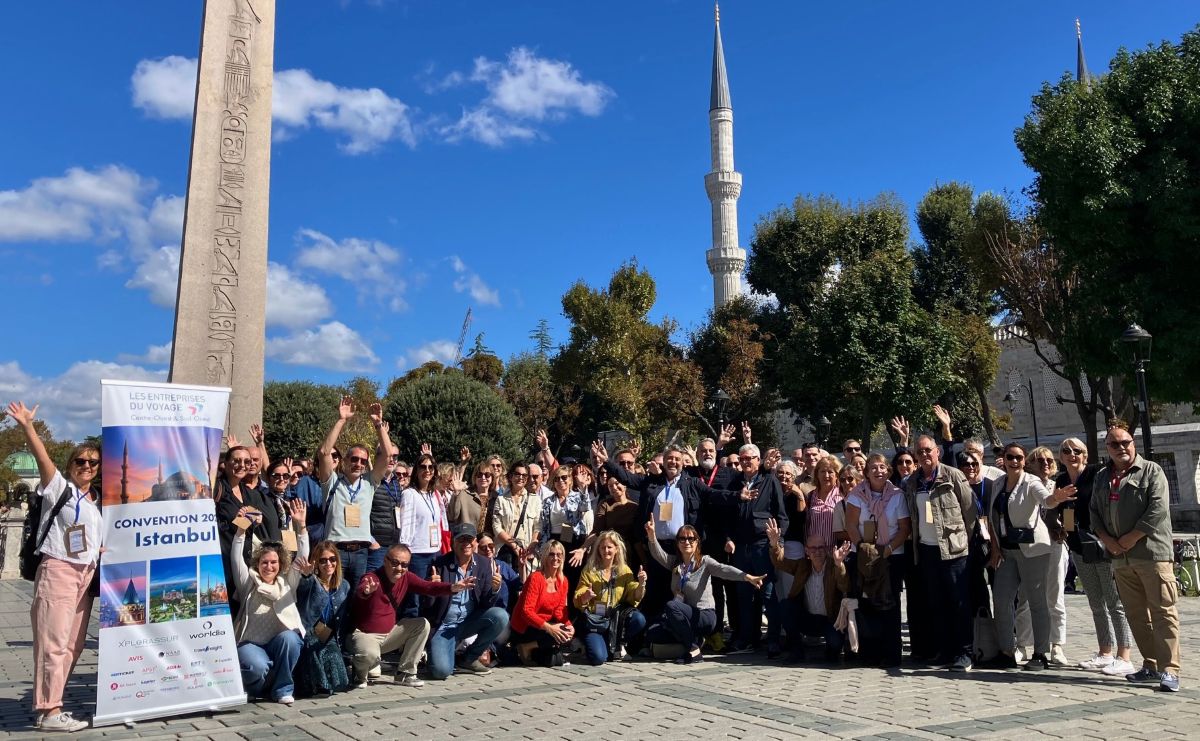


The regional convention season for the Travel Companies (EDV) is officially underway. This year, the EDV Centre-Ouest, chaired by Yvon Peltanche (Eden Tour) and beginning a third term, opened the ball with a touch of originality.
For its event held in Istanbul, the regional branch of the employers’ union joined with the Sud-Ouest. “I was elected a few months ago and I wanted to relaunch the organization of a convention, which had been lacking in our region,” explains Bruno Abenin (Travel Evasion), the new president of the EDV Sud-Ouest.
Unity is strength and the rapprochement happened naturally, to save time and pool resources, but also with the idea of opening exchanges more broadly among members.
Speakers Who Captivate
About 80 tourism leaders (around fifty licenses) traveled to Turkey, complemented by 19 partners who presented their products during a workshop held on a boat cruising the Bosphorus.
The convention also provided a full day of discussions. The pragmatic and educational approach of François Gemenne, professor at HEC Paris and lead author of the IPCC’s Sixth Assessment Report, on the economic transformations linked to the ecological transition, captivated the participants.
Just as the intervention of Charles Tandonnet from the Travelsoft group, who came to talk about Artificial Intelligence. In the future, facing AI, the travel agent’s job will be to secure the client and to generate trust at the destination, he recalled.
Valérie Boned, the national president of the EDV, also used the convention to lay out the major topics that will shape the union’s life in the coming months, starting with an update on the conjuncture.
A Recovery That Remains Fragile


“Les chiffres s’améliorent progressivement après la crise du printemps, avec des prises de commande pour le mois de septembre qui progressent par rapport à septembre 2025, en valeur” a d’abord rassuré Valérie Boned.
Lire aussi : Baromètre EDV – Orchestra : les vacances de la Toussaint en retard fin septembre
“Nous voyons à nouveau des clients se projeter pour les mois prochains, qui poussent la porte des agences, avec de beaux dossiers.”
Pour autant, la situation demeure fragile. “Les incertitudes persistent chaque jour, avec des interrogations sur le pouvoir d’achat ou encore la fragilisation de certains opérateurs, notamment des compagnies aériennes.” Ainsi Volotea, très présente dans l’ouest, à Nantes mais aussi à Brest où la compagnie met en sommeil sa base pour tout l’hiver.
Cette prudence a été renforcée par l’intervention de Marc-Elie Caspar, directeur France de Convera, qui a dressé un bilan peu rassurant de la situation économique.
“It is Necessary to Regulate AI Usage”
AI also occupied a large portion of Valérie Boned’s address. “We need to examine the issues, and support agencies with experts…” the president continued.
Thus, the EDV launched a project with two pilot regions to study use cases and help companies take the right path.
“We see that everyone uses AI, often in an intuitive way; but it’s a jungle, and this jungle is dangerous. If we don’t jump on the AI train, we will stay on the platform. But it is essential to regulate its use: which tasks do we entrust to AI, what place for humans, what rules for employees…”.
A Webinar and a Guide on AI
If it is impossible to draw up a standard charter for the profession, the union announces a webinar on Tuesday, October 6, which will present to members a guide enabling everyone to build their own charter, covering relationships with suppliers to the rules of use for employees.
This guide will then be distributed as a six-page document, with color codes according to the vigilance required for the various listed uses, from handling emails to managing disputes, including content production, photos, and more.
To better support members in rolling out AI, the EDV also signed, a few months ago, a partnership with the company Concentrix.
A Tourism-Focused Session with the Presidential Candidates
 Published by Thierry Beaurepère Journalist
See all articles by Thierry Beaurepère


Add TourMaG to your Google News feed