

Q3 Corporate Bankruptcies: What About the Tourism and Travel Sector?


Défaillances d'entreprises au 3e trimestre : quid du secteur du tourisme et du voyage ? - Photo IA Chat GPT

Attitude Hotels


Corporate insolvencies stabilized in France in the third quarter of 2026. According to the Altares study, 14,652 procedures were opened between July and September, representing a year-over-year rise of just 0.5%. Across a twelve-month period, however, nearly 72,000 businesses defaulted, a record-high level.

The accommodation sector is among the weakest links. Insolvencies there rise by more than 30%, with hotel insolvencies up by 28%. Short-term tourist accommodation accounts for 32 procedures, i.e., twice as many as a year earlier. The restaurant industry also deteriorated, with 1,694 insolvencies, up by almost 10%. Fast-food establishments grow by 15.8%, versus 6.3% for traditional dining.

In the travel sector, 28 insolvencies were recorded in Q3 2026, up from 24 a year earlier (+16.7%). Travel agencies remained stable with 13 procedures, while tour operators increased from 5 to 7 insolvencies. Booking services and related activities rose from 6 to 8 procedures.

See infographic

In the realm of passenger transportation, the trend is upward: 208 insolvencies were recorded in Q3, versus 181 in the corresponding period of 2025, a rise of 14.9%. Taxis account for 197 procedures, up from 168 a year earlier (+17.3%). Regular passenger road transport and other road passenger transport remain stable.


Direct judicial liquidations decline slightly (-1.2%)

Developments remain mixed across other sectors. Construction, the leading sector by insolvencies with 3,452 procedures, records a 3.1% decrease. Manufacturing industry also improves (-11.8%), as do transport and logistics (-1.6%).

Business services retreat by 1.7%. Conversely, difficulties persist in the food trade (+15.3%) and beverage outlets (+13.4%). Agriculture continues its decline, with a 3.9% rise in insolvencies.

Commerce related to personal care is also in the red (+11%), spanning from pharmacies to optics and orthopedic goods. The same goes for bookstores (+10%), sporting goods stores (+16%), and hardware stores (+18%).

On an economy-wide scale, direct insolvencies declined slightly (-1.2%), while judicial reorganizations increased by 4.2%. Enterprises with fewer than three employees accounted for 75% of procedures, with 10,960 defaults, up 2.9%.

For Thierry Millon, head of Altares’ studies, “the surge in insolvencies seems to have passed, but corporate financial fragility remains.” The study also identifies 50,510 threatened jobs in the third quarter, a figure down by nearly 3% year over year.


Altares · Corporate Insolvencies
Insolvencies in the Travel & Passenger Transport Sector
Safeguard openings, restructurings and direct liquidations · Q3 2026
Q3 2026
vs Q3 2025

National context
Altares study — October 13, 2026
14,652 insolvencies in Q3 2026 (all sectors combined) (+0.5%)
With 14,652 procedures opened between July 1 and September 30, the third quarter marks a stabilization at a historically high level. September alone sets a record with 7,100 insolvencies. Over a rolling 12 months, nearly 72,000 companies defaulted. The number of threatened jobs fell by 3% year on year to 50,010 employees. “The peak of insolvencies may be behind us, but the fragility of companies’ finances remains,” summarizes Thierry Millon, head of Altares’ studies.
14 652
Q3 procedures

52 700
in 9 months

50 010
threatened jobs (−3%)

72 000
over 12 rolling months

Key figures · Q3 2026 – Travel & Transports

Travel Sector
28
insolvencies
▲ +16,7 % vs Q3 2025

Travel Transports
208
insolvencies
▲ +14,9 % vs Q3 2025

Combined total
236
insolvencies
▲ +15,1 % vs T3 2025


Focus
Travel Sector
28 insolvencies in Q3 2026

Travel agencies
7911Z

13
= 0,0 %

vs Q3 2025 · Q3 2024

Q3 22Q3 23Q3 24Q3 25Q3 26

Tour operators
7912Z

7
▲ +40,0 %

vs Q3 2025 · Q3 2024

Q3 22Q3 23Q3 24Q3 25Q3 26

Booking services
7990Z

8
▲ +33,3 %

vs 6 in Q3 2025 · 6 in Q3 2024

Q3 22Q3 23Q3 24Q3 25Q3 26

Travel Sector — Annual Insolvencies History
Travel Agencies + Tour Operators + Booking Services
96
93
97
94
72
90
103
120
104
2017
2018
2019
2020
2021
2022
2023
2024
2025

Analysis : After a peak of 120 insolvencies in 2024, the travel sector fell back to 104 in 2025 (−13.3%). In Q3 2026, it records 28 insolvencies, up from 24 in Q3 2025 (+16.7%). The rise is driven by tour operators (7 vs 5) and booking services (8 vs 6), while travel agencies remained stable at 13. Over the first nine months of 2026, the sector totals 84 insolvencies, vs 82 over the same period in 2025 (+2.4%).


Distribution of the 28 Travel insolvencies · Q3 2026
Agencies 46.4%
Tour operators 25.0%
Booking services 28.6%

Travel agencies (13)
Tour operators (7)
Booking services (8)


Transport
Passenger transport
208 insolvencies in Q3 2026

⚠
Taxis & VTC — Sector under intense pressure
4932Z
197
insolvencies in Q3 2026
▲ +17,3 %

Taxis and VTC account for 94.7% of passenger transport sector insolvencies. The rise has been ongoing since 2021 (305 → 857 in the 2025 annual figure). In Q3 2026, the sector shows 197 insolvencies, up from 168 in Q3 2025, after 281 in Q1 and 254 in Q2 2026.
319
515
571
339
305
395
470
648
857
2017
2018
2019
2020
2021
2022
2023
2024
2025

Other transport sub-sectors · Q3 2026
Sub-sector
Q3 2025
Q3 2026
Evolution

Maritime transports
1
4
+300 %

Inland waterways
0
0
—

Air transports
3
1
−66.7 %

Regular road transport
3
3
= 0 %

Other road transport
7
7
= 0 %


Summary
Annual comparative evolution
Travel Sector
Annual insolvencies 2017–2025
2017
96
2018
93
2019
97
2020
94
2021
72
2022
90
2023
103
2024
120
2025
104

Total Passenger Transports
Annual insolvencies 2017–2025
2017
453
2018
650
2019
669
2020
413
2021
341
2022
454
2023
543
2024
726
2025
925

Source : Altares — Insolvency statistics
Safeguard openings, restructurings and direct liquidations · Q3 2026
NAF codes: 7911Z, 7912Z, 7990Z (Travel) · 5010Z, 5030Z, 5110Z, 4932Z, 4939A, 4939B (Passenger Transports)
Aviation Sector: “A Very Serious Situation” According to FNAM


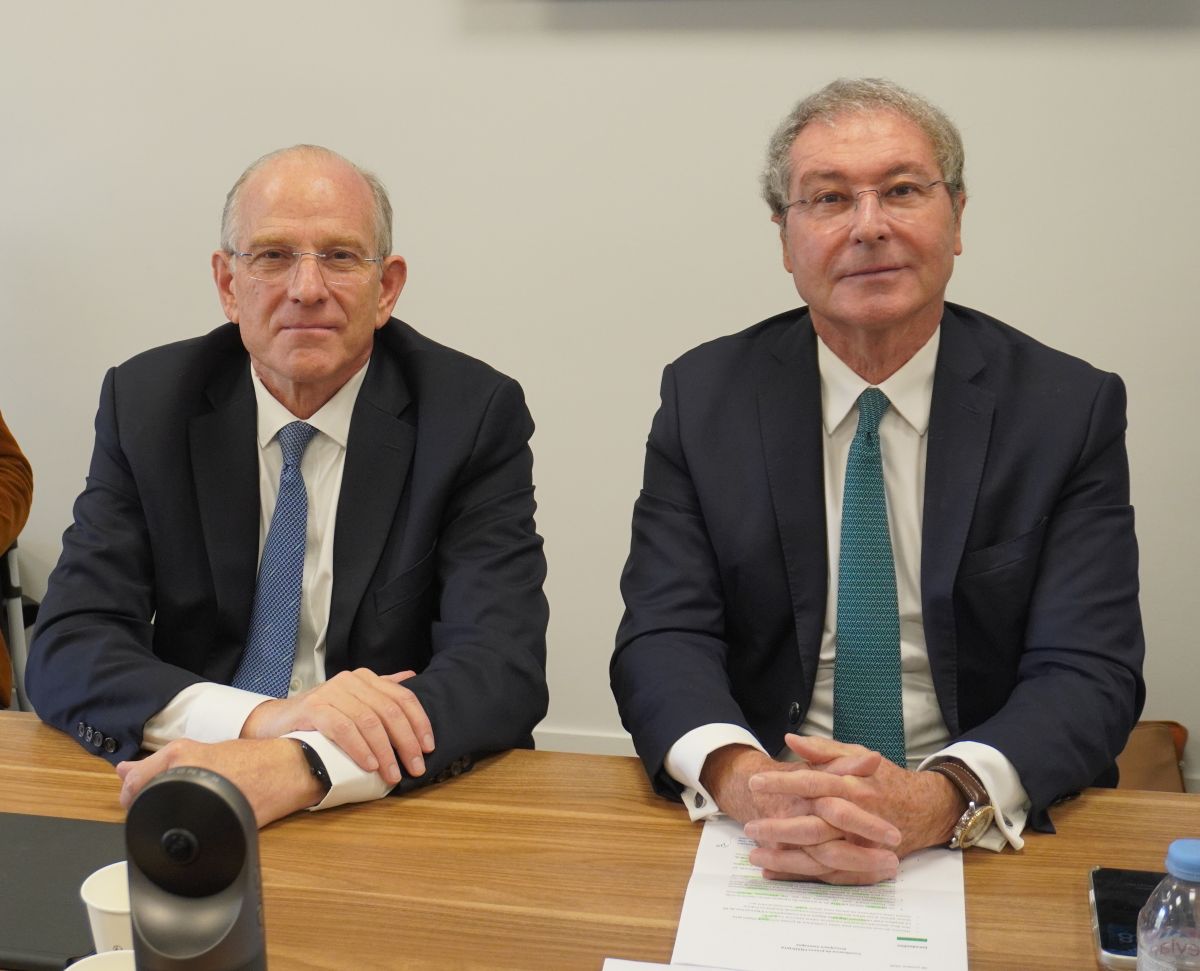
de gauche à droite, Rafael Schvartzman et Pascal de Izaguirre dans les locaux dela FNAM le 8 octobre dernier. Photo: C.Hardin

PONANT


Invited to a press conference to take stock of the situation last Thursday within FNAM, one would have expected, given the latest announcements regarding the preparation of the 2027 budget, that the president of FNAM, Pascal de Izaguirre, would look gloomy.

Not surprising, then, that in the preface to his assessment of air transport after this summer, he mentions a “very serious situation“, particularly for France.

To go beyond the Franco-French context and see how France stands in Europe and how Europe stands relative to other regions of the world, FNAM had invited Rafael Schvartzman


Europe Weakened, France Falling Behind

In Europe, despite the Gulf crisis, passengers continue to travel: summer 2026 was another record season for European air travel, with nearly 36,000 flights per day on average (+2.4% vs summer 2025) and an all-time high of 37,640 flights in one day according to Eurocontrol.

However, warned Rafael Schvartzman, the real risk lies in rising costs. Since the closure of the Hormuz Strait, the price of kerosene has surged by about 60% and can now account for up to 45% of airlines’ operating costs, versus 25% in normal times.

Industry margins are expected to fall to around 2%, the lowest since the COVID crisis.

France, for its part, according to the figures from the IATA Europe Vice-President, has lost 6% of the airlines operating on its territory and today, traffic growth stagnates or even declines, a consequence of geopolitical tensions worldwide, but also of a European and national tax regime that is particularly high.

An observation clearly shared by the president of FNAM, who likewise provided figures showing a contraction in traffic in 2026: in August, passenger traffic fell by 1.0% compared with August 2025 (-1.4% internationally, -3.5% on Paris platforms). Over the year, traffic is below its 2025 level (-0.5%) and only slightly above 2019 (+1.0%), while domestic traffic remains at -21% compared to 2019.

The most worrying signal now concerns seat supply, planned months in advance: indexed to 100 in 2019, it stands at about 111 on average across Europe versus 102.1 in France, a gap of almost 9 points.

In this highly competitive French aviation market, where the Air France-KLM giant can afford to moderate price increases, other French airlines with weaker cash flows suffer from not being able to better pass through the impressive kerosene price increases.

According to DGAC, departure fares from mainland France rose by only +2.2% in the first eight months of the year.

To safeguard the viability of companies, FNAM has officially put forward several requests:

  • the tracking and securing of kerosene supplies, which must remain a priority;

  • Flexibility in flight scheduling, with a moratorium on the rule that you lose your slot if you don’t use it (Use-it-or-lose-it). During this crisis, it enables cancelling unprofitable flights;

  • Immediate liquidity support, notably, as during Covid, the return of state-guaranteed loans (PGE);

  • The suspension, for the duration of the conflict, of the aviation ETS, the European Union’s carbon market where airlines must buy and surrender quotas corresponding to their CO₂ emissions, as well as the mandatory compensation of domestic flights defined by Article 147 of the Climate and Resilience law;

  • Finally, a reduction of the air ticket tax back to the level applicable before March 1, 2025.

Taxes, again and always, remain, according to FNAM leaders, one of the major causes of the downturn in air transport.

Tirelessly, the head of FNAM advocates for the abolition of the TSBA with arguments that are well heard by the supervising authority, DGAC, and the Minister of Transport, though they cannot yet bend Bercy. It is true that the current situation does not make things easy.

“We are heard, but we are running into a short-term vision from the government, the concern of showing billions of euros in savings today,” laments Pascal de Izaguirre.


The Swedish Example

Yet the FNAM’s demonstration that higher taxation harms medium-term public revenue is rather persuasive.

Indeed, it estimates the foregone tax revenue associated with the additional downturn since 2025 at €750 million in 2025 and nearly €1.6 billion in the projected annual 2026, compared to a nominal tax revenue of €850 million.

A negative yield, just as the federation would argue, would be the case for the new taxes planned in the 2027 budget proposal, the TEITLD and the security-safety tariff (T2S), which would siphon an additional €250 million from the sector.

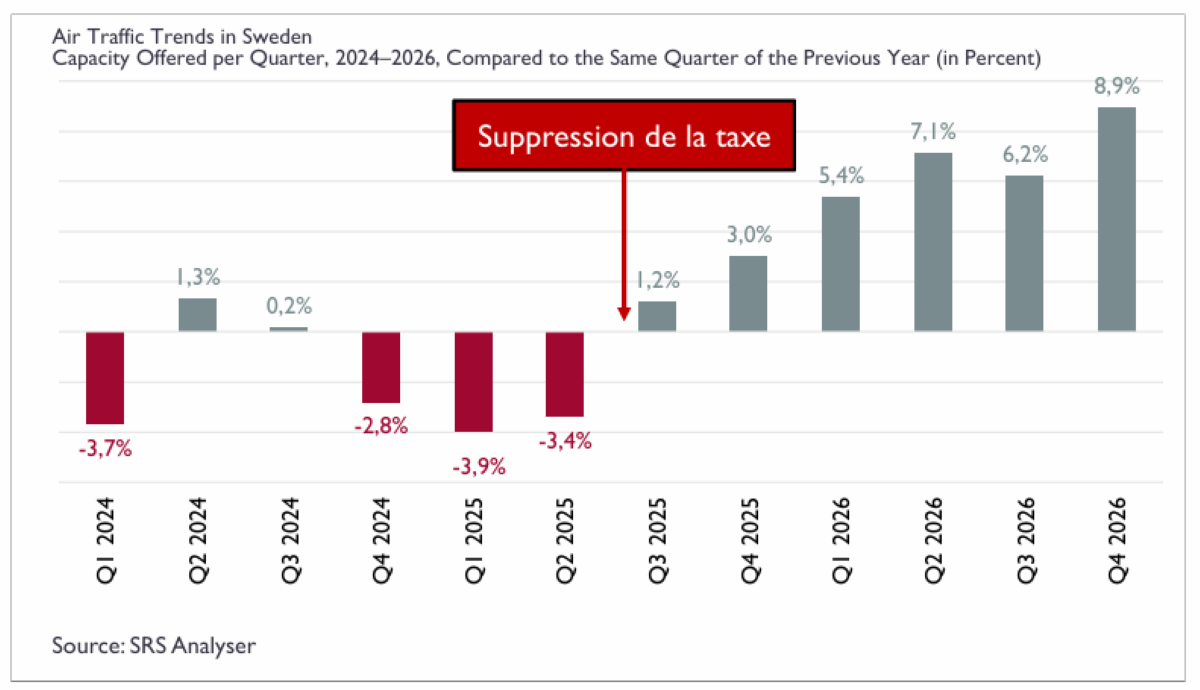
To add even more ammunition to this difficult anti-tax crusade, the FNAM gave a concrete example, that of Sweden, which, according to them, clearly illustrates the reversibility of the tax and the possibility of reversing the supply dynamics.


Secteur aérien : "une situation très grave" selon la FNAM
On the presented chart, one notes that following the removal of the tax there is a significant rebound in capacity growth and a forecast that this growth will continue up to +8.9% in the fourth quarter compared to 2025.

“Moderation on taxes is needed by the air transport, and among the measures we can implement immediately that would ease the economy of French airlines, this is one of the most accessible and effective ones,” added Laurent Timsit, the FNAM’s general delegate.


Soon a Presidential Platform

Convincing the government is therefore a tough fight, but it is also to those who will lead the country next year that one must start talking.

Asked by TourMaG about this, the FNAM president clarified: “We are working on preparing a platform for the presidential elections. We have asked the Deloitte firm to refine and complete their previous studies on the economic impact of aviation, and the negative impact of taxation.

This work will be completed by the second half of October. During November, we will build this presidential platform.

We are waiting a bit for the landscape to settle, and at that moment, we will approach the candidates who are most likely to run to present all these elements.
”


Institutional Tourism Crisis: Could the Private Sector Be the Solution?


Tourisme institutionnel : un secteur en quête de légitimation... Atout France comme exemple à suivre ? - Depositphotos.com, 3d_generator

CroisiEurope


More than six months after the melodrama that shook institutional tourism with the hypothetical closure of the Val-de-Marne Departmental Tourism Committee, the sector is sinking deeper into crisis.

Admittedly, the structure has not yet closed its doors, but it must operate without the department’s 900 000 euros subsidy, which greatly jeopardizes its future.

And if Val-de-Marne Tourism is still standing, Solutions & Co. is no longer.

The Pays de la Loire Economic Development Agency, which encompassed the Regional Tourism Committee, was liquidated, because the region “does not have the means to maintain such an agency“.

Its president explained to our colleagues at La Tribune that France has entered “the era of exigency, where every public euro must be a useful euro“. Tourism professionals will appreciate being described as useless.

Ce n’est pas tout, car Gironde Tourisme va connaître le même sort.

If the explanation lies in the department’s heavy deficit, the mayor of Lacanau regards the CDT as “useless” and denounces a “millefeuille institutionnel“, unable to “implement a concrete action“.


A sector seeking legitimacy: Atout France as a model to follow?

The politicization of the debate, added to exhausted public finances, seems increasingly to threaten this sphere of the tourism industry.

The presidential deadline should not really reassure the leaders and employees of the various structures, as a disengagement by the State becomes more openly acknowledged.

“The crisis is intensifying, because we are now witnessing not only budget cuts but closures as well. The fact is there. Communities have less money.

In this context, and to stem the bleed, the profession should come together and propose measures to rationalize what sometimes resembles an institutional mille-feuille
“, contextualizes Jean Pinard.

“It would be possible to better distribute the housing tax. Imagine that in Paris, out of the 120 million euros in revenue from this tax, only 4 million goes back to the tourism office.

We should also question private players: how to mobilize Club Med, Belambra and all those actors who keep the destinations alive
.”

While some operators struggle to justify their budgets and their missions, faced with the rise of artificial intelligence, networks and the omnipresence of OTAs, public authorities have a free hand to cut budgets, or even eliminate levels.

Among these bad news, there are nonetheless solutions, as notably demonstrated by Atout France’s GIE.

Founded in 2009, the group of economic interest (GIE) enables governance and financing of the agency to include not only the French administration but also private players.


Private funding: the Dordogne Périgord Tourism case

Atout France is not the only case study, a CDT has also taken this turn.

You have to go to the Southwest, to a territory of character offering visitors caves, castles and a plethora of the most beautiful villages in France.

It is in Dordogne that we go. In this territory, tourism is omnipresent. It represents just over one billion euros in turnover and consumption in the department each year, for 19 million overnight stays.

Volumes higher than 2019, a year when the sector simply weighed 22% of the local GDP.

“Post-Covid, with the fall in transfer duties coupled with the collapse of the real estate market, we saw our subsidies begin to drop.
The decrease is 100,000 euros for 2023, 2024 and 2025.
For us, tourism is not just about promotion or marketing; it is also about networking, animation, and support
“, explains Christophe Gravier, director of Dordogne Périgord Tourism.

“We therefore created a first club on relationship marketing, where we bring along the offices. This allowed us to pool certain tools, such as the newsletter and a shared database that we manage.
Then, while discussing with on-the-ground operators the financing issue of the CDT and their needs, we realized there was private demand
.”


Dordogne Périgord Tourism: “We rested on the housing tax or subsidies”

The structure thus saw 300,000 euros disappear in total over three years, out of nearly 2 million euros of annual budget. But from faint signals and discussions at events, the operator organized itself.

It launched two clubs, but above all emerged an offer based on new services capable of bringing added value to private players in the region.

“This led us to create a somewhat hybrid structure and to reinvent the CDT’s classic economic model. Being a bit provocative, I would say that, for convenience, we had relied for years on the housing tax, additional taxes, or subsidies.
This drop in budget forced us to wake up.

Either we retraced our steps into engineering, or we wanted to maintain an ability to support on the marketing and communications front. In that case, we had to do it differently.

Rather than remaining in a logic of image marketing and notoriety, we considered that this communication would be more relevant if it were invested for the benefit of professionals, in a performance-based logic“, wants to highlight Christophe Gravier.

One of the clubs addresses heritage topics, whether caves, remarkable gardens or castles.

Members pay a membership fee that funds a marketing pool, from which managers of these sites can draw to finance training actions, gain perspective on new technologies, carry out commercial outreach, or launch campaigns on social networks.

“We try to deliver a set of services with real added value, while ensuring we do not compete with the work done by tourist offices or the CRT. We operate in a cluster logic“, defines the leader.

Read: Google in AI fashion: what life without clicks or audience?

The second club focuses on iconic sites and products. It brings together the entire excellence chain, including truffles, foie gras, walnut production, as well as 4- and 5-star hospitality.

A third club is expected to be launched in 2026 on nature sports, as Dordogne is a hub for hiking and canoeing, and a fourth is under development around oenotourism.


A beneficial shift for private actors and the CDT budget

This transformation has benefited both private players and the CDT budget. In just two years, 150,000 euros were collected. Moreover, partners contribute funds allowing nearly 50% of the action plan of the organization to be financed.

A change that has not completely questioned Dordogne Périgord Tourism’s role.

“We remain the department council’s arm to deploy its tourism policy, that does not change.
Anyway, private operators have the flow, the traffic. Rather than chasing audience or imposing an image that already exists, at least for Dordogne, we come to support them and amplify the impact of their investments.


We are a small team of 15 people. We had to shift our logic to integrate a commercial, representational side into our work, and the need to bring added value. Because if the clubs bring nothing to the business leaders, next year they will not renew the experience.

We are, I think, closer to the ground and to the expectations of the actors


Cape Verde’s Tourism Sector Continues to Grow


Le Cap-Vert continue son ascension, Desposit.photos.com

Top of Travel


Le chiffre est désormais officiel et témoigne du changement de dimension de la destination : avec 1 248 052 visiteurs enregistrés en 2025, le Cap-Vert affiche une progression solide de +6 % par rapport à l’exercice 2024 (qui comptait 1 177 467 visiteurs).

Ce nouveau record s’inscrit dans une dynamique à long terme spectaculaire.

En l’espace de dix ans seulement, la fréquentation touristique a plus que doublé dans le pays, bondissant de +119 %.

Dans un contexte mondial pourtant marqué par des incertitudes géopolitiques, le Cap-Vert s’impose définitivement comme l’une des valeurs refuges et l’une des destinations les plus dynamiques du continent africain.

Outre sa stabilité politique exemplaire, cet État insulaire situé au large du Sénégal bénéficie d’un climat tropical sec particulièrement clément, avec des températures douces, comprises entre 24 °C et 30 °C, et un ensoleillement quasi permanent qui séduisent les voyageurs en quête de dépaysement.


Cape Verde doubles its number of tourists in 10 years!

This passage past the 1.24 million visitor mark is not an isolated peak, but the result of four years of uninterrupted growth since 2022.

After having first crossed the symbolic milestone of one million tourists in 2023, the archipelago continues to push its limits.

Thus, 6,120,204 overnight stays were recorded in 2025, an increase of +8.3 % (higher than the growth in arrivals, a sign that tourists stay longer or spend more).

The bed occupancy rate rose to 72 %, gaining 12 percentage points in one year, and as much as 20 points compared with 2022 (52 %).

These indicators prove that the Cape Verde model is not subjected to a fleeting trend, but rests on solid fundamentals, managing to smooth its visitation across all quarters of the year thanks to a diversified offering.


Cape Verde: Sal and Boa Vista, engines behind this record of attendance

While all ten islands of the archipelago benefit from this appeal, this historic record of 1.24 million visitors is largely driven by its two seaside powerhouses.

Sal Island remains the primary anchor of tourist flows, capturing 57.7% of arrivals by itself.


It is firmly complemented by Boa Vista, which records 24.4% of arrivals and shows an exceptionally strong occupancy rate, confirming travelers’ preference for its endless fine-sand beaches and its premier hotel complexes.

Together, these island pillars drain more than 82% of visitors, attracting a largely European clientele, non-residents representing 95.5% of total arrivals. Within this market, France stands out as the 4th global partner, with more than 120,000 travelers in 2025.

French tourists are distinguished by a strong appetite for green and cultural tourism. They feed the more preserved islands such as Santo Antão, renowned for its striking volcanic reliefs and hiking trails, Santiago, historic cradle housing Cidade Velha, or São Vicente, the archipelago’s cultural and musical capital, inseparable from the famed singer Cesária Évora.

A trend that demonstrates that, behind the overall record figures, Cape Verde is progressively succeeding in diversifying its sectors.