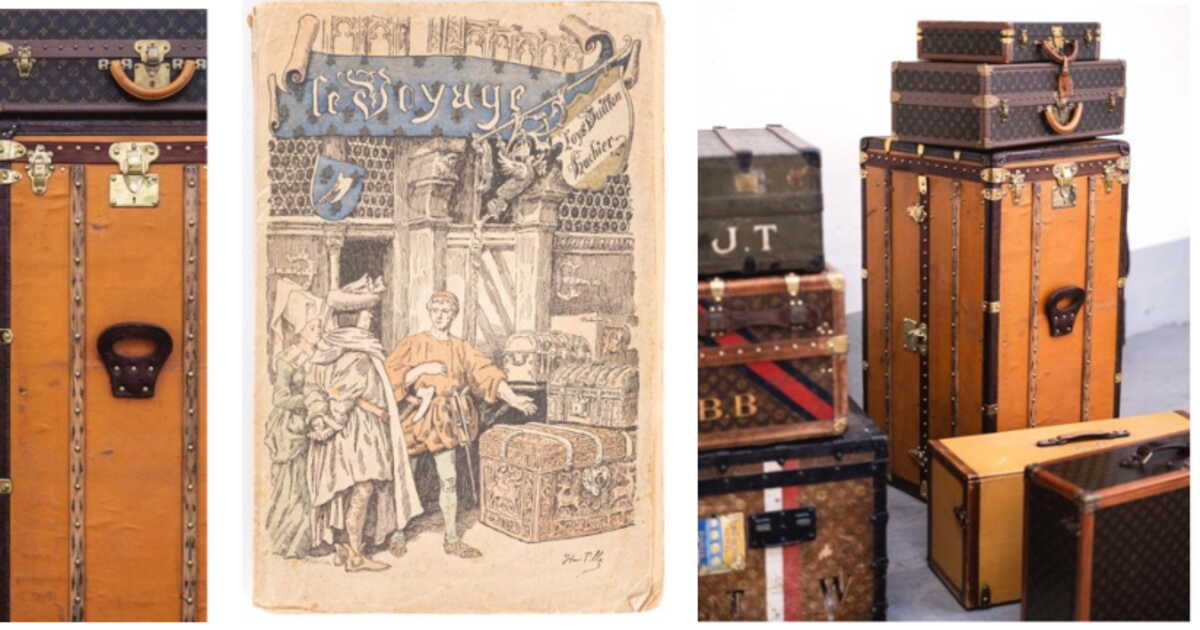
Sleeping in the heart of the jungle, writing aboard the Orient Express, or crossing the Atlantic with dozens of suitcases: Louis Vuitton trunks tell a whole history of travel on their own. On the occasion of the Monogram canvas’s 130th anniversary, the auction house Gros & Delettrez is organizing a public exhibition from May 19 to 21, 2026 at 2, rue de Bérite, in the 6th arrondissement of Paris, ahead of an exceptional auction on May 21 dedicated to the universe of the French house: explorer bed-trunks, library trunks, travel cases, or models designed for transatlantic crossings.
Far more than mere luggage, these objects tell a certain idea of travel, between luxury, innovation and adventure. To understand how these creations accompanied the evolution of travel styles since the 19th century, we spoke with the auctioneer Antoine Saulnier, who has led the sales of this specialty for over 15 years.
The Monogram canvas is celebrating its 130th anniversary this year. How did this motif become such a strong symbol of luxury and travel?
Antoine Saulnier: Even when it was created in 1896, this canvas was truly a mark of distinction. At the time, most trunk-makers used plain canvases, often Trianon gray or khaki, or striped canvases. Georges Vuitton, Louis Vuitton’s son, created this monogram largely because the house was heavily copied. When he passed by the shop windows of rivals on Rue Saint-Honoré, he saw models very similar to theirs, sometimes even presented with phrases like “as with Louis Vuitton”. The creation of the monogram was therefore also a way to assert a distinct identity and to combat counterfeiting. The initials “LV” became a real signature.
Then, Louis Vuitton quickly became a major house. Louis Vuitton was the layetier-emballeur of Empress Eugénie, which contributed greatly to its reputation.
Then, in the 20th century, the house did not limit itself to trunks: the monogram expanded to leather goods and other objects. It went down into the street, it became visible everywhere.
And obviously, the brand’s international expansion amplified this phenomenon. The monogram has been revisited by artists such as Takashi Murakami or Stephen Sprouse. Today, Louis Vuitton is probably one of the most well-known luxury brands in the world.
What is fascinating is that it all started with a young man who arrived in Paris on foot, penniless, from the East of France.
Were Louis Vuitton trunks particularly innovative for their time?
Yes, absolutely. It’s even the brand’s great strength. Louis Vuitton has always sought to invent solutions that others did not dare to offer. There is, by the way, a famous anecdote: before creating his own house, Louis Vuitton worked for another trunk-maker. A client reportedly asked for a solution to transport glasses during a long journey. His boss refused, but Louis Vuitton allegedly replied that it was possible. This spirit of innovation has truly marked the house’s entire history.
Everything was fully customizable. This is clearly evident in this sale with trunks designed for explorers. We showcase notably two exceptional bed-trunks, including one made for Jules Tivan, an explorer of the French Congo. These are objects designed for extreme conditions.
There were also “Aéro” trunks, created to be lighter in order to travel by hot air balloon or by airplane. Louis Vuitton also designed trunks for automobile cruises, such as those used in the Citroën expeditions of the Yellow Cruise (April 4, 1931 to February 12, 1932) or the Black Cruise (October 28, 1924 to June 26, 1925).
And that went even further, the house produced medical boxes, trunks to transport photographic equipment, picnic necessities, travel secretaries… We even had very specific models, such as suitcases intended for transporting hunting rifles for ladies. At the time, travel often meant departing with an entire personal universe: clothes, accessories, writing objects or leisure equipment. Each creation met a very precise need.
Did the explorer models require particular materials?
Yes, everything was designed according to the travel conditions and the type of expedition. For explorers like Pierre Savorgnan de Brazza or Jules Tivan, trunks had to withstand extremely difficult environments, whether humidity, bad weather, insects, heat or long transports.
We can see this clearly with the bed trunks presented in this sale. They are quite extraordinary: inside, there was the entire frame of a foldable bed allowing comfortable sleep during an expedition, even in the jungle. These trunks were also very heavy and often required porters.
Some were made with materials specially chosen to protect their contents. For example, there were trunks coated with zinc, sometimes considered unsinkable, to prevent moisture from entering. Others were made of brass, wood or entirely leather for the most luxurious models.
Everything was designed to measure according to the traveler’s needs and the nature of the expedition. Some trunks were intended for transporting clothes, others for delicate equipment, furs, pharmaceuticals or even equipment specific to great explorations. Everything was organized to prevent objects from moving during transport and to arrive intact despite sometimes extremely long journeys and challenging weather conditions.
Looking at the evolution of the models, can we see a change in the way of traveling over time?
Yes, entirely. At the time, traveling often meant crossing the Atlantic with thirty or forty trunks. Luggage was designed to be stored for long periods, sometimes for weeks of crossing. One could bring a lot of belongings. Even a single full trunk required porters; you did not carry your luggage yourself.
With the arrival of the automobile and especially the airplane, constraints changed: lighter luggage, more maneuverable, and easier to carry by oneself. Today, journeys are much faster. Louis Vuitton understood this very well, and the house developed rolling models, more practical, suited to modern travel.
The very notion of luxury has changed. In the past, luxury also meant taking the time of travel. We crossed the world by boat, we traveled by train, we settled in for weeks. The journey almost became part of the experience. Some travelers carried wardrobe trunks, travel libraries or travel secretaries to continue writing, reading or changing clothes during several weeks of crossing. Today, travel is much faster and more frequent, especially by airplane, so the relationship with luggage is no longer the same at all.
But the know-how, it continues to exist. Louis Vuitton still maintains its historic workshop in Asnières-sur-Seine, where bespoke orders are crafted. The artisanal precision remains the same.
What are your favorites in this sale?
I really like the yellow canvas desk and laundry trunk from the early 20th century. It’s a very rare model, entirely original and in remarkable condition. The bed trunks are also quite extraordinary. They are seen very rarely today.
But I also have a soft spot for the small writing-library trunk. I find that it perfectly embodies the luxurious travel of the early 20th century. One can easily imagine someone on the Orient Express, writing after dinner, reading during the journey, then closing his trunk before stepping off the train. This type of object truly tells of an era when travel took time and was part of everyday life. It’s a very famous model. A similar example belonged to Ernest Hemingway and was found after his death in the Ritz’s cellars with an unpublished manuscript. I find this story fascinating.
Who buys these kinds of pieces nowadays?
The profiles are very varied. There are Louis Vuitton collectors, travel enthusiasts, lovers of vintage leather goods, but also institutions. These objects represent a piece of history: the history of travel, of luxury, of craftsmanship and fashion.
But there are also buyers who simply want a beautiful decorative piece. Today, most of these trunks no longer travel. They become coffee tables, decorative objects in a living room or a bedroom. There are also decorators, hotels or interior designers who buy this kind of pieces for their projects.
Even if some people still occasionally use vintage Louis Vuitton luggage for particular trips, these pieces have become, above all, collectibles and decorative objects, more than everyday travel luggage.





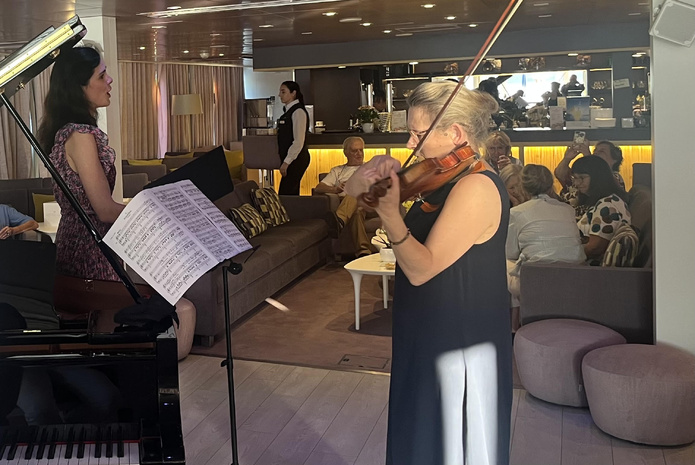



 To give substance to this ambition, Voyages d’Exception has relied for nearly ten years on Sophie Lemonnier-Wallez, a violinist and the artistic director of these programs.