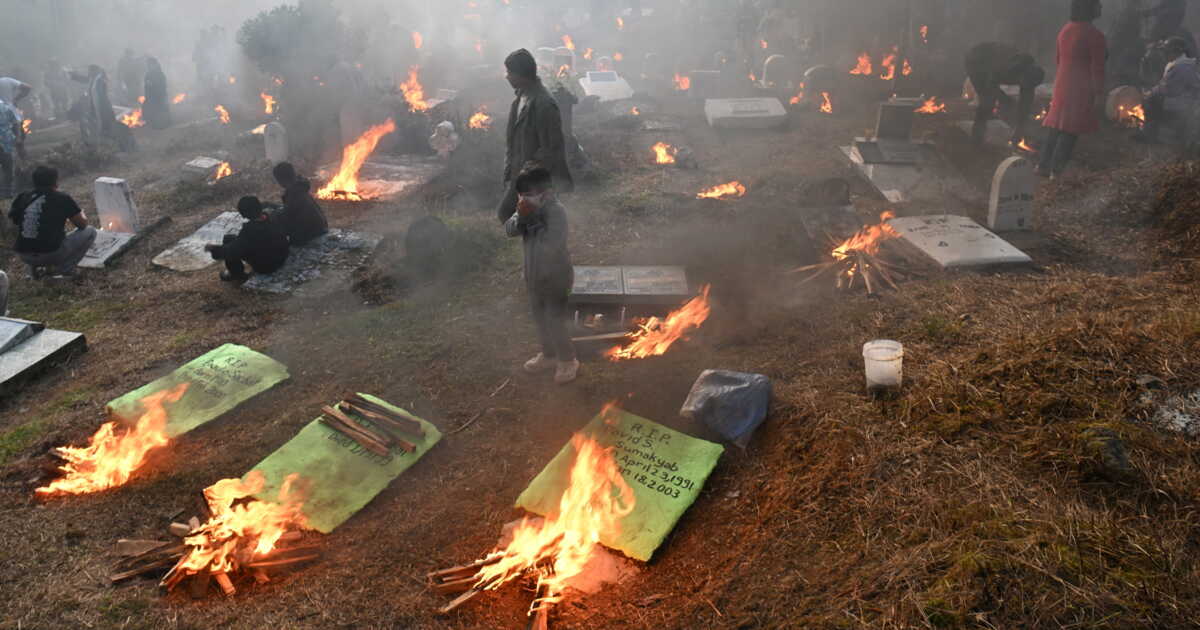
Thousands of Fires Light Up a Mountain Cemetery in the Philippines to Honor the Dead

The Panag-aapoy (“lighting a fire”) takes place on All Saints’ Day in the tourist town of Sagada, north of Luzon’s main island, for 122 years, according to Winston Garlejo Menong, director of the Saint Mary the Virgin Episcopal Church, cemetery owner.

As night falls and darkness covers the four hectares of the burial ground, a sepulchral glow appears, the flames burning for more than 2,000 deceased souls.

The animist inhabitants of the Cordillera mountain region did not adopt Christianity until after the Philippines were ceded by Spain to the United States in 1898, four centuries after Catholic Spanish missionaries had evangelized the local coastal populations. American Protestant missionaries encouraged Sagada residents to bury their dead and to light candles on their graves, notes Winston Menong. “According to our concept of the Bible, Christ means light”, he declares.

Whether with candles or pine torches, in Sagada lighting a flame amounts to “welcoming the presence of Christ among us, sharing in a communion with our departed loved ones”, he explains.

Respect Boundaries

The early Christians of Sagada burned pine wood because candles were expensive and their flames easily died in the wind, unlike the burning of aromatic pines rich in resin, explains Sagada’s tourism officer, Maria Teresa Abad, to AFP. This practice recalls the burning of incense in Buddhist rituals.

Cybil Domoguen returned to Sagada this year with her father and a bundle of 51-centimeter pine sticks to honor her grandparents who had raised her there. “If a tomb has no visitors, we make sure to light a few sticks for it”, explains AFP this 31-year-old teacher. Like other participants in the ceremony, she feels mixed about the growing tourist presence. “Last year, tourists were taking photos of us, which was embarrassing”, she adds. “We have no problem with strangers as long as they respect the boundaries”, she supports.

Hanging Coffins

The inhabitants of Sagada did not always light flames for their dead, nor even bury them. Before the arrival of the missionaries, the favored practice was to suspend coffins on cliff faces or wedge them at the entrances of caves, a custom that did not completely disappear until 2010, notes Ms. Abad.

Some of these “hanging coffins” remain visible on the cliffs near Sagada. “Traditional beliefs about burial link caves and elevated burial places to the passage of the spirit to the realm of ancestors”, she explains, which burial would hinder. It also offered the advantage of protecting the remains from wild animals and floods.

Over time, Panag-aapoy and the hanging coffins have become major tourist attractions, much to the dismay of locals. The Church and local authorities have since taken steps to safeguard the region’s cultural heritage. Picnic blankets and drone photography have been banned, and noisy tourists, phone in hand, are kept at a safe distance from the graves and asked to observe respectful silence.

“Panag-aapoy is a sacred cultural tradition, NOT a festival or a tourist event,” stated the Philippine Department of Tourism in a notice published for the season. “The solemnity of the practice is being lost”, sighed Mr. Menong with a sigh. “It was turning into a puppet show.”

Rex Refuela, a 46-year-old tourist from Manila, says he understands the need to show respect. “It is acceptable to impose a few restrictions to preserve and maintain the solemnity”, he tells AFP, adding: “it’s an absolutely incredible beauty”.
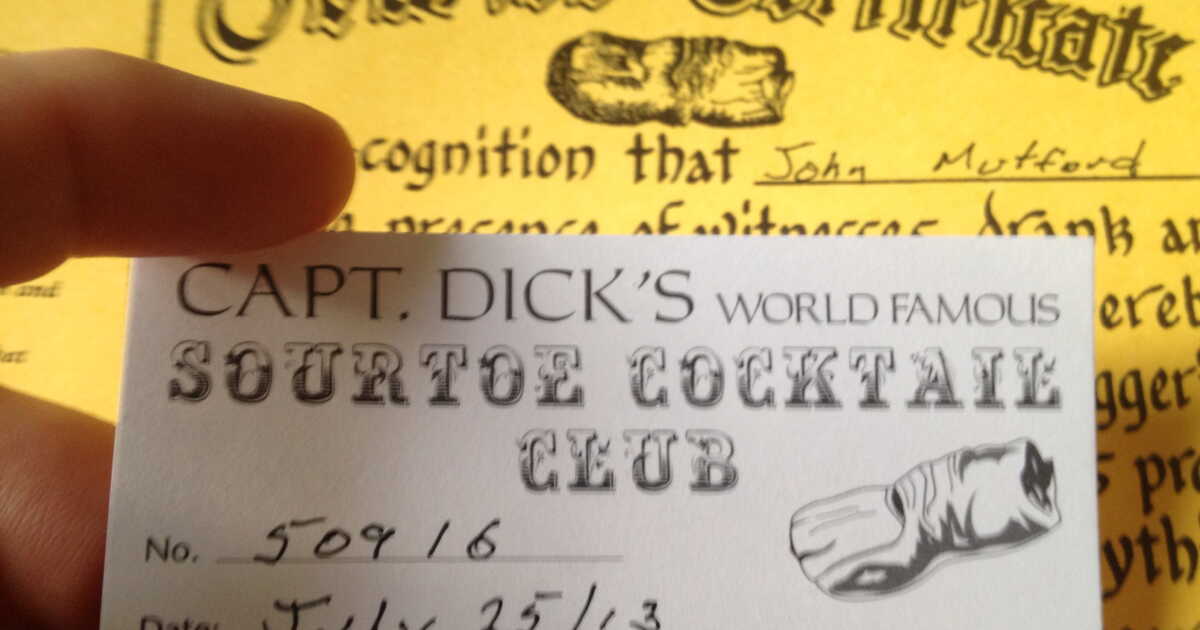

Canada’s Unusual Mummified Toe Cocktail Draws Thousands of Curious Visitors Each Year

Drinking a glass of alcohol in which a real human toe has macerated may seem like a challenge… absurd! Yet, in a small, isolated Yukon town in northwestern Canada, this experience has become a must-see attraction for more than 50 years. Called the “Sourtoe Cocktail,” this drink is served according to a precise ritual, with a mummified limb whose bearer’s lips must inevitably touch the end. Behind this rather bewildering tradition lies a story of gold rush fever, frostbite, and colorful personalities, as explained by the BBC.

A frostbite-origin tale behind an unusual tradition

To understand how a human toe ended up in a glass, head for Dawson City. This town of around 2,300 inhabitants, located 531 kilometers from the nearest city, first earned its fame thanks to the Klondike gold rush. After the precious metal was found in the region in 1896, tens of thousands of prospectors rushed there in search of fortune. When the gold seekers eventually left for other territories, Dawson City retained its frontier-town atmosphere.

It is within this backdrop that the story behind the Sourtoe Cocktail is said to have begun. In the 1920s, during Prohibition in the United States, two brothers, Louie and Otto Linken, were allegedly caught in a violent snowstorm while smuggling liquor toward Alaska by dog sled. Louie, frostbitten after submerging his foot in icy water, reportedly ended up needing an amputation. According to local legend, his brother Otto then severed the toe with a hatchet, keeping it in a jar filled with alcohol.

It wasn’t until the early 1970s that this relic resurfaced. While cleaning an abandoned cabin that had belonged to the two brothers, a Dawson City resident named Dick Stevenson, known as Captain Dick, is said to have discovered the famous jar. In 1973, he decided to turn it into an unusual ingredient for a cocktail and invited his friends to try the experience. The Sourtoe Cocktail was born.

The concept is simple, but the rules are strict. Patrons must order a glass of alcohol, typically whiskey, into which the mummified toe is submerged. A single requirement applies: the lips must touch the toe. It, however, is forbidden to chew, suck, or swallow it. A sign even warns participants that they face a fine of 2,500 dollars (about 2,230 euros) if they ingest the piece of human body accidentally or intentionally.

A rite of passage that continues to draw more visitors

Today, the Sourtoe Cocktail has become one of the Yukon’s most famous curiosities. Around 140,000 people are said to have tried it, automatically joining the Sourtoe Cocktail Club. Their names are entered in a register after this very unusual tasting.

Terry Lee, one of the bartenders responsible for overseeing the ceremony, has held the role of Toe Captain for 13 years. During the peak summer season, he can serve between 75 and 100 cocktails per evening, during his four-hour shift. The drink is offered from May to September at the Sourdough Saloon, inside the Downtown Hotel, and then the rest of the year at the Sluice Box Lounge of the Eldorado Hotel.

“It’s considered something like a rite of passage. Many locals have done it”, Terry Lee told the BBC. The tradition has, however, experienced a few incidents. In 2013, a customer deliberately swallowed the toe, triggering a local scandal. Others have also accidentally swallowed some of the precious appendages.

To prevent the tradition from dying out, organizers now have about 25 toes at their disposal, used in rotation. Some come from posthumous donations. In 2018, a British athlete who suffered frostbite during the Yukon Arctic Ultra ultramarathon donated three of his toes. Dick Stevenson, the creator of the ritual, had himself donated all ten of his toes before his death in 2019.

This practice also reflects the distinctive character of Dawson City. Between its historic buildings, colorful façades, and quirky events, the town fosters a somewhat singular identity. “The Sourtoe has become a kind of strangely proud motif”, says Tara Kehoe, curator at the Dawson City Museum, to the BBC. Even those who refuse to drink the cocktail enjoy bringing their loved ones to witness the scene.

The popularity of this tradition also shows no signs of waning. In June, the Sourdough Saloon set a record by serving 156 Sourtoe Cocktails in a single evening. A testament that in this former gold-rush town, a simple mummified toe can still draw crowds.

Thousands of Football Fans Denied U.S. Visas for World Cup

Who is the FIFA World Cup for? The question may seem surprising, yet it appears utterly legitimate just days before the launch of the 23rd edition of this flagship event in world football. This year, the matches will take place across three countries: Mexico, Canada and the United States. Millions of fans typically travel to watch the games in stadiums – in 2022, in Qatar, 3.4 million people attended the matches, according to FIFA. This year, Donald Trump’s immigration policy deprives thousands of people of the event.

BBC journalists gathered testimonies from several football supporters who did not obtain visas to the United States. As the World Cup kickoff on Thursday, June 11, 2026 approaches, thousands are barred from entering American soil. In many cases, it is the visa issuance restrictions set by Donald Trump that are to blame.

Citizens of these countries have no chance of attending the World Cup live

For supporters of the Haiti, Iran, Senegal, and Ivory Coast teams, all represented in this World Cup, a trip to the United States is almost impossible. Since his re-election, Donald Trump has issued travel bans or pushed for a reduction in the number of visas issued to these countries. “It’s a form of segregation that does not name itself,” says Julien Kouadio Adonis, a member of the Ivorian fans’ association.

European fans, meanwhile, will probably have no problem entering the territory. If they are nationals of one of the 42 countries worldwide that have an agreement with Washington to enter the United States without a visa, they only need to pay the 40-dollar ESTA travel authorization. No African country is on this list. And only three Middle Eastern countries are on it: Brunei, Israel and Qatar.

A World Cup among nationals from wealthy countries?

In countries where it is possible to apply for a visa to the United States, the criteria are particularly restrictive. Applicants are usually required to prove they have thousands of euros in their bank accounts and a return ticket to their country of origin. In May, the administration announced that a simple ticket to attend the matches would be enough to apply for a visa — instead of the usual cash deposits. But the announcement arrived far too late to meet the processing times of local embassies, and this despite the FIFA Pass principle, intended to speed up the process.

Finally, some foreign nationals have faced another problem: the absence of U.S. consulates or embassies in their country. Since they must undergo a prior interview to obtain a visa, this lack of diplomatic representation effectively prevents them from setting foot in the United States. This particularly affects Iraqi fans. Washington is usually represented in Baghdad, but it has suspended its consular activities since the beginning of the conflict with Iran, rendering it impossible to grant visas to local football fans. The Iranian team is nonetheless qualified for the competition for the second time in its history and the first time since 1986.

In some cases, foreign supporters can turn to matches held in Canada or Mexico, which are less restrictive. But even there, a portion of visas is refused and the issue of consular representation also arises. And that’s without mentioning the price of tickets for this World Cup. Due to dynamic pricing and resales, prices reach record highs. According to RMC Sport, the current record stands at 17,199 euros for the group-stage match between Spain and Uruguay.