Amid the clamor of belts and sheets whizzing through a Kyoto printing house, two artists watch their work come to life on paper as they strive to win over new audiences in the AI era. Despite the decline of the publishing industry, self-publishing and handmade magazines known as “fanzines” or “zines” are gaining popularity in Japan, a reflection of the country’s enduring love for paper, even in the digital age.
Paper “is a medium that engages the five senses“, as Kazuma Obara, one of the two creators, explains to AFP, his hands stained with ink from his photo essay.
Together with his partner Akihico Mori, this 40-year-old photographer is among the artists using a press provided by the Kyoto Shimbun daily newspaper, which is seeking alternative uses for its machines in the face of falling subscriptions.
As the printing presses roar, five technicians quickly flip through pages to check quality. “I think the printed press is incredibly ‘open’. You can give a newspaper and read it together,” explains Obara, who notes a difference between paper and mobile phones, “which are very compartmentalized.” One can feel the artist’s passion when holding the work in one’s hands, Mori, a 44-year-old writer, explains. “That is what makes it so attractive, and AI simply cannot reproduce it.
The duo’s work was showcased at Kyotographie, the renowned international photography festival, held from April 18 to May 17 across Kyoto.
“Interesting Because It Is Old”
Yoshihiko Okazaki, from Kyoto Shimbun Printing, explains that the age range of his clients—artists—spans from teenagers to people over 70. “Interestingly, this phenomenon resonates with younger people… I even hear comments like: ‘it’s interesting precisely because it is old.’“
The country has seen a rapid decline in print publishing. Book and magazine sales have fallen 40% from their 1996 peak when they brought in 2.6 trillion yen. And print newspaper circulation, which peaked in 1997 at 53.76 million copies, has roughly halved by 2025, according to the Japanese Association of Newspaper Editors and Publishers.
Many authors and publishers around the world fear this trend could be accelerated by AI and social networks: in the United Kingdom, half of novelists believe artificial intelligence is likely to replace their work, according to a 2025 study.
However, as in other parts of the world, self-publishing is rising in Japan, particularly among young people. And especially the fanzines—these publications that emerged in the 1930s among American science-fiction fans. According to a study cited by NHK, Japan’s self-publishing market is estimated at over 800 million euros for the fiscal year ending March 2026—almost twice what it was four years ago.
“Something Tangible”
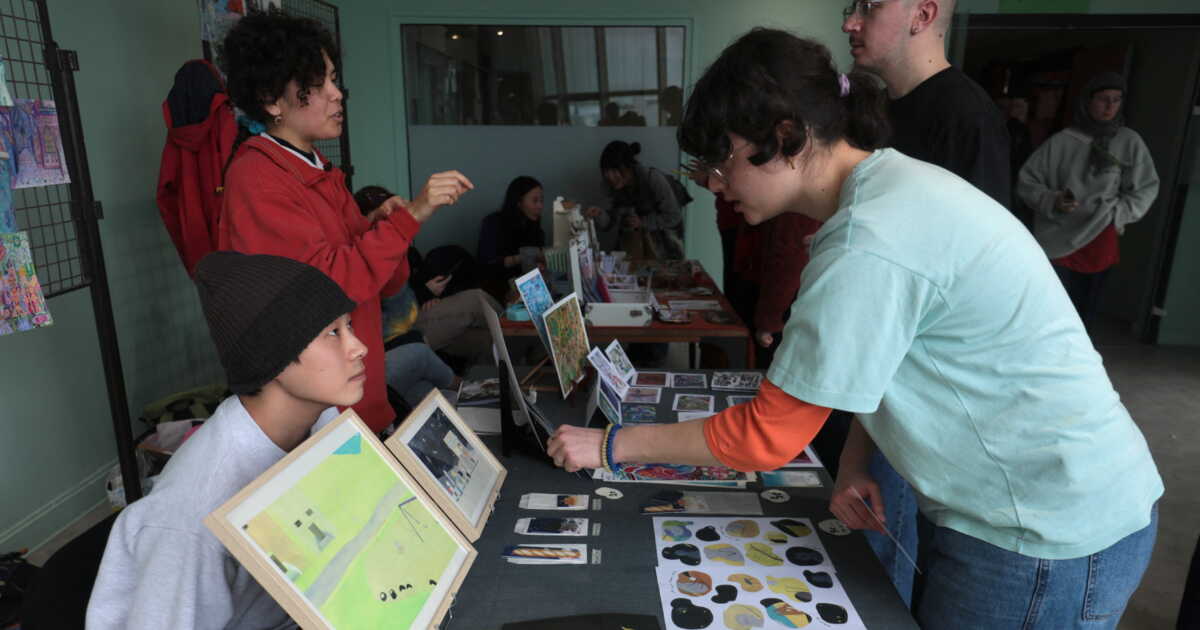
A fanzine fair showcasing a wide range of these handmade magazines in varying sizes and formats has drawn a large crowd in Tokyo.
“AI and social networks are guided by algorithms that only show us what we want to see or what suits us best. But the fact that so many zine creators are taking part in this fair suggests that there are many other visions of the world”, cheers Harumi Kikuchi, a 22-year-old attendee.
The creator Watashi Kishino, who hand-draws her daily life in black-and-white illustrations, concedes that one can “do a lot with AI and digital technology”. “But I also think there is a charm to holding something in your hands”, she says as she displays her works.
Major bookstores are also embracing the trend. Sanseido, a 145-year-old Tokyo bookstore located in the Jimbocho book district, began placing self-published journals on its shelves almost a year ago. “Zines can appeal to an audience different from that of traditional readers,” explains AFP to Masato Sugiura, deputy director of the sales promotion department.
Watashi Kishino believes in the staying power of physical books and magazines despite the digital era. “There is a warmth that only paper can offer,” she says.
For a long time kept off the main European tourist routes, Poland reveals a remarkable heritage and landscapes of surprising diversity. From history-soaked cities to the wide natural expanses of the northeast, the country lends itself to both cultural getaways and refreshing outdoor breaks.
1. A Dive into Kraków’s History
Exploring Kraków allows you to trace the foundations of Polish history through its monuments, its medieval atmosphere, and its role as the country’s historic capital. The Old Town houses an exceptionally dense concentration of must-see monuments, including the Wawel Royal Castle and the emblematic Gothic cathedrals of the medieval era, making it a central segment of any culturally oriented trip to Poland.
Nearby, the Wieliczka Salt Mine represents another facet of this heritage, as does the former Jewish ghetto—a landmark to pair with a visit to Auschwitz. All of this forms an essential part of Poland holidays, enriched by approachable local cuisine and often affordable prices. Kraków thus embodies a coherent destination, built around memory, architecture, and the country’s diverse monuments.
2. Warsaw, a Capital with a Thousand Faces
Warsaw, a modern and resilient capital, houses monuments from different eras, symbols of a troubled yet rebuilt history. The Old Town, UNESCO-listed, faithfully mirrors the medieval atmosphere, even though it was rebuilt after the war. Among the buildings to visit are the Wilanów Palace and the visible remnants of the former Jewish ghetto, key elements for grasping the city’s memory.
Incorporating a stroll through the beautiful Łazienki Park botanical gardens or following a guided route through the museums of Wrocław or Warsaw helps structure a substantial portion of the stay. Taken together, these create a core segment of the many essential historical sites on a Poland trip, blending urban discovery, memory transmission, and cultural practices. With reasonable prices for transport or accommodation, Warsaw remains accessible even in peak season.
3. Getting Lost in the Białowieża Forest
The Białowieża Forest, designated a biosphere reserve, represents a unique part of Poland’s natural heritage. A true relic of Europe’s primeval forest, it offers a rare ambiance for guided strolls within an intact ecosystem. This protected area, spanning several square kilometers, is home to the last European bison and provides an unforgettable experience for visitors attentive to conservation.
Accessible on foot and guided by professionals, the forest walk doubles as an educational experience on conservation, endemic species, and contemporary threats. Integrated into a personalized itinerary focused on natural areas, this destination complements other cultural sites, enabling a Poland trip that balances heritage and biodiversity.
4. Gdańsk and Its Medieval Charms
Gdańsk, located on the Baltic Sea, is a city with a rich commercial and political past, home to many must-see monuments in Gdańsk and part of a structured Polish holiday circuit. The royal castle, Gothic-style buildings, the narrow streets of the Old Town, and museums tied to the Solidarity movement reflect a dense urban history.
On the outskirts, the towns of Sopot and Gdynia offer coastal extensions, with nautical activities and nature experiences in a kid-friendly atmosphere during the summer. Linked to the country’s monuments, the region allows for pairing seaside relaxation with historical exploration. Gdańsk thus stands as a coherent part of a northern cultural and seaside itinerary, enriched by a sea stroll, attractive prices and a strong sense of memory.
5. The Wieliczka Salt Mines, a World Beneath Our Feet
The Wieliczka Salt Mines, famed for their impressive salt monuments, form part of the many underground sites listed as world heritage. A few kilometers from Kraków, this subterranean network welcomes visitors in a unique atmosphere, blending history, engineering, and spirituality. Among the most iconic spaces are chapels and sculptures carved from salt, illustrating the miners’ craftsmanship.
With reasonable prices for guided tours, the site is aimed at families or school groups, with a well-supervised kids-friendly ambiance. Accessible for a multi-hour underground stroll, Wieliczka offers an unforgettable experience that fits perfectly into any Poland itinerary focused on the country’s industrial and artisanal heritage.
6. The Charms of Masuria
The Masuria, in the northeast, embodies a major lake region, often named the “land of a thousand majestic lakes,” ideal for boating or walks in the surrounding massif. Perfect for Poland holidays centered on nature and relaxation, it enables gentle activities such as fishing, sailing, or birdwatching in a tranquil atmosphere.
Thanks to a network of villages, the cost of a bus trip or a car rental stays affordable, facilitating exploration of a part of the country that remains relatively lightly urbanized. The calm of its rivers, the reflections on its waters, and the diversity of its fauna make Masuria an ideal area for respectful tourism, away from crowds, especially outside the peak season.
7. The Trails of Zakopane and the Tatras
Nestled at the foot of the Tatras, the town of offers an immersion into Polish highland traditions, combining mountain walks, local folklore, and active Poland holidays. Nearby, the Morskie Oko Lake, at an altitude of over 1,300 meters, stands as a major site for a walk to Morskie Lake, highly frequented in high season for its panoramas.
The Tatra National Park, an integral part of the region, offers regulated access to alpine landscapes and protected wildlife. The local cuisine, artisan markets, and the mountain ambiance give Zakopane a strong identity, ideal for days of real downtime.
Is Poland a Good Idea? A European Destination Between History, Accessibility and Cultural Vitality
Asking whether it makes sense to visit Poland means weighing the advantages of a country that remains underestimated in the European tourism scene. A member of the European Union, with a modern transport network and a dense cultural offering, the country attracts with the richness of its cities—from Kraków to Gdańsk—and the variety of its landscapes. It is also an economically accessible destination, with excellent value for money in lodging, dining, and activities.
In terms of tourism, Poland is still perceived as safe, stable, and well-structured to welcome international visitors. Far from the clichés, it offers a modern experience rooted in its heritage, driven by a strong identity and a growing openness.
What Do People in Poland Like to Do? Daily Life Anchored in Sociability, Nature, and Traditions
Understanding what Poles enjoy doing helps approach a culture deeply attached to communal life and seasonal rhythms. Forest walks, very common, reflect a constant tie to nature, ever-present in the country’s geography.
In urban areas, people frequent cafes, markets, and parks, especially in Warsaw or Wrocław, where public spaces play a central role in sociability. Regular hiking, cycling, or winter sports in the Carpathians also show an active relationship with the land.
Alongside this, there is a strong attachment to religious fêtes, culinary traditions, and family gatherings. Observing daily life here means grasping a culture that is both understated and profoundly vibrant.
What to Do in Poland in Winter? A Country to Rediscover Under Snow and Seasonal Lights
Visiting Poland in winter reveals a lesser-known facet of the country, marked by a hushed atmosphere and striking seasonal aesthetics. Christmas markets, especially in Kraków or Wrocław, offer a warm immersion into local traditions.
In the south, the Tatra Mountains near Zakopane allow skiing, snowshoeing, and thermal baths, with infrastructure suited to all levels. The major cities maintain a rich cultural life: museums, concerts, literary cafés, all within an intimate atmosphere. Polish winter, far from deterring, gives a new sense to discovery, blending heritage, indoor comfort, and stillness in nature.
Poland Travel Safety: What You Need to Know to Travel with Peace of Mind
The question of tourism-related danger in Poland rarely arises, given the country’s recognized political, social, and health stability on a European scale. Safety levels are high in tourist zones such as Warsaw, Kraków, and Gdańsk, with a visible police presence and a low crime rate.
Incidents involving travelers are rare and typically relate to minor acts such as opportunistic theft on public transport. Medical facilities are modern, food standards are high, and tour operators are well trained.
In short, Poland is a safe destination, provided you follow the elementary precautions applicable to any major Central European city.
This article was written with the help of artificial intelligence, then corrected, expanded, and validated by the editors.
An inexperienced eye might dismiss it as a plain nettle. Not at all! “It’s a magnificent purple dead-nettle. Once cooked, it has a subtle taste of spinach and mushroom. A delight!” exclaims Christophe de Hody, our guide, waving a plant speckled with violet blossoms. Gathered around the bearded quadra in a khaki jacket, about twenty people nod in agreement, focused. Each scribbles in their little notebook, pulls out their smartphone, the botanist’s loupe. We are not in the countryside, nor in the mountains… But just a few hundred meters from the Paris ring road, at the Bois de Vincennes.
But what could possibly push all these people to rise on a Sunday to play amateur foragers, when others go for a jog or walk their dog? “I think the primary motivation of all these people is to regain direct contact with nature”, replies Christophe de Hody. For fourteen years, the founder of the Chemin de la Nature and his colleagues have ridden the wave by offering year‑round walks and courses “inÎle-de-France, but also in many regions of the hexagon as well as in Switzerland”. “I signed up after watching his videos”, whispers Alison, 35. This short-haired brunette came all the way from Brussels.
The naturopath, herbalist and field botanist has also become an influencer
It must be said that with 520,000 followers on YouTube, 827,000 on Facebook, and 262,000 on TikTok, the naturopath, herbalist and field botanist has also become an influencer who commands a growing community of curious people. While one might expect an audience of retirees, surprise! Among the 22 foragers in our Sunday group, the ages span from Alma, six and a half, who came with her Parisian mother, to Hubert, 74, from Rouen, who was in the capital for the weekend. “Each time, the profiles are very varied”, confirms Christophe.
In the wake of the Chemin de la Nature and its well‑supervised foraging outings in Vincennes, Saint-Cloud or the Buttes-Chaumont (30 euros for a 2h30 tour, 50 euros for the half‑day), dozens of companies have sprouted up like mushrooms, all aiming to offer city dwellers a breath of fresh air and the prospect of an adventure right at the end of the street. The online platform Wecandoo, which since 2017 catalogs activities and workshops organized by artisans, has seen, over ten years, the number of such city‑on‑the‑edge strolls soar, around the Paris region, but also near Nantes, Bordeaux or Lyon. Among the offerings: “Pick Your Mushrooms”, “Discover Edible Wild Plants”, “Create Your Herbal Tea from the Field”…
Large groups have also spotted the opportunity. Like the equipment supplier Decathlon, which on its travel platform offers around fifty courses labeled “bushcraft” (the English term for the art of surviving in the woods) that emphasize, between building a makeshift shelter and ways to navigate in the forest, foraging for wild edibles. A program aimed at a much broader audience than survivalists, who advocate autonomy and self‑reliance in the face of a potential societal collapse. Meeting during a forest outing in Vincennes, Timothée, 37, a trekking enthusiast and an IT executive in Luxembourg, who doesn’t want to be grouped with the more extreme fringe preparing for the apocalypse, confirms: “Better understanding how to use nature’s resources to reconnect with the wild is what pushed me to sign up.”
Reconnecting with nature in the face of climate change
“There is probably alsoan undercurrent of ecological anxiety in this craze for edible wild foraging, admits Natalia Santos Amado. But I think, deeper still, what interests people is to reconnect with skills we have lost.”
This Colombian native, trained as an ethnologist, recalls holidays as a child with her maternal grandparents, farmers in the Santander department in northern Colombia. “My grandmother knew every plant on the tip of her fingers.” Decades later, the young woman studies the forgotten medicinal uses of coca leaves among Indigenous tribes. She then ran the Lula organic and vegetarian restaurant in Paris for seven years. After the Covid crisis, the establishment closed. She trained with Chemin de la Nature, joined their teams, before founding her own organization, Caucalis, in 2022, through which she offers workshops that mix foraging and cooking open to all.
A way to reinvigorate the lifestyle of our ancient hunter‑gatherer ancestors by making nature into a pantry?“Today, the principle of wild foraging is not about aiming for subsistence; that would be illusory. It’s more about reintroducing into cooking a few elements we have gathered ourselves”, corrects Natalia. She emphasizes the importance of taking only what is necessary. At the Bois de Boulogne, there used to be a place where wild garlic thrived. “When I passed by last time, I saw that everything had been picked clean, the bulbs trampled… It’s the exact opposite of the spirit of wild foraging”, she laments.
Foraging is part of the daily life of city dwellers in Denmark
The regulatory framework, to say the least, is blurry, and controls are almost non-existent. But the implicit rule for the forager is: “You should collect only up to 30% of what’s available”, explains Clotaire Poirier. The Top Chef finalist in 2024 spent three years in Copenhagen, cooking at the two‑Michelin‑star restaurant Kadeau. “In Denmark, the practice of wild foraging is far more widespread than in France”, adds the 35‑year‑old chef. On his smartphone’s home screen sits a Danish app. The brilliant collaborative map, Vild Mad, lets everyone list spots they’ve found and when to harvest what. “In Copenhagen the city is cleaner than in Paris. There is also incredible biodiversity in the parks… People pick wild strawberries, blueberries… In France, renewed urban interest in this practice gradually emerged, he analyzes, after seeing chefs on TV or on social media taking part.”
His colleague Jacky Ribault, at the helm of L’Ours (one star, just steps from the Bois de Vincennes) tempers the enthusiasm for edible foraging in peri‑urban environments. At least, for professionals. Dog excrement (even human ones), cigarette butts… This chef with rural roots prefers to avoid, for sanitary reasons, serving what one could gather in the nearby woods. If Sunday foragers don’t need to follow the same rules as restaurants, Natalia Santos Amado recalls a few common‑sense rules: “You must gather at least 50 meters away from roads, far from railway lines.” In an environment as frequented as the Bois de Vincennes, the guide advises harvesting “50 cm above ground, and ideally the first leaves, to avoid contamination by excrement or urine, vectors of pathogenic microorganisms”.
Knowing how to identify plants
Above all, as she emphasizes at the outset of every outing, “before harvesting to eat it, you must be 100% sure you have correctly identified the plant”. In France, among 8,000 species, “around 20,000 edible plants grow in the wild”. Not counting mushrooms, and excluding plants with mild toxicity, there would be about fifty species potentially deadly if ingested. “Knowing how to identify plants helps break the fear we have of nature”, she notes. It is also the best way to reconnect with our natural environment, “and to democratize access to these plants, which are available to everyone, not just to chefs”.
At the end of the workshop, the participants, each having paid 75 euros, taste together the various preparations. The root of butterbur, with a fruity and sharp taste, can be eaten steamed or puréed. The field sow‑thistle (thistle) tastes somewhat like artichoke. But the real star of this early spring is the young nettles, which, in addition to being cooked in all sorts of ways—sweet fritters, or savory, minced into dumplings with parmesan and nutmeg—also boast, one learns, an impressive protein content (40%).
And if the true virtue of wild plants did not lie in their gustatory value or their nutritional properties, but rather in the pretext they give us to take to the fields? “Gathering, above all, is a way to enjoy very beautiful walks”, confirms Natalia. Leaning toward the ground in search of a hypothetical mushroom, peering at tree trunks to spot lichens, parting the branches of a bush to see what lies behind… It’s also a way to walk “actively,” being attentive and making nature something more than mere scenery.
A new look at the city
Among the walks Natalia likes to offer her clients, there is one whose main objective is neither to gather nor to cook, but to observe. It happens just a few steps from the Porte de Charenton, along a stretch of the Petite Ceinture, the old disused railway that once surrounded Paris. There, the wild grasses have overtaken the rails. Grasses, couch grass, and the entire procession of wildflowers (ragwort, dandelion, parietary…) mingle with elder bushes and hawthorn copses.
There are places like this near every major urban center in France, within easy reach on foot, by metro, or by regional train. Walking there with a basket guarantees you’ll see them with different eyes. If you return with a handful of wild garlic, or a few wild mushrooms, that’s the cherry on top of the omelette. And if you come back with an empty basket, that’s perfectly fine too.
➤ Article published in GEO HS magazine no. 133, “France, our favorite walks for the summer”, June–July 2026.
➤ Do you like GEO? Then to never miss anything, discover our subscription options to receive GEO at home every month with ease.
In Jericó, nestled in the coffee-growing region of southwest Antioquia in Colombia, the streets rise almost vertically between vividly colored houses. This southwestern city in the Antioquia region is the cradle of one of Colombia’s most cherished accessories: the paisa carriel, a small leather accordion-fold bag.
On the corner of a sloping street, behind a white and red façade, the workshop “Carrielarte Jericó” catches the eye. Inside, pale walls contrast with the long strips of leather hanging. Under the neon lights, Rubén works bent over his bench, a brown apron tied across his chest, his face focused on a piece of hide. Around him, the scent of leather tells the story of the muleteers who crossed the mountains.
“Welcome to the guarnielería”, Rubén says without lifting his eyes from his work. “This is where we manufacture the typical guarniel of the Paisa region, which newer generations now call a carriel”. Beside him, Cathy, a local guide and founder of the Kaanas Travel agency, adds, “The word “carriel” comes from the English carry-all, which means “everything-carrier.” But for artisans like Rubén, the real name remains guarniel. That is why he does not consider himself a mere leatherworker, but a guarnielero”.
L’atelier Carrielarte Jericó existe depuis plus de 76 ans.
An Accordion Bag with Multiple Pockets
In the workshop, Rubén demonstrates the various pieces laid out on the table. “A carriel is a 116-piece leather puzzle”. On some models, red and yellow accents appear in the stitching. “Those colors are the ones on Jericó’s flag”, Rubén specifies before adding “nothing here is chosen at random”.
He then slowly opens a finished model. Inside appear the famous secret pockets. “Traditionally, there are twelve”, he explains. “In the days of the arrieros (the muleteers), these pockets were essential. Men carried their entire lives in them.”
Cathy then takes over to describe the usefulness of this object. ” muleteers sometimes spent months in the mountains. They had a reinforced pocket for a revolver or a knife, needles and thread to repair coffee bags, a mirror, a candle for caves, tobacco, dice for playing, family photos, and even images of protective saints”.
Traditionnally, there are twelve secret pockets in a carriel
The shaggy foal leather that covers the front of the carriel immediately catches visitors’ attention. Cathy explains that this aspect comes from a very old tradition. “In the past, artisans used skins of wild animals such as jaguar or ocelot. Today, these species are protected. Artisans now work only with cowhide, but they have kept this hairy texture which has become the carriel’s signature.”
How artisans adapt the carriel to today’s needs
In one corner of the workshop, several sizes are lined up on shelves, from the smallest to the largest. “There are sixteen different sizes,” Rubén explains. “The smallest is called the Chichigua. It’s made for babies who are starting to walk, so they can already carry the identity of their region.”
“For years, it was a very macho world,” Rubén acknowledges. But about 82 years ago, artisan Gildardo Uribe created the first carriel with an oval shape designed for women. This marked a shift in this craft. Since 2012, Rubén’s daughters, Alejandra and Carolina, have become the first women in their lineage to work officially as leather artisans in the family workshop.
The business has existed for more than seventy-six years and has received three national craft medals. Yet despite this recognition, the trade remains fragile. “In some regions, it has disappeared completely,” Rubén explains. Some artisans have even lost the old traditional models. The Jericó workshop participates in rebuilding this know-how, as in San Pedro de los Milagros, for example, to revive production there.
The modern world has also transformed the use of the carriel, and artisans have had to adapt. Today they also produce contemporary backpacks, thermos holders, and laptop bags, while preserving the ancient guarniel techniques.
*This report was made possible by ProColombia within the TRECC project (Responsible, Community, and Cultural Tourism), which allowed us to discover “The country of beauty”.
As heat waves become more frequent in Europe, many vacationers rethink their summer plans. Rather than chasing sun at any price, they now favor destinations where temperatures stay pleasant even in the height of summer. This trend, dubbed “coolcation,” favors maritime, mountainous, or Nordic regions. From the Anglo-Norman islands to the vast Nordic expanses, several areas stand out as preferred refuges for a cool vacation.
Islands and Coasts Betting on Cool Temperatures
Just a few tens of kilometers from the French coast, Jersey and Guernsey offer an immediate sense of escape without requiring a long journey. Thanks to the influence of the English Channel, temperatures generally remain mild during the summer. Jersey particularly charms with the diversity of its landscapes: long sandy beaches, sheer cliffs, natural swimming pools revealed at low tide, and small fishing harbors compose a setting conducive to outdoor activities. Surfing, stand-up paddleboarding, kayaking, or coastal hiking allow visitors to fully enjoy an environment where the ocean is ever-present.
The Guernsey archipelago, which also includes Herm, Sark, and Alderney, attracts travelers seeking calm. Cliff-top trails offer spectacular views of the sea, while secluded coves and narrow country lanes invite you to slow your pace. The Anglo-Norman atmosphere, inherited from its distinct history, further enhances the sense of escape. A destination that notably charmed Victor Hugo in his time.
Further north, western Sweden constitutes another destination particularly suited to hot summers. Its vast archipelago, stretching along the Bohuslän coast, is dotted with fishing villages with colorful houses, rocky islets, and traditional ports. Summer temperatures are often cooler than those observed in southern Europe. Between cycling trips, boat excursions, swimming in often chilly seas, and sampling local seafood, the region offers a vacation style focused on nature and simplicity.
For those wishing to stay in France, Brittany remains a reliable choice. Thanks to its Atlantic-facing coastline, it generally escapes the intense heat that affects other regions of the country. Areas such as the Gulf of Morbihan, the Pink Granite Coast, or the environs of Lorient allow you to enjoy beaches, coastal trails, and nautical activities in conditions often more comfortable than in the Mediterranean.
Heading for the Mountains and the Great Northern Outdoors
The mountainous landscapes also serve as a coveted refuge during periods of heat. Nestled in the heart of the Austrian Alps, Innsbruck blends urban heritage with direct access to the mountains. From the city center, several ski lifts enable quick access to the surrounding summits. Travelers can thus alternate cultural visits, panoramic hikes, and breaks by alpine lakes where the air remains markedly cooler than in the lowlands.
In the Pyrenees, the Andorran town of Canillo captivates with its preserved environment. Surrounded by green valleys and mountain lakes, it offers an ideal setting for walkers, mountain bikers, and outdoor enthusiasts. The altitude helps maintain pleasant temperatures even during heat events affecting neighboring regions.
Ireland also ranks among the most popular destinations for fans of the “coolcation.” Temperatures there generally stay moderate throughout the summer, which fosters road trips across the island’s spectacular landscapes. Vertigo-inducing cliffs, lakes, mountains, coastal roads, and colorful villages compose a scenery particularly cherished by nature lovers. This mild climate makes it possible to multiply outdoor activities without suffering from intense heat.
Finally, it would be hard to speak of cool vacations without mentioning Iceland. With summer temperatures typically ranging between 10 and 15 °C, the Nordic island stands as one of the emblematic destinations of this new way of traveling. Monumental waterfalls, glaciers, volcanoes, black-sand beaches, fjords, and geothermal springs offer landscapes unique in Europe. A striking contrast to Mediterranean destinations, which explains travelers’ growing interest in a more breathable summer.