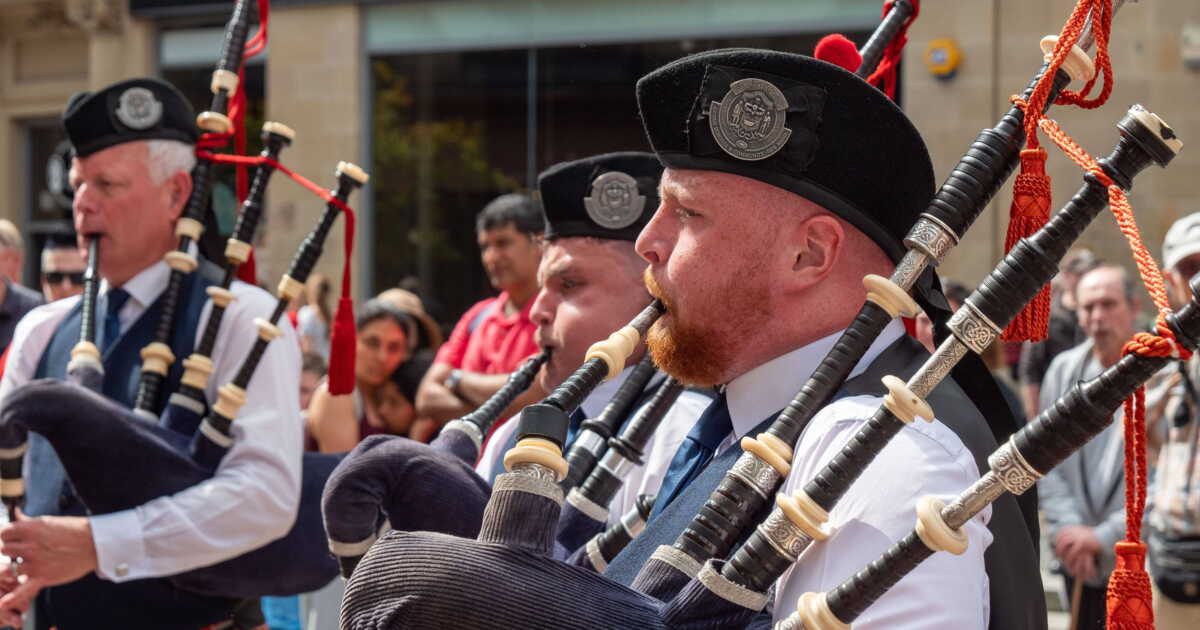
In Edinburgh’s Old Town, at the foot of the Royal Mile—the long thoroughfare linking the medieval castle to Holyrood Palace, the British monarch’s official residence in Scotland—St Mary’s Street unfolds 300 meters of uneven cobblestones, flanked by sparrow‑spout gables and colorful façades. A street where pubs, fish-and-chip counters, souvenir shops selling kilts, sporrans (traditional pouches) and Highlands tartans follow one another. At number 27, a dark storefront sometimes draws the eye as much as the ear: Kilberry Bagpipes is one of the country’s last workshops to craft bagpipes entirely by hand.
The vast majority of these instruments are indeed today cast in plastic resins and assembled on an assembly line. Only a handful of artisans keep the flame of custom work alive across Scotland, notably in the Lowlands. In Glasgow, R.G. Hardie & Co welcomes purists by appointment, and in Kilmarnock, McCallum Bagpipes offers very high-end models. At Kilberry, the pursuit of excellence verges on obsession: carved from the densest woods and fitted with pouches made from animal hide (goat or sheep) or Gore-Tex membranes, the instruments prized by the best players are compared without flinching to the violins of the illustrious Italian master luthier Stradivarius.
Between 1,750 and 6,000 euros
The master craftsman Dave Wardell, 73, is a quiet man who avoids the limelight. Watching him drill a fire‑hard wooden mouthpiece with surgical precision into African kingwood—an exceptionally dense wood, denser than ebony and humidity‑resistant— or adjust a reed to shape the instrument’s tone, is a privilege. Dave has been making bagpipes for more than half a century. He learned everything on the job, leaving school at 16 to apprentice with Hugh MacPherson, a legend of the craft.
Excellence has a price, one he must bear: standing while he works, continually forcing his hands to shape woods of extraordinary hardness and sharpening his gouges every hour, Dave suffers from serious nerve injuries in his left arm. In his lair in the old town, every instrument is handmade to order, from the first cut of the blade to the final finishing touches. The operation lasts five days.
A basic model retails for around 1,750 euros, while an exceptional piece adorned with solid silver and engraving can exceed 6,000 euros. And with a fully booked order book, clients face up to two years of waiting. In Scotland, to declare— even after a pint in a pub in Edinburgh, Glasgow or Inverness—that the bagpipe did not originate on these lands—risks drawing some raised eyebrows. And yet! In 400 B.C., the Theban musicians were blowing through bone pipes linked to a dog’s skin, and Emperor Nero himself boasted of playing in Rome. It is perhaps the Roman legions, advancing from the first century to the northern reaches of Great Britain, that introduced their ascaules, ancestors of this biniou with its distinctive sound, onto the land of the Picts. But it is in Scotland that the instrument became a weapon of psychological warfare.
In the fourteenth century, its bold cry resounded across battlefields: in 1314, the drone of the bagpipes unleashed Robert Bruce’s forces against the English at the Battle of Bannockburn. Inspiring the clans and terrifying the foe, the piercing sound has crossed eras: in 1815 at Waterloo, the piper Kenneth Mackay strode out of the British squares to taunt the French dragoons, and a century later, on June 6, 1944, the young Bill Millin landed on Sword Beach in a kilt, playing beneath German gunfire.
The Piper of D-Day
On Sword Beach, at Colleville-Montgomery (Calvados), the statue of Bill Millin stands with his kilt billowing, facing the enemy. After the mass casualties of 1914–1918, the tradition of pipers leading troops into battle had been banned in the British Army. But on June 6, 1944, by order of his commander, the 21‑year‑old Scottish piper advanced under machine-gun fire, playing tunes such as and . German prisoners would later confess they hadn’t shot him, thinking him mad. “I didn’t even notice that I was being fired upon”, Bill recalled. After the war, he became a psychiatric nurse, continuing until his retirement in 1988. He died in 2010 at the age of 88, leaving one of his bagpipes to the Pegasus Memorial in Ranville.
The bagpipe is “not a fossil of folklore”
In Glasgow, the National Piping Centre safeguards this heritage. Housed in a former church just a stone’s throw from the city center, the building shelters the jewel of Scottish tradition: a 17th‑century chanter that belonged to Iain Dall MacKay (1656–1754), a famed blind bard from Talladale in the Highlands. The instrument is the sole relic of the golden age of pibroch, the “great music” of the Highlands.
Opened thirty years ago, this bagpipe temple is far from a dusty museum. In the former nave, now transformed into studios, the centre offers around a thousand lessons each month, both in person and remotely to students connected from around the world. It trains both children learning their first notes and students pursuing university diplomas. Between the restaurant The Pipers’ Tryst (featuring smoked salmon and haggis) and rehearsal rooms, youngsters in kilts mingle with virtuosos from around the world on a daily basis, enveloped by the constant thrum of the instruments.
Finlay MacDonald, the institution’s artistic director, is the piper and composer who embodies this bridge between past and present. “The bagpipe is not a fossil of folklore, but a living music that is constantly evolving,” he explains. “It shapes our national identity, and it goes far beyond that: it is a universal bond. The world continues to globalize, but nothing can replace the raw power of a live pipe band. That is why the breath will never go out.”
Every summer in August, Glasgow hosts Piping Live!, the world’s largest international bagpipe festival. For a week, the city becomes a vast open‑air sonic stage, opened by a grand parade in which more than 200 pipers march to the Kelvingrove Museum. Between competitions, avant‑garde projects and ceilidhs (traditional dances) improvised in pubs, the event showcases the World Pipe Championships. Some 100,000 enthusiasts descend on Glasgow Green, the city’s park: on the land of clans, the drone’s sound has not lost its force.
➤ Article appeared in GEO magazine no. 573, “Scotland, generous and proud,” November 2026.
➤ If you love GEO, discover our subscription options to receive GEO each month at home.