Five European Cities Not Yet Overrun by Tourists and Worth a Detour

Summer holidays may be over, but that is no reason to give up traveling. The journalists from The Guardian have compiled a list of five particularly pleasant European destinations that are still relatively under-visited by tourists from around the world. Ideal for a long weekend or a week of autumn break, for instance. The first destination is French and it is even the sixth-largest city in the country: Nantes. For the journalists of the British outlet, the Loire-Atlantique commune—which lies directly on the Loire—offers a form of escape that the other major French destinations do not.

A special note is made of the Carousel of the Marine Worlds and its Jules Verne-inspired machines, which you can ride for a few minutes. Art, anyway, has a prominent place in Nantes, especially in its contemporary forms. Just like history, notably represented by the Château des ducs de Bretagne or the Memorial to the Abolition of Slavery, Nantes having been one of the cities at the heart of the slave trade in the 18th and 19th centuries.

Spending time along riverbanks

Our neighbors also offer stunning landscapes to reveal to us. In Switzerland, people mostly know the Geneva region, that of Zurich, or the capital Bern. But Basel is less renowned. Yet this The “city of art and culture on the Rhine” offers sublime scenery around the river—where locals and visitors alike swim willingly. Basel also houses several design-focused museums, such as the Beyeler Foundation and the Vitra Design Museum.

Further north, you could be tempted by Lübeck, in Germany. Again, it is a port city that The Guardian invites us to discover. About 70 km from Hamburg, it is a medieval town, relatively spared from the bombings of World War II, that stands out. Therefore you should of course see the old town, on an island in the center of Lübeck, made of red bricks and streets so intricately woven they resemble a labyrinth. If you can, take the time to learn more about the place’s history by exploring the city’s history and art museums. Lübeck will also appeal to fans of Thomas Mann’s work, Buddenbrooks. It is there that the story of this family unfolds.

Travel ideas for Southern Europe in 2027

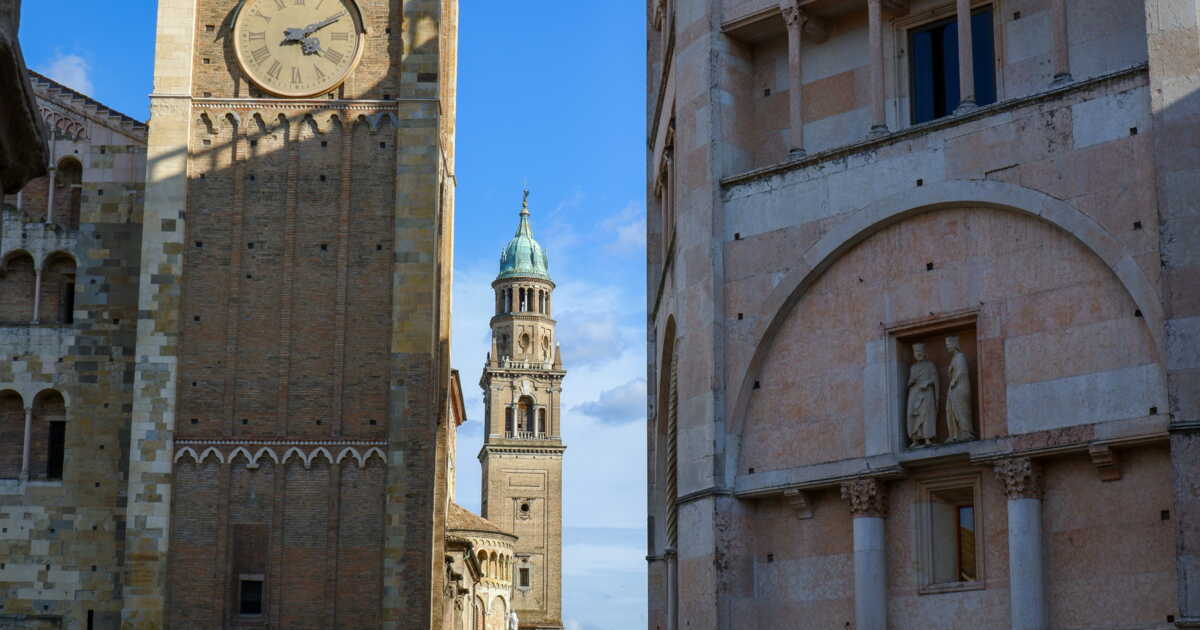
If you’re looking to head further south in Europe, The Guardian has also got you covered. And if, instead of Rome, Venice or Florence, you gave Parma a chance for your next Italian getaway? The city is reachable by train from Milan or Bologna, the food is divine yet affordable — including its famous ham — and everything can be explored on foot there. Here again, a river cuts the city in two. But on each bank there are treasures to discover, notably in the form of cathedrals and other Baroque buildings. The National Gallery of Parma, far less visited than other Italian art centers, is worth a look.

In Spain, finally, you may want to stop a few days in Santander, Cantabria. It lies only about 180 km from the French border and could become a new favored destination. Indeed, a new cultural center opened its doors on September 8: 1,000 works, including paintings by Goya, Velázquez, or Picasso, are now exhibited there. An extension of Madrid’s Reina Sofía Museum is also expected for 2027. All of it opens directly onto the Atlantic, and promises pleasant moments of relaxation.
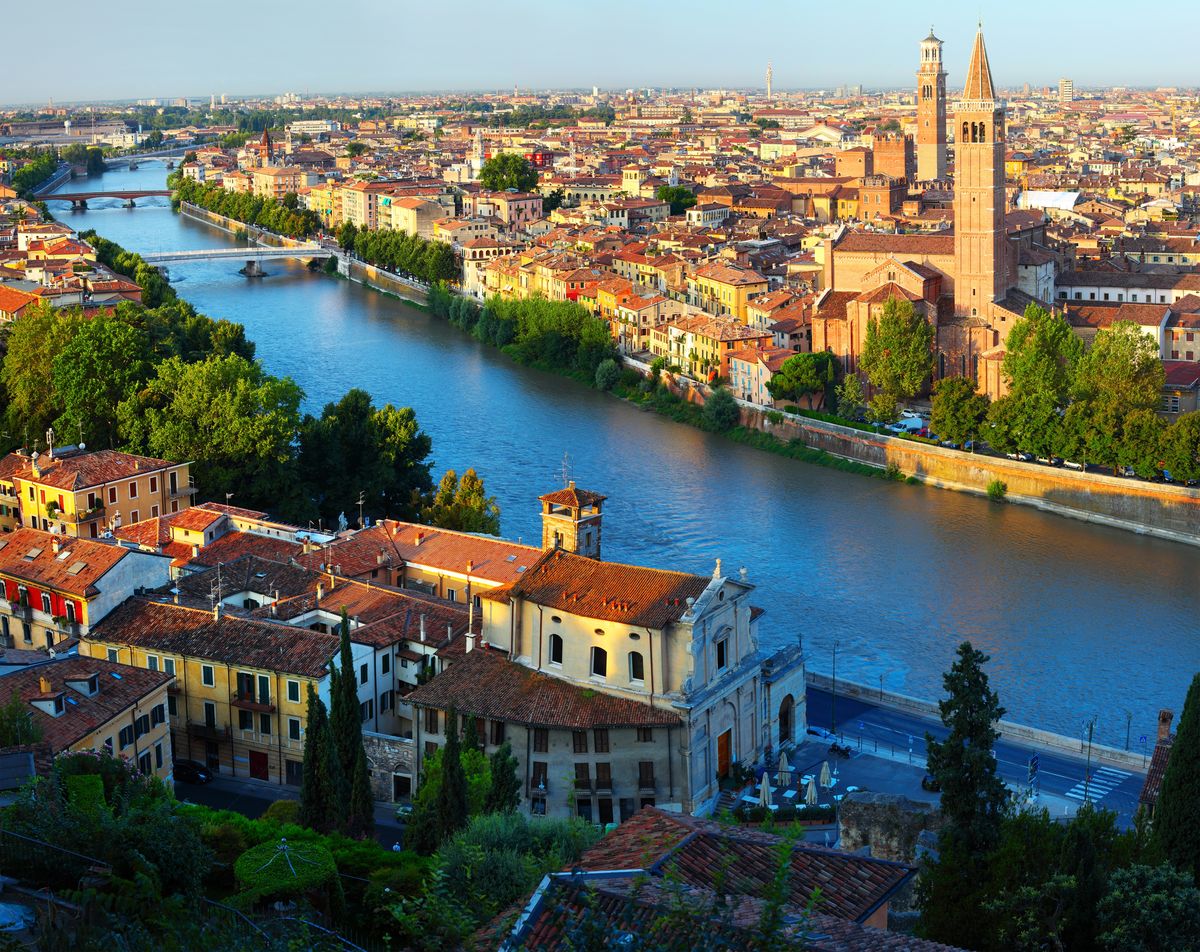
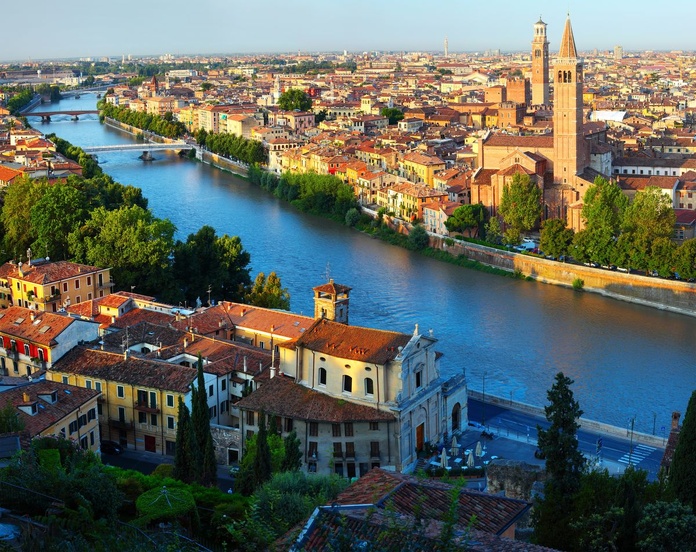
Italy: Verona Is Worth More Than the Romeo and Juliet Legend


Vue générale de Vérone. © Deposit Photos.

Hurtigruten


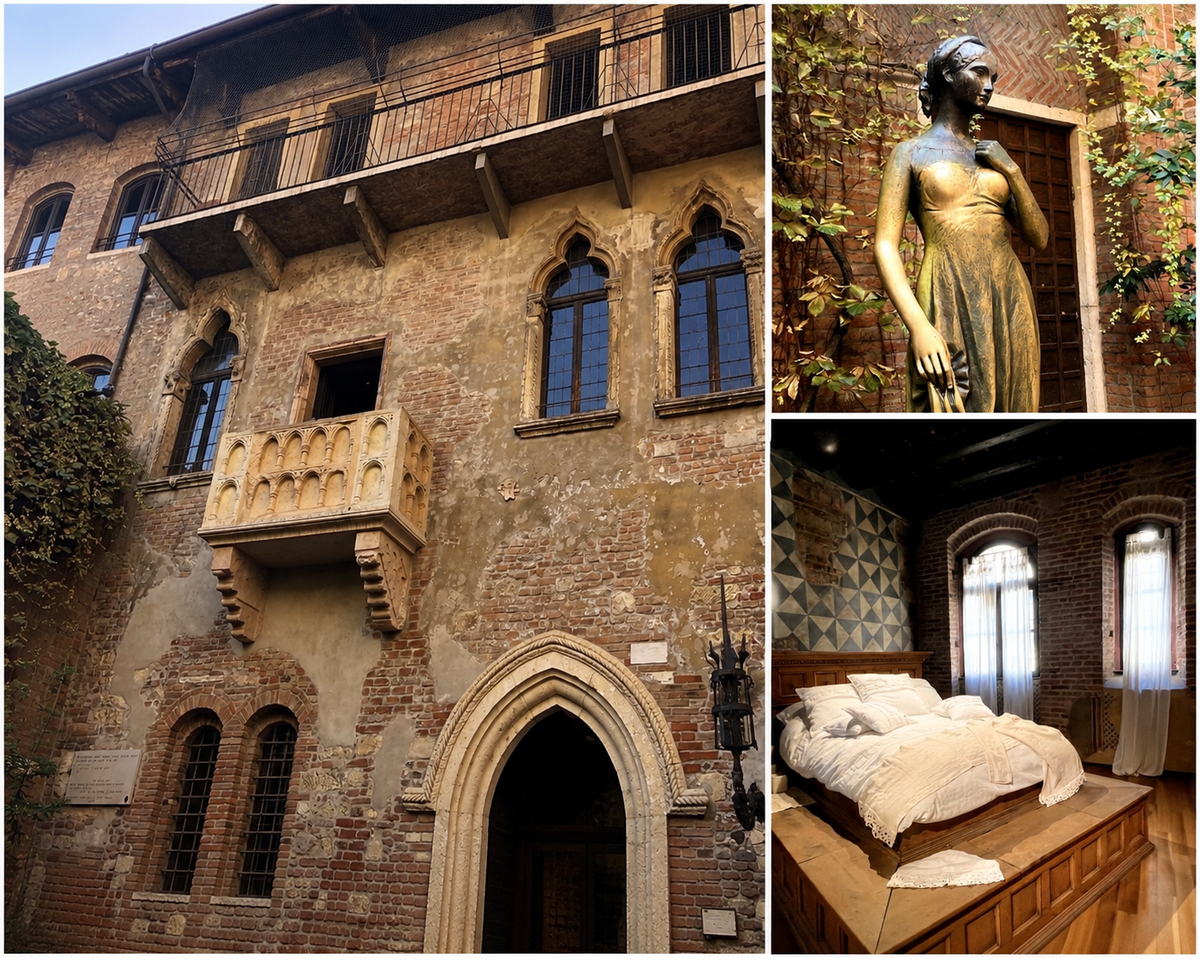
No. 23, Via Cappello is never quiet.

It is here that Juliet Capulet, Romeo Montague’s passionate lover, is believed to have lived, two Verona youths whose story ends in tragedy due to the hatred between their two families.

Poignant, this tragic love story is nevertheless fictional. The “Juliet’s House” is not much more authentic. Indeed, it is a 14th‑century Gothic dwelling, but the balcony Roméo is said to have climbed was added in the 20th century, as is the bronze statue of Juliet in the courtyard.

This does not stop tourists from flocking there, as the “Lovers of Verona” have been captivating figures since, in 1596—a couple of centuries after the alleged events—the English playwright William Shakespeare made them the heroes of one of his most famous plays.


A Legend in Solid Gold


La maison et son balcon rajouté au XXe siècle; la statue de Juliette ; dans le petit musée installé dans les étages, le lit des "amants de Vérone" utilisé en 1969 par Franco Zeffirelli pour son film Roméo et Juliette. Photos PB. Composition générée par IA.

This drama did not originate from Shakespeare’s imagination: the story reached him after nearly a century’s journey, across Italy, France, and England, and through the hands of at least five different writers.

It was a certain Luigi da Porto who, first (the date is 1531), placed the plot in Verona. Reading Dante’s Divine Comedy, he learned that the Renaissance poet explicitly cited the Montecchi (Montagues) and the Cappelletti (Capulets) to illustrate the political struggles between rival families that stained medieval Italy, Verona in particular.

It is from these history-laden names that Da Porto and, in his wake, Shakespeare wove this story which, after them, inspired numerous books, films and performances. As for the city of Verona, it leans into this legend to boost its tourist appeal…


Two thousand years of history


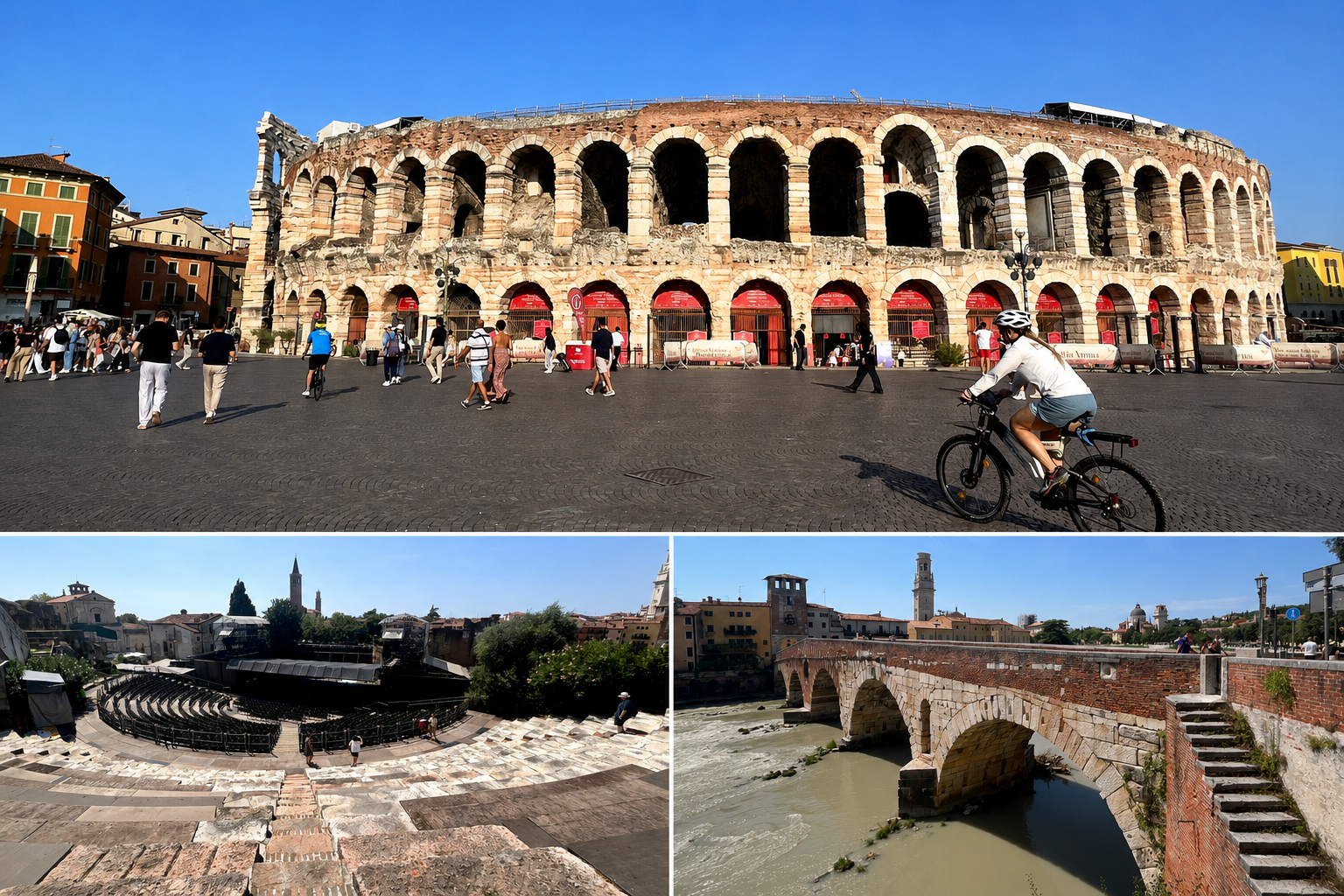
Les arènes de Verone. Le théâtre antique. Le pont romain qui enjambe l'Adige. Seules ses premières arches sont d'origine. Photos PB. Composition générée par IA.

Although Juliet’s House is almost obligatory on the itinerary (15 € entry, all the same), Verona deserves to be explored for many other reasons that make one regret the myth’s heavy prominence.

Indeed, in this Northern Italian city founded by the Romans over 2000 years ago, everything is beautiful: pink marble (sourced from Valpolicella, a region best known for its wines) and the bricks used for so many palaces, the colorful façades, the carved window and door frames, the ornate balconies, the fountains, the squares, the courtyards, the countless churches…

From its origins, Verona preserves many Roman remains, two gates, part of the ancient ramparts, its Ponte Pietra spanning the Adige river, and of course its ancient open-air theater perched against San Pietro hill: rediscovered in the 19th century after centuries of neglect, it hosts a Shakespeare Festival every July, while the contiguously located former monastery San Girolamo houses a rather interesting archaeological museum.

And then, on the imposing Piazza Bra, there are the Arenas which, every summer, draw in lyric artists and opera lovers from around the world.


Verona: the jewels of Piazza delle Erbe


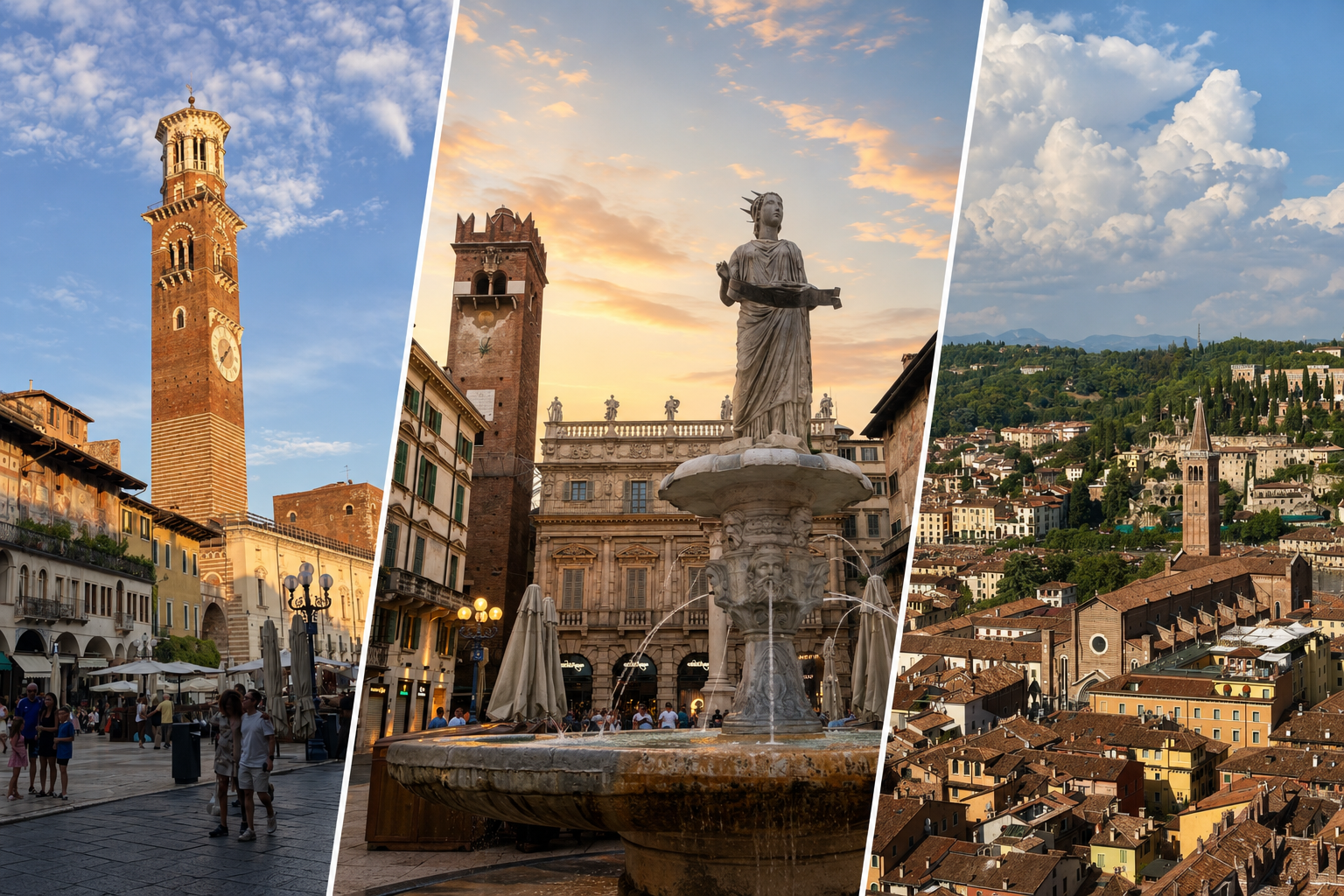
La tour des Lamberti. La place aux herbes, la fontaine Madonna et au fond, le palais Maffei. Vue des toits de Vérone depuis la tour des Lamberti. Photos PB. Composition générée par IA.

Verona today blends historic charm, cultural energy and the Italian art of living to perfection.

If, on Piazza Bra where the Arenas stand, you can admire a few palaces (Barbieri Palace, Gran Guardia Palace) before sitting under the arcades, on the prestigious Piazza delle Erbe you are spoilt for views, even though souvenir and ice cream vendors and fresh fruit stalls slightly spoil the perspective.

This square sits at the site of the ancient Roman forum and right at the intersection of the two main arteries that formed the grid of the ancient city: one axis, running east-west, connected Venice, Milan and France; the other, north-south, linked England to Rome and was long used by merchants from northern Europe.

A major commercial crossroads of northern Italy since antiquity, Verona remained so in the Middle Ages: witness the red-brick Domus Mercatorum, also called Casa dei Mercanti (House of Merchants), built in 1301 at a corner of Piazza delle Erbe.

This square is surrounded by so many magnificent historic buildings that you can almost get dizzy: Gardello Tower, completed in 1370, housing one of Europe’s oldest public clocks; right next to it, Maffei Palace, with a Baroque façade and a balustrade adorned with statues of Greek gods; then, the Mazzanti Houses decorated with splendid 16th-century frescoes; finally, Palazzo della Ragione (Palace of Reason, seat of medieval justice).

Adjacent to this palace rises the Tower erected by Verona’s wealthy noble family, the Lamberti. About 300 steps lead to its panoramic terrace (84 meters) from which the view over Verona’s rooftops is sublime. Don’t worry—the elevator is available!

In the middle of the square, the Madonna Verona fountain has displayed since 1368 its elegant red marble and its Roman statue.


At the Heart of the Medieval Struggles


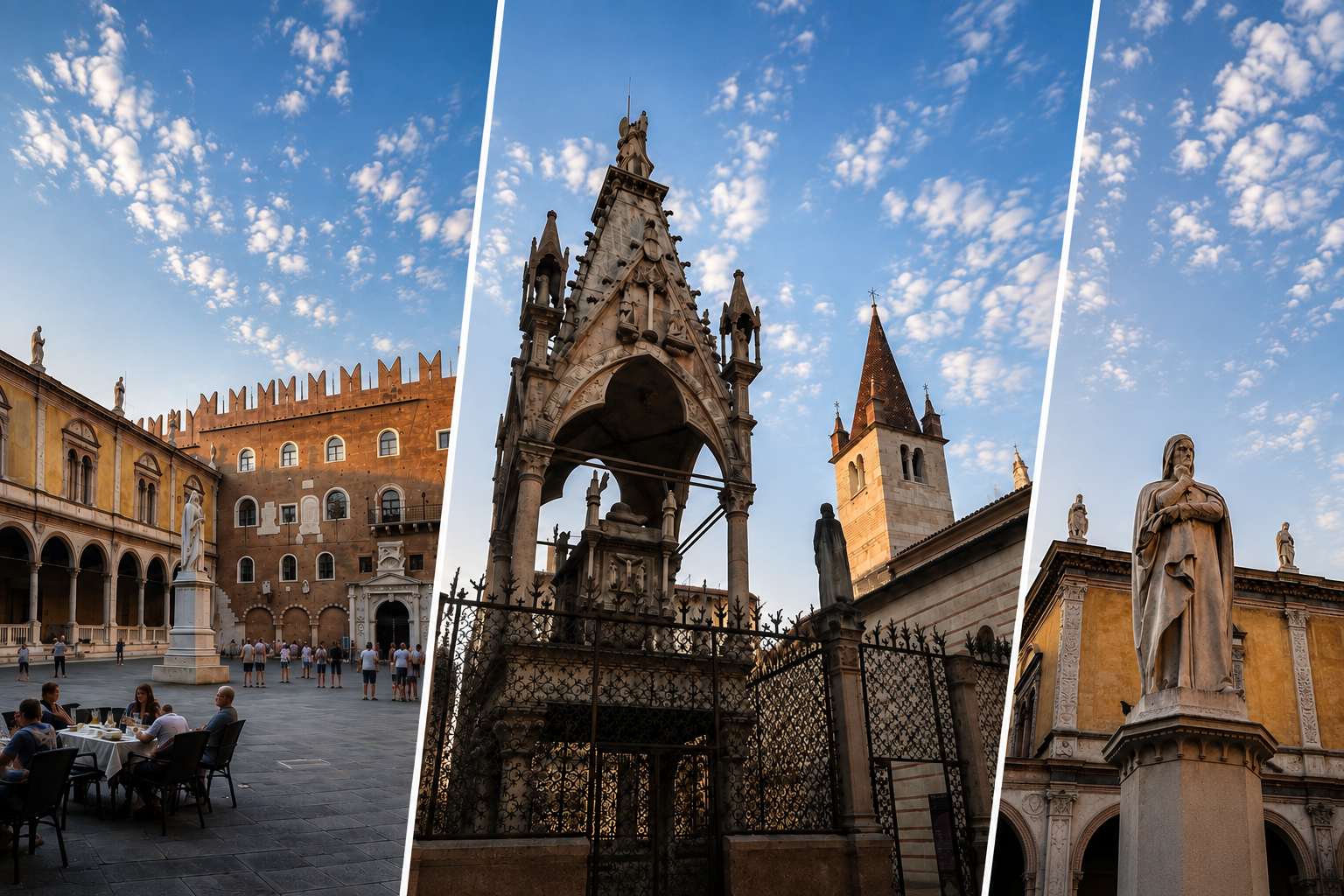
Place de la Seigneurie. Complexe funéraire gothique de la dynastie des Scaglieri. Statue de Dante Alighieri sur la place de la Seigneurie. Photos PB, composition générée par IA

Two steps from the Piazza delle Erbe, the Piazza della Signoria — the political heart of the medieval city — houses a statue of the poet Dante, who took refuge in Verona after his exile from Florence.

All around, elegant palaces — linked together by arcaded galleries and loggias — speak of the splendor of the past. Among them, the former Residence of Cangrande I della Scala, the most prestigious figure of the powerful Scaligeri family, who, after a merciless struggle, seized power in Verona in 1262 and made it a prosperous city.

After the Scaligeri lost power in 1387, Verona lived under other dominations, notably that of the Republic of Venice (hence the column bearing the Lion of Saint Mark on Piazza delle Erbe): begun in 1405, this period ended in 1797 with Napoleon Bonaparte’s occupation during his Italian Campaign, which led to Verona’s… alignment with Austria.

Just a few steps from the Piazza della Signoria, right beside Santa Maria Antica, a Gothic funeral complex leaves one astonished: lay in marble sarcophagi the principal figures of the Scaligeri dynasty. That of Cangrande I is topped by a magnificent equestrian statue!


Four churches not to miss


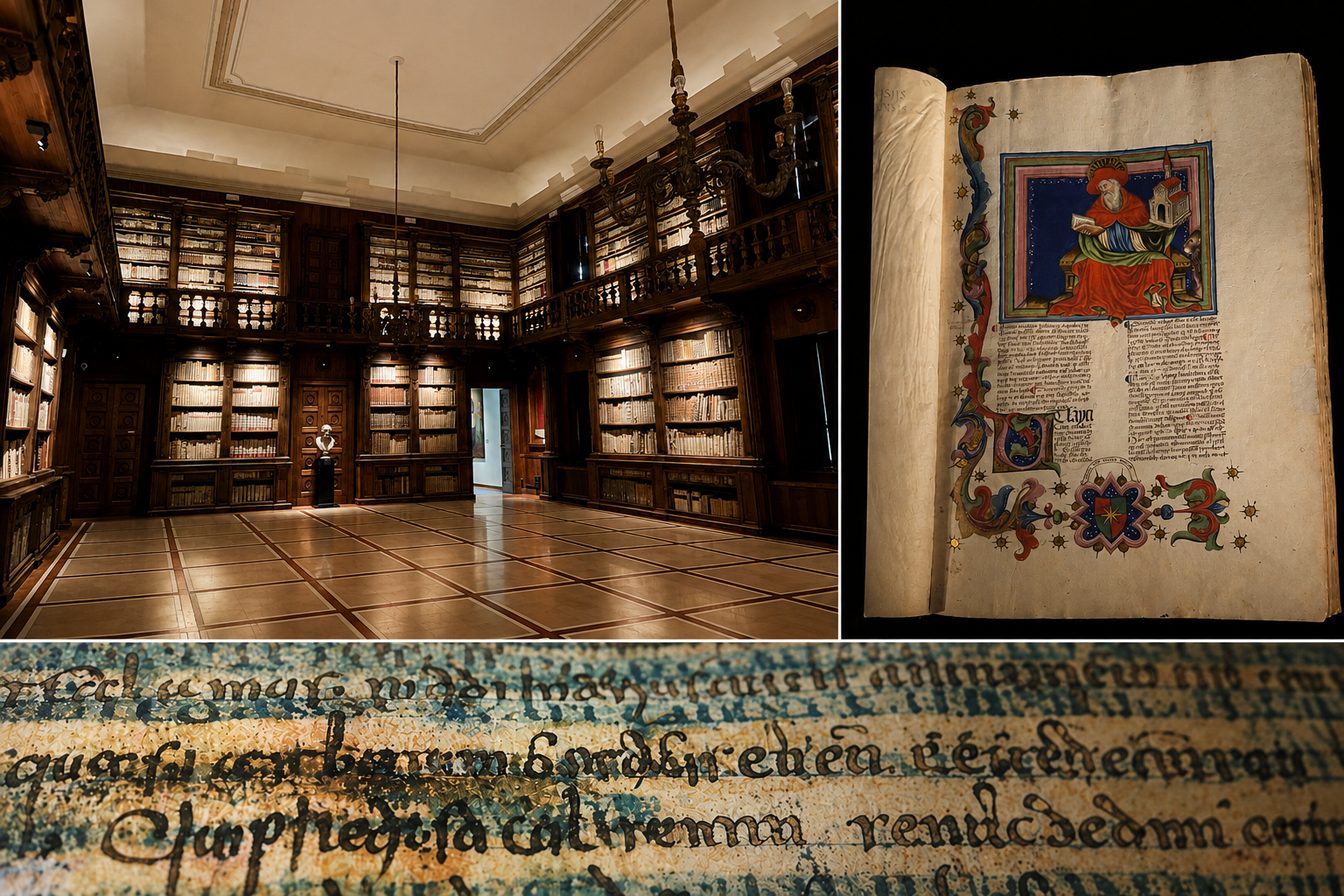
The Capitular Library, a genuine treasure


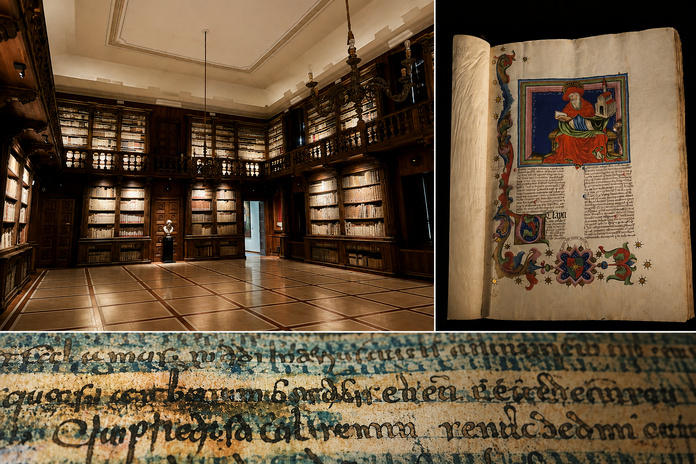
La salle principale de la Bibliothèque capitulaire. Liniature de Saint-Jérôme illustrant un manuscrit du XIVe. Détail (reproduction) du Palimpseste de Gaius. Photos PB. Composition générée par IA.

The most extraordinary jewel, nonetheless, is the Capitular Library, housed in the canonical palace just to the left of the Duomo!

Now managed by a Foundation, it was originally the study library of the Cathedral’s Chapter of canons.

“Founded 1600 years ago, it is, insists Valeria Nicolis, the conservator, the oldest library still in operation in the world”. It houses 700 rare works of art, 1200 manuscripts and 100,000 printed books, ancient and modern, spanning disciplines from theology and history to philosophy, literature, law, medicine, botany and astronomy. The main hall, with shelves from floor to ceiling, holds no fewer than 15,000 volumes.

Its most precious treasures are manuscripts, including major and unique pieces, notes Valeria Nicolis.

The oldest (the Codex Ursicinus) dates from 517! The Indovinello veronese is, itself, the oldest testimony of the transition between Latin and the vernacular Italian language. Finally, the Palimpsest of Gaius is the only text we have that attests to the foundations of classical Roman law.

No wonder scholars from around the world come to study there on site (possible since 2023)!

The general public, meanwhile, swoons over manuscripts adorned with delicate illuminations: some are displayed for a few weeks in hermetically sealed cases (temperature and humidity controlled), before a long return to the depths of the archives. Seeing originals is such a rarity!


A city terrifically alive


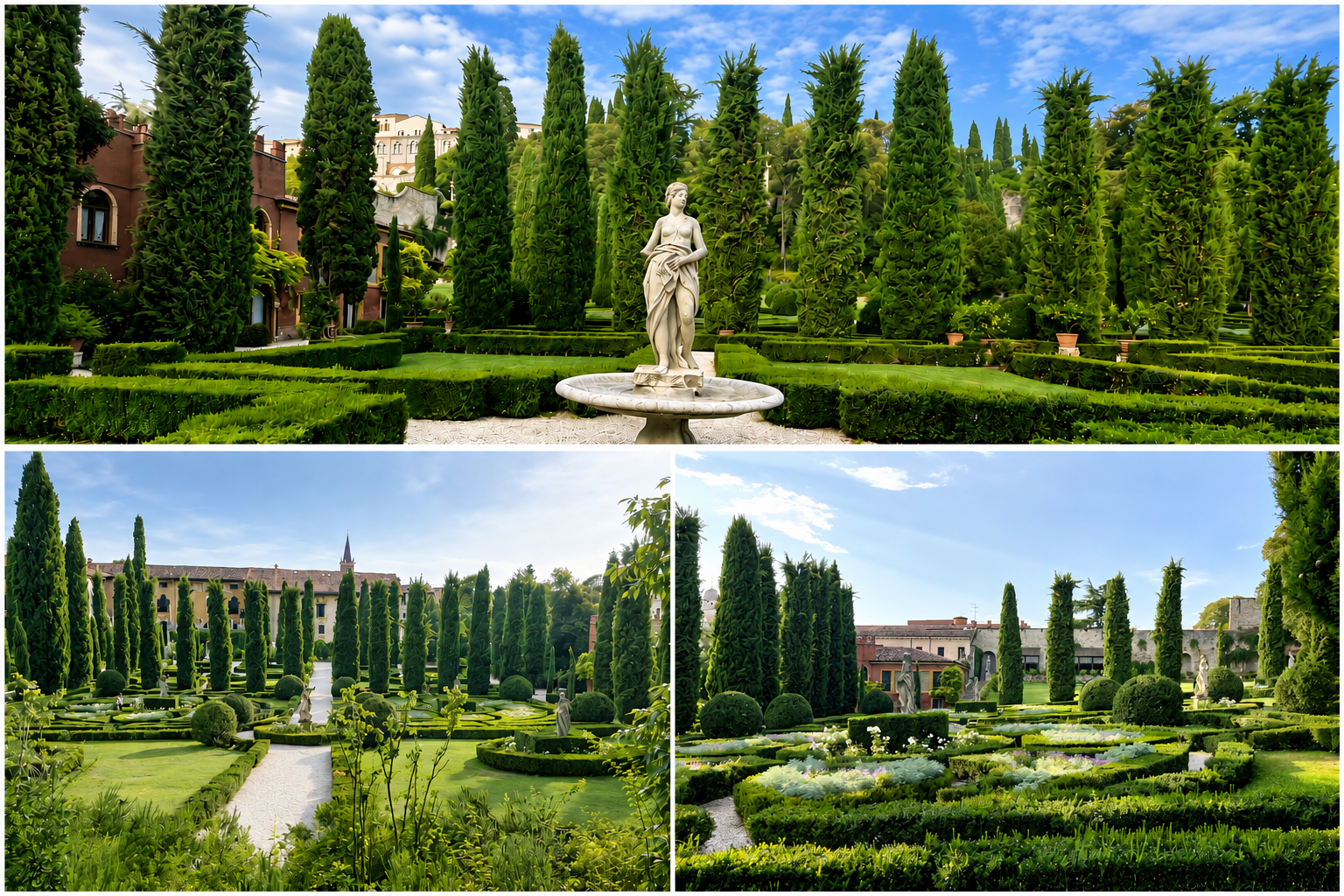
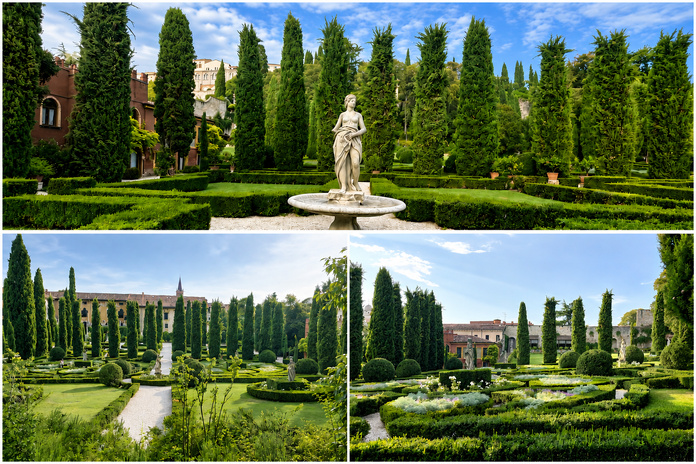
Créés au XVIe pour la famille Giusti, ces jardins en terrasse constituent l’un des exemples les plus aboutis de l’influence de la Renaissance italienne. Photos PB. Composition générée par IA.

Although all these marvels leave little room for doubt, Verona is above all a city where life is good, to stroll, to savor specialties (risotto all’Amarone soaked in wine, gnocchi, sweet Pandoro…), or simply to sip an espresso or a spritz on the numerous terraces of Piazza Bra and Piazza delle Erbe! Even shopping in the charming shops of Via Mazzini, Corso Porta Borsari or Via Rosa.

It is also pleasant to cross the Adige to explore, on its left bank, the Giusti Palace garden — one of the finest Renaissance-era parks — and the Veronetta student district, peaceful in the summer when the city center is buzzing.

This Verona escape ends on a high note if you ascend—though you can take the funicular!—to Castel San Pietro’s belvedere. Perched on a hill, this former fortress offers an unforgettable view of Verona, especially at sunset. It is also an ideal starting point for strolling along the old ramparts or across the surrounding hills.


PAULA BOYER Publié par Paula Boyer Responsable rubrique LuxuryTravelMaG – TourMaG.com
Voir tous les articles de Paula Boyer

  • picto Twitter
  • picto Linkedin
  • picto email
Ajoutez TourMaG à votre flux Google Actualités Google Actualités icône


150 Years of Holiday Camps: A French Exception Worth Preserving [ABO]


La « colo » devrait avoir de beaux jours devant elle. A condition que le pouvoir politique admette la nécessité de ne pas détruire un « jouet » qui a mis 150 ans à se développer… - DepositPhotos.com, gpointstudio

Costa Rica


Que s’est-il passé ? Depuis une époque douloureuse où les villes asphyxiées par l’installation d’usines, d’ateliers et de transports divers, ne recelaient plus un air respirable, des âmes sensibles suivant le modèle mis en place en Suisse (voir encadré) eurent l’idée d’envoyer à la campagne des enfants malingres, chétifs, désœuvrés et livrés à eux-mêmes dans un espace urbain ouvert à tous les dangers, donc risquant de « mal tourner » !

Reçus soit dans des familles d’accueil, soit dans des centres collectifs histoire de se faire une santé physique, ces jeunes profitèrent aussi des valeurs prônées par les mouvements d’éducation populaire qui, au fil des années, tentaient de façonner un tourisme accessible et profitable à tous.

La machine était lancée.

Répondant à la vocation hygiéniste de l’époque, l’Etat et la collectivité participaient au financement de tels séjours qui, dans les années soixante, accueillaient plus de 4 millions de jeunes Français. Un record jamais égalé depuis!


A Continuing Decline

Au contraire ! L’histoire glorieuse des « colos » n’est pas linéaire.


Entre 2018-2019 et 2024-2025, près de 132 000 départs de mineurs ont été rayés des listes des jeunes vacanciers. Soit une baisse de 9%.

Sur la seule année passée observée, le nombre de départs en séjours avec hébergement recule de 4%, soit de 50 000 départs, alors que la population augmente. Mais, pourquoi cette hémorragie ?


A Chronic Financial Problem

Une récente enquête Ifop concernant des enfants de 5 à 19 ans, comme tant d’autres au fil des années, invoque cette fois encore, le coût des « colos » !

Pour 52% des parents d’enfants, c’est bel et bien le cas.

Et cela d’autant plus que le paradoxe de la formule réside dans le fait que les classes les plus modestes sont aidées financièrement en fonction des quotients familiaux, alors que la classe moyenne supérieure, en particulier celle qui ne dispose pas de Comités d’entreprise, ne l’est pas.

Une singularité qui fait baisser drastiquement le nombre de partants, surtout quand on sait qu’un séjour qui s’appuie sur une activité nécessitant équipements et personnels très qualifiés (voile, équitation, ski, golf… et séjours linguistiques) avoisine les 400 à 500 euros la semaine, voire plus !

Une somme que peu de familles peuvent débourser, surtout quand elles ont deux ou trois enfants à envoyer en vacances ! Et qu’elles ont ensuite les séjours familiaux à payer.

Quand on sait que le budget moyen pour un foyer pour les vacances estivales se situe autour de 2 000 euros, le calcul est vite fait.

On sacrifie la « colo » et l’on se dépanne comme on peut pendant une partie des vacances avant de s’offrir quelques jours ensemble.

Ainsi, depuis 2020, on enregistre 7% de départs supplémentaires en famille. Une bonne nouvelle confortant la nécessité pour parents et enfants de se retrouver dans un cadre délivré de contraintes.

Mais, dans le même temps, un tiers des enfants et des jeunes âgés de 5 à 19 ans ne sont pas partis du tout en vacances en 2025. Une mauvaise nouvelle qui représente 4,2 millions d’enfants et de jeunes et souligne les inégalités sociales d’un pays comme le nôtre.

Lire aussi : Les colonies de vacances menacées par le budget 2026 ?


Safety under Question

Autre frein à l’envoi d’enfants en « colos », celui concernant la sécurité en général.

Sécurité sanitaire et sécurité liée à des risques de maltraitance de la part de l’encadrement. Une crainte intensifiée par le climat dans lequel est plongée la France à l’heure actuelle.

Certes, les cas sont rares. A moins qu’ils ne soient pas encore révélés. Mais, l’anxiété est réelle et pénalisante pour une formule qui est pourtant soumise à des règles drastiques en matière d’encadrement, activités de loisirs et éducatives.

Autre obstacle au départ, le rejet des séjours collectifs par certains enfants. Généralement les plus jeunes qui, soit ont fait une mauvaise expérience, soit ont entendu leurs proches en parler, soit préfèrent rester chez eux ou chez leurs grands-parents. Lesquels ne l’oublions pas, offrent une solution de « gardienage » très utile aux jeunes couples ne disposant pas d’autant de temps libre que leurs enfants.

N’oublions pas non plus que les 5 semaines de congés ne suffisent pas à prendre en charge des enfants dont les congés sont de 16 semaines !


The “Tour of the Colos”: a Summer Initiative of the JPA


The Invention of Summer Camps

« Les colonies de vacances sont nées à la fin du XIXe siècle. Si certains chercheurs proposent différentes origines aux « colos » en s’appuyant sur des structures existantes auparavant, c’est souvent le pasteur Bion qui en est présenté comme l’inventeur. Ce serait d’ailleurs lui qui leur a donné leur nom, « Ferienkolonien ».

En 1876, ce pasteur de Zurich constate que des enfants de la ville étaient en mauvaise santé alors que les enfants de la campagne étaient en meilleure santé. Il décide alors d’amener 68 enfants de Zurich sur le plateau d’Appenzell durant les mois d’été et continue sur sa lancée les années suivantes, impulsant un mouvement imité dans de nombreux pays d’Europe.

Très vite, il a existé deux types de colonies : le placement familial, par groupes de deux ou trois enfants dans une famille, le plus souvent paysanne et la colonie collective où les enfants logent tous dans la même structure.

Organisée en 1881 par le pasteur Lorriaux, la première colonie de vacances française (de type placement familial) a été soutenue par des Caisses des Écoles, notamment Parisiennes sous le nom de colonies scolaires. Elles étaient laïques, puis se sont diversifiées parmi les pratiquants des autres religions… »

Extrait de « Enfances et jeunesse infos »


Josette Sicsic - DR

Journaliste, consultante, conférencière, Josette Sicsic observe depuis plus de 25 ans, les mutations du monde afin d’en analyser les conséquences sur le secteur du tourisme.

Après avoir développé pendant plus de 20 ans le journal Touriscopie, elle est toujours sur le pont de l’actualité où elle décode le présent pour prévoir le futur. Sur le site www.tourmag.com, rubrique Futuroscopie, elle publie plusieurs fois par semaine les articles prospectifs et analytiques.

Contact : 06 14 47 99 04

Mail : [email protected]

Your Traveler’s Phone Is Worth More Than Their Luggage—and No One Protects It


Smartphone, ordinateur : le seul bagage qui vaut vraiment quelque chose, celui qui contient les contrats, les fichiers clients, la propriété intellectuelle de la boîte, est précisément celui que personne ne pense à protéger - DepositPhotos.com, ViewApart

IFTM prenez RDV avec TourMaG


An employee returns from Shanghai. He crossed the border without a hitch, handed his phone to an officer who kept it for four minutes, retrieved his laptop after a “routine inspection,” and he comes back convinced that nothing happened.

Three weeks later, something surfaces on the company’s network.

No one makes the connection, because there is no alert for this kind of event.

The breach didn’t occur at headquarters. It arrived in a suitcase, and you were the one who had sent that suitcase to fetch him.

This is the blind spot that our profession prefers not to talk about.

We have built a duty of protection that stops at the traveler’s skin. We insure him against car accidents, guarantee hospital care, we craft impeccable repatriation procedures, and at the same time we let them cross borders that copy their equipment with no scruple, without briefing, without a dedicated device, without the slightest written trace of what we did to prevent it.

The only baggage that is truly valuable, the one containing contracts, client files, and the company’s intellectual property, is precisely the one that no one thinks to protect.


The legal dimension of the duty to protect

And the most awkward part is that the standard you brandish to justify your duty of care ends up working against you.

ISO 31030, the reference standard for travel risk management, the one your teams cite in meetings to check the box, explicitly places data, equipment and the company’s intellectual property among travel-related risks.

The text doesn’t talk only about health or physical safety. It talks about information. And it reminds us of a point we often forget: the duty to protect has a legal dimension, which can arise from negligence, contract, or the law, and courts have already ruled against employers who did not uphold it.

Put plainly, deliberately sending someone into an environment where we know their data will be siphoned, without doing anything to prepare for it isn’t chance when things go wrong. It is a fault.

I’ll be told this is specialist paranoia. But the problem isn’t in the “exotic” countries we no longer use; it sits in destinations where you send people every month.


Find all of Christophe Mazzola’s articles by clicking on this link.


The phone, luggage like any other

China, first. Its anti-spying law, updated in 2023, broadened the definition of espionage to cover all “documents, data and materials” touching national security, a phrase vague enough to encompass almost any business activity.

It authorizes inspections of baggage and electronic devices, and the authorities have tools to extract the contents of a phone seized at a checkpoint.

The U.S. State Department now warns its nationals to expect on-site digital privacy to be almost non-existent. This isn’t just a theoretical worry: some European pharmaceutical inspectors have already reduced or suspended factory visits in China, fearing their own data could be collected under this law.

When professionals start to forego travel, the risk stops being theoretical.

Hong Kong, in particular, has removed the last reflex many still relied on: refusal. Since March 23, 2026, the police can compel anyone they suspect of threatening national security to hand over their password or decryption key, without a warrant, including a simple transit passenger who never even leaves the international zone.

And refusal is no longer neutral: it has become a crime in itself, punishable by up to a year in prison, where digital silence now amounts to an admission.

The American consulate alerted its citizens the day after. Several companies have already decided, removing Hong Kong from routes for employees carrying sensitive data or requiring them to use pristine phones.

When a hub as connected as one of the world’s busiest airports abandons its flight plans, this is not a posture, it’s a risk calculation.

And let’s not delude ourselves into thinking this only targets authoritarian regimes.

In the United Kingdom, an officer can, under anti-terrorism legislation, detain you for several hours and demand access to your device without a shred of suspicion.

In Canada, you are required to hand over your passwords on demand.

In New Zealand, refusal is met with a fine.

In the United States, customs inspect devices at entry, manually and without justification, intensified whenever a suspicion arises.

The phone has become baggage like any other, something that can be opened and copied, and this isn’t limited to the countries we point to. The excuse of exoticism no longer exists.


Who is Christophe Mazzola?

Evaluating hotel name formatting

I think we should make the title more natural, like "Aix-en-Provence: Grand Hôtel Roi René Unveils its Renovation" or perhaps "Aix-en-Provence: Grand Roi René Hotel Reveals its Renovation." However, "Grand Hôtel Roi René" is the formal name of the hotel, and in English, I’m considering how to best render it. For SEO purposes, using "Grand Hotel Roi Rene" without accents might be better. Ultimately, I’m leaning towards keeping it elegant while thinking about its marketing appeal.Considering hotel title options

I’m thinking about the title "Aix-en-Provence: Grand Hotel Roi Rene Unveils Its Renovation." Maybe it’s worth adding "in Aix-en-Provence," but since that’s already the location phrase, it might sound repetitive. It seems best to propose the title as "Aix-en-Provence: Grand Hôtel Roi René Unveils Its Renovation," while pondering whether to drop the accent for SEO purposes. However, keeping "Roi René" as is helps preserve the hotel’s proper name, even if it can confuse search engines. I’ll stick with the hotel’s name in English to ensure clarity.Finalizing the hotel title

I think we should translate the title correctly: "Aix-en-Provence: Grand Hôtel Roi René Unveils Its Renovation." In English, "Grand Hôtel" is "Grand Hotel" without the accent. So, "le Grand Hôtel Roi René" becomes "the Grand Hotel Roi Rene." "Dévoile sa rénovation" translates to "unveils its renovation." Putting it all together, I have: "Aix-en-Provence: the Grand Hotel Roi Rene Unveils Its Renovation." To keep it SEO-friendly, I’ll use title case: "Aix-en-Provence: Grand Hotel Roi Rene Unveils Its Renovation." That’s around 68 characters, which is just right!


Le Grand Hôtel Roi René réouvre à Aix-en-Provence.   Crédit photo : Grand Hôtel Roi René MGallery

IFTM


The Grand Hôtel Roi René reopened in Aix-en-Provence after a year of renovations, in late April 2026.

The hotel is pursuing a new identity, blending noble materials, craftsmanship, and contemporary design.


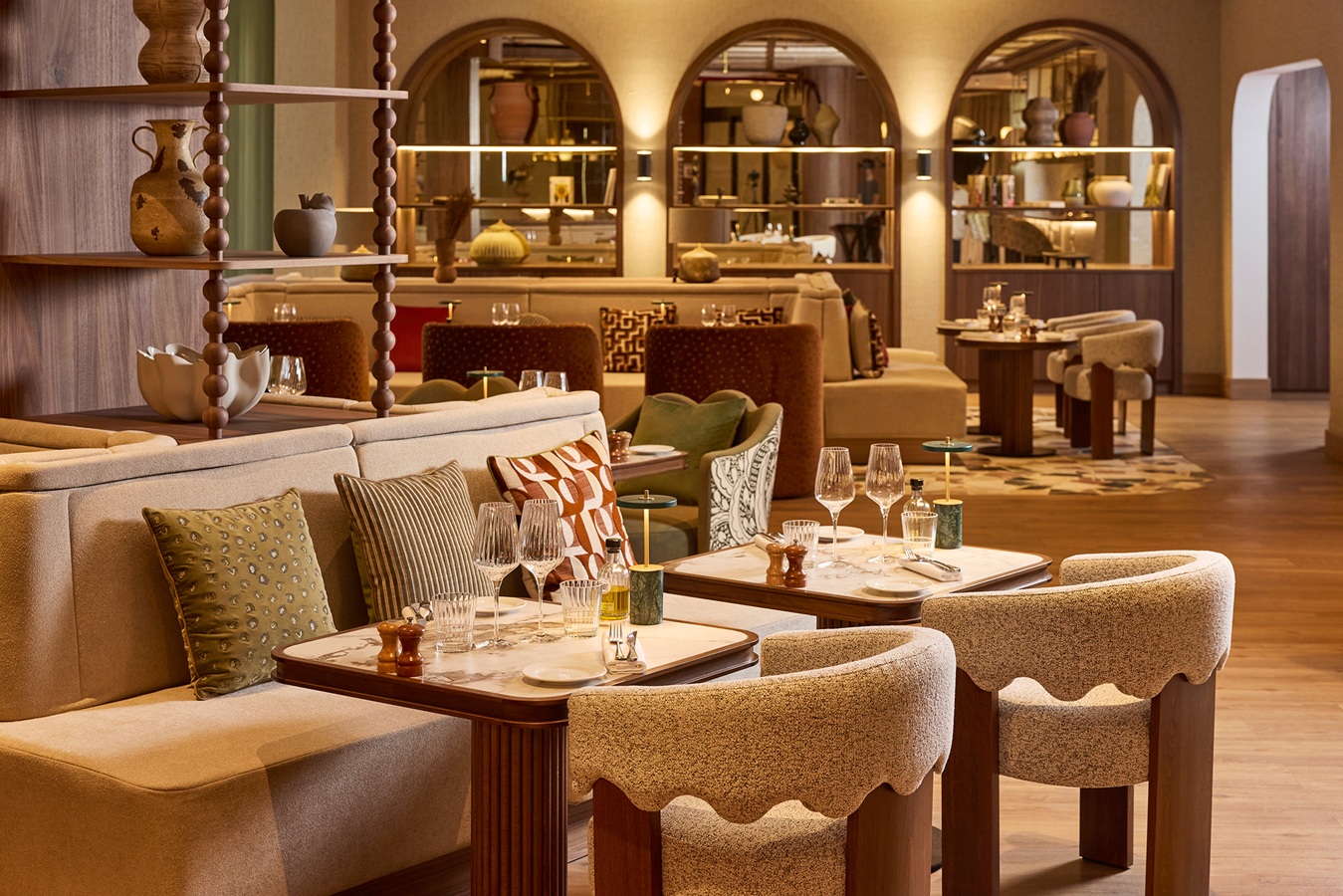
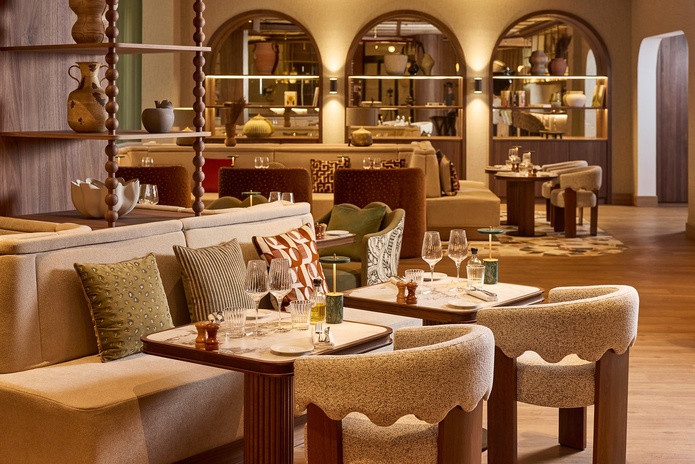
The renovation was entrusted to interior designer Fabien Roque, who completely reworked the lobby, the restaurant, the bar, and the reception areas.

The property notably highlights a world inspired by Provençal colors, with terracotta tones, olive green and beige, paired with solid wood, marble, leather and velvet.

The hotel also hosts several artistic creations, including a ceramic screen signed by Marie Levêque, installed in the public areas.

The exteriors have also been redesigned around a spirit of “French Riviera“, particularly around the pool and the relaxation spaces.


Grand Hôtel Roi René: 131 renovated rooms and a new dining offer


Grand Hôtel Roi René : 131 chambres rénovées et une nouvelle offre de restauration - Crédit photo : Grand Hôtel Roi René MGallery

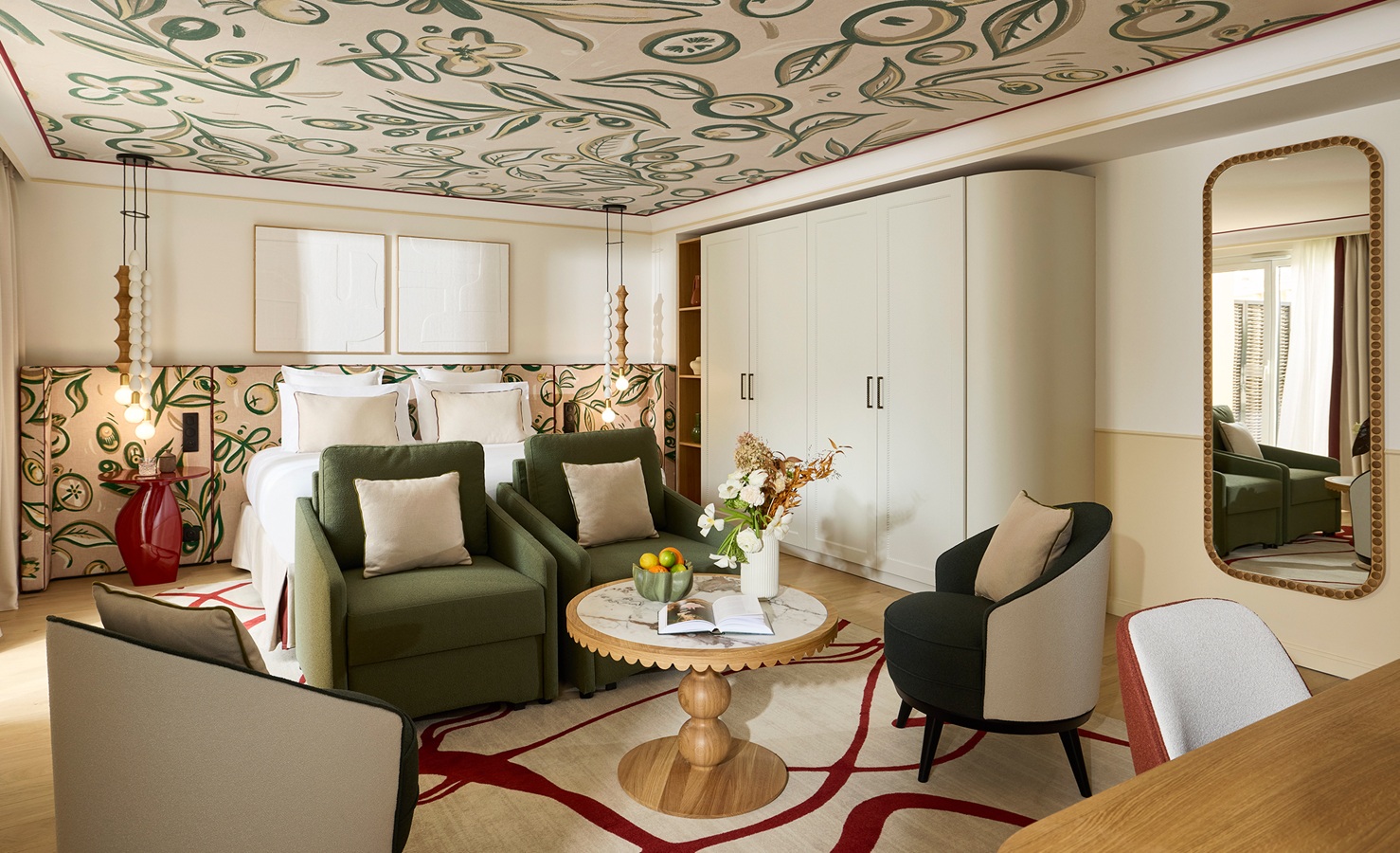
The establishment has also completely renovated its 131 rooms, including six suites and 17 rooms with terraces.

The rooms now emphasize brighter spaces, with a decor inspired by contemporary Provence and materials such as wood, stone, and linen. Some suites feature furnished terraces.

The project also includes the launch of the AÏGA restaurant, the hotel’s new Mediterranean dining concept. Open for lunch and dinner, the restaurant offers cuisine inspired by Provençal flavors and the Mediterranean basin, with mezzés, shareable dishes, grilled fish and reinvented specialties.

To read: Four places to see near Aix-en-Provence

The Aix calisson, a historic symbol of the city, also plays an important role in the culinary experience offered by the hotel.

Reachable in under three hours from Paris by train, the property also features a restaurant, a bar, an outdoor terrace, a 14-meter pool, and five meeting rooms.