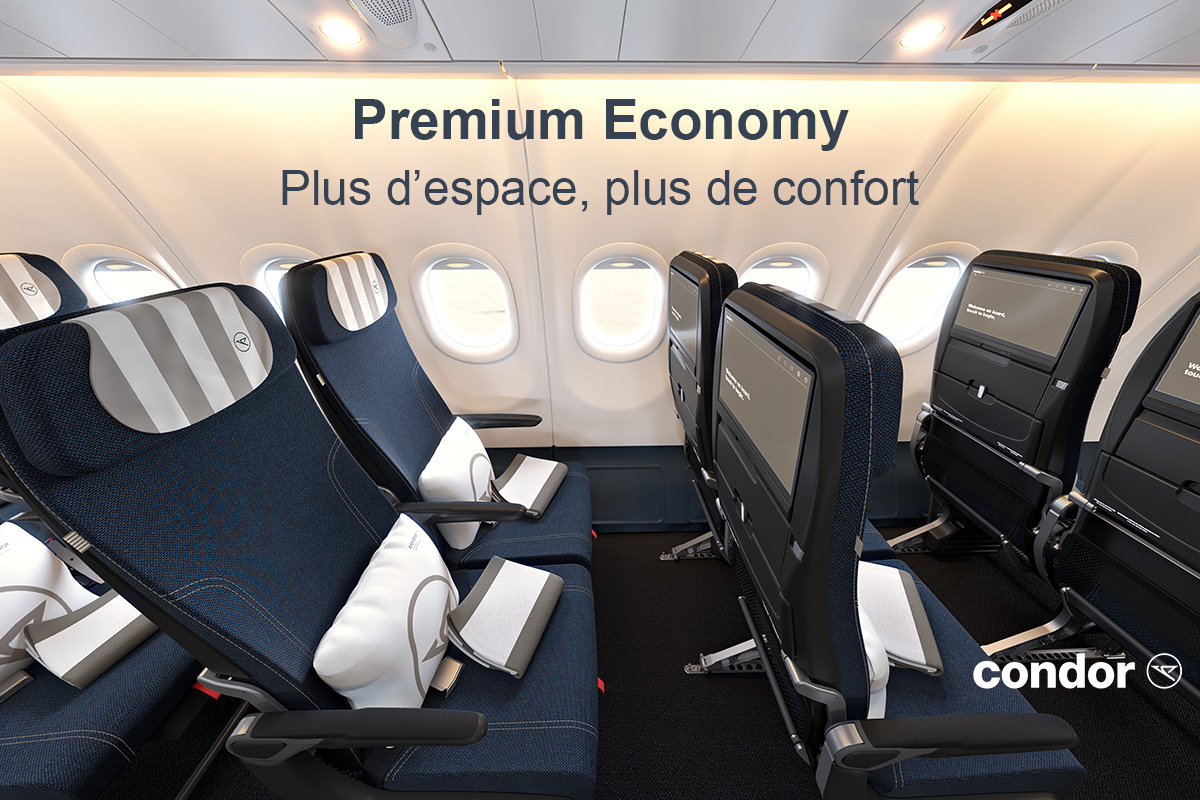
Condor Premium Economy: Pricing as a Key Selling Point


Condor: A Premium Experience

Premium Economy Condor Airbus 330neo © Condor Flugdienst

CroisiEurope


Understanding Condor’s Premium Economy to Better Offer It

Condor’s Premium Economy responds to a growing traveler expectation: enjoying more comfort on long-haul flights without exceeding the budget of a Business Class.

And it is precisely the balance between comfort and price that makes Condor’s offer particularly interesting.

Let’s take four telling examples of verified fares as of October 14, 2026. The gap between the Economy Classic fare and Premium Economy Classic was:

– €80 incl. tax for a Mauritius – Paris-CDG via Frankfurt, departing December 8, 2026

– €100 incl. tax for a Los Cabos – Paris-CDG via Frankfurt, departing January 11, 2027

– €120 incl. tax for a Cancun – Paris-CDG via Frankfurt, departing April 7, 2027

– €160 incl. tax for a Paris-CDG – Windhoek (Namibia) via Frankfurt, departing June 29, 2027

On a long-haul journey, such a price gap can thus make the Premium Economy option especially attractive.


More space and comfort designed for long-haul travel

On board its Airbus A330neo, Condor offers 64 Premium Economy seats.

With a wide 89 cm legroom, a 12° recline, an adjustable footrest, and an ergonomic six-position headrest, the seat is designed to provide a more comfortable position during long hours of flight.

Each passenger also has a 13.3-inch 4K personal screen, as well as USB-A and USB-C ports.

A pillow and a blanket complete the onboard experience, as does the individual entertainment system offering, among other things, a selection of films in French.

The service also includes several priority services: Priority Check-in, Priority Boarding and Priority Baggage.

For travel agents, these are concrete elements that help highlight the upgrade to clients.


And in the dining, we also switch to Premium

The Premium Economy experience does not stop at the seat.

Condor presents its dining concept “Taste the World”, with a Premium Economy menu as well as a selection of alcoholic and non-alcoholic beverages included.

Different meal options are also offered, including vegetarian, vegan, gluten-free menus, and many others.


The takeaway: systematically compare before proposing

This is probably the essential point to remember for travel agents: do not assume that Premium Economy will necessarily be much more expensive.

The reflex may be to offer Economy right away when the client is looking for a controlled price. Yet, depending on dates and destinations, the gap with Premium Economy can be small enough to justify presenting both options.

Premium Economy thus allows you to spontaneously offer a travel experience that may be more comfortable than the client had perhaps imagined.

Also note: Condor offers TO (tour operator) fares in Premium Economy, an element worth including in comparisons and packaged offers.


Economy, Premium Economy, or Business with a lie-flat seat: three experiences to suit every traveler



La Premium Economy de Condor : le tarif comme argument de vente

Condor is the second-largest regular German airline. Condor is represented in France by Aviareps, 122 Avenue des Champs-Élysées 75008 Paris.

Email: [email protected] | [email protected]

Phone: +33 (0)1 53 43 53 92 (Mon-Fri, 9:00–18:00)

linkedin


Travel Agent: Selling a Trip Also Means Taking Responsibility


"Les voyages m'ont appris la souffrance, l'amour, la liberté et la responsabilité. Ils m'ont surtout appris qu'avant de vouloir transformer le monde, il faut accepter d'être transformé par lui" - Photos : Cathy Bou et Nicolas Demare

CroisiEurope


I was thirteen when I first discovered Morocco. I could tell you about the light, the Atlas Mountains, or the aromas of spices.

Yet the memory that has accompanied me for more than forty years is quite different. A road toward the Algerian border. A poverty I had never imagined. Glances I did not know how to bear.

I got out of the car. I threw up.

For a long time, I believed it was only a travel memory. Today, I think that my body understood before my mind that there are realities to which one cannot remain indifferent.

We sometimes take decades to find the words for what our hearts already knew.

A few years later, another journey would overturn my perspective.


The Stendhal Syndrome

In 2006, in Cyprus, one evening, in a small tavern, the music stops.
The men rise. One after another, they kneel before their wives and lay rose petals at their feet. Nothing ostentatious. Nothing theatrical. Only an infinitely simple way to honor the woman with whom they share their life.

I stand still. The tears rise and I cannot hold them back.

The next day, I collapse.

In trying to understand what had happened to me, I discover the Stendhal syndrome.

But this medical explanation did not answer the essential question. What had overwhelmed me was not the beauty of a landscape or a work of art. It was the almost physical encounter with a form of unconditional love that our society often speaks of, yet does not always know how to live.

Many years later, when I chose the name Agapè, I understood that that evening had sown a seed whose name I did not yet know.


When discovering a country reveals who we are

In 2013, I set off for India with my twenty-year-old son. We thought we were going to discover a country. It is he who reveals us to ourselves.

We are struck by the constant coexistence of the most dazzling luxury and the most extreme poverty.

One day, a cow rams me with its horn. I was afraid. My son looks at me and simply says: “She sensed it.” This sentence will haunt me for a long time.

I wondered whether my intuitions were drawing to me what I feared. It took me years to understand that they created nothing. They merely perceived what was already unfolding.

We return on August 27. On November 21, I leave Thomas Cook. Many regard it as a rupture. I saw only fidelity. I was not leaving a company I loved. I was simply no longer abandoning myself.

Looking back on this journey today, I understand that these travels and my profession have never told two different stories. They told only one.


Crises Never Strike Without Warning

When I joined Havas Voyages in 1989, I thought I would learn the art of being a travel agent. In reality, I gradually learned what it means to be responsible for the experience others will live through.

Behind every trip lie choices, trade-offs, and responsibilities.

From 2004 onward, I read hundreds, then thousands, of complaints. Food poisonings. Hotels that deteriorate. Fragile suppliers. Decisions that seem trivial when examined in isolation, but when stitched together, tell a far deeper story.

I am not yet speaking of weak signals. I simply discover that crises never strike without warning.

In 2009, I completed my first carbon footprint assessment. Not for public relations. To understand. I needed to confront my intuitions with facts. Intuition opens a door. Knowledge learns to cross it.

When I participated in COP21 in 2015, I first felt immense hope. Finally, scientists, governments, businesses and civil society seemed to be looking in the same direction.

Then a subtle dissonance emerged. Speeches advance faster than decisions. Commitments faster than renunciations.

I left with a conviction that has never left me: life does not negotiate. It responds.


We Struggle to Turn What We Know into Decisions


About Cathy Bou


Cathy Bou - Photo : Nicolas Demare, Nidimages

The path of Cathy Bou is that of a professional who grew up with tourism.

Entering Thomas Cook as an intern in a travel agency in Arcachon, she builds there, over nearly twenty-five years, a rich and evolving career.

From travel agent to head of customer relations in the Paris region, she discovers the trade in all its dimensions: distribution, customer relations, the handling of sensitive situations, management, change management and the early challenges of sustainable development.

Driven by a thirst to learn and to share, she chose in 2015 to reinvent herself and earned a Master in Management of Corporate Social Responsibility (CSR) at the Conservatoire national des arts et métiers (CNAM). This training marked a decisive turning point: applying her tourism expertise to sustainable transformation.

She then founded Agapè, a consulting firm specializing in responsible strategy. Since then, she has supported companies, travel agencies, tour operators, event organizers and health sector actors in building models that balance economic performance, environmental responsibility and social impact.

Her journey has led her to speak at major international events such as the COP21, the G7 in Biarritz, the BIG trade show by Bpifrance, and the UICN World Conservation Congress, as well as with public institutions, large companies and reference organizations, including the Curie Institute.

Nothing in her background foretold this path. It is precisely this practitioner’s perspective, forged by on-the-ground experience as much as by strategic reflection, that now informs her analyses.

Through her columns in TourMaG, she defends a belief: the tourism of tomorrow will be built by balancing the health of businesses, the health of people and the health of living beings.


About Agapè

Agapè is a consulting firm in responsible strategy that assists organizations in their transformation efforts, certification processes, environmental assessments and capacity-building initiatives.

The firm primarily operates in the realms of tourism, events and health, with a strong conviction: responsible performance is born from balancing economic, human, environmental and governance dimensions.

It also rests on leaders’ ability to understand complexity, to make informed decisions and to act with coherence.

Through its consulting, auditing, training and digital solution development missions, Agapè helps organizations turn their commitment to responsibility into a genuine lever of performance, resilience and living beings preservation.

More than a consulting firm, Agapè develops an ecosystem of methods, tools and training designed to guide decision-makers through the transitions shaping tomorrow’s world.


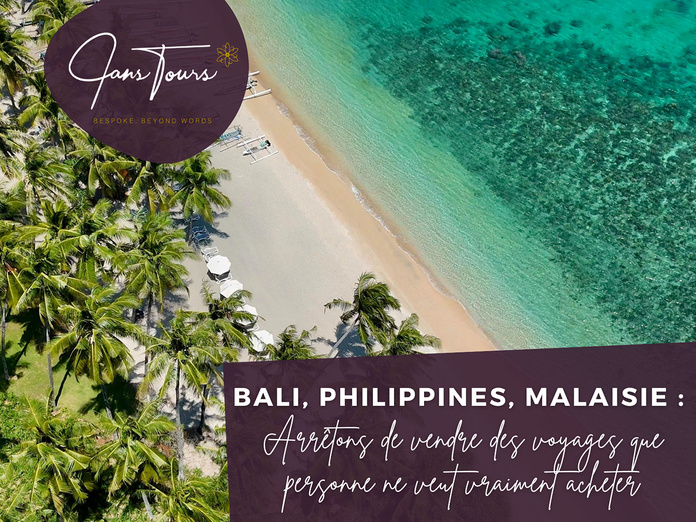
Bali, Philippines and Malaysia: Stop Selling Unwanted Travel


© Canva by Holger Raukamp from Pexels

CroisiEurope


Bali: the destination everyone already feels they’ve seen before departure

Bali has become a case study.

Everyone markets it. Everyone knows it. Everyone thinks they know it.

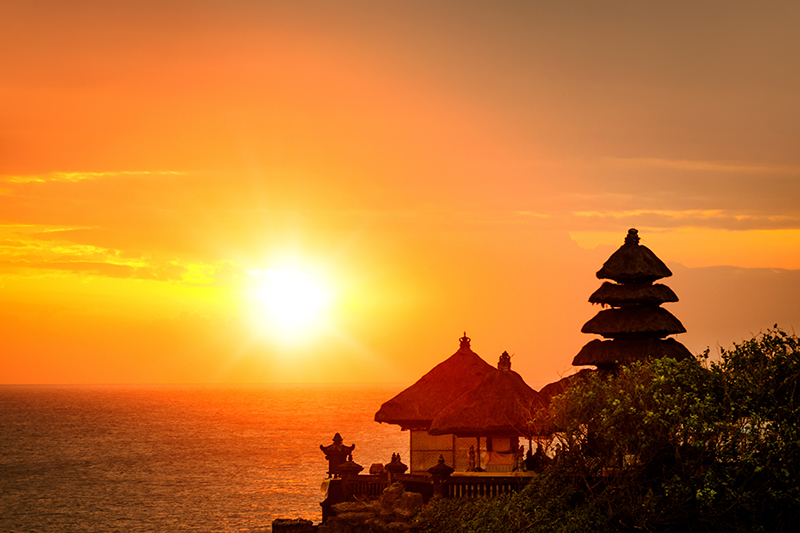
Before even booking a ticket, travelers have already watched hundreds of videos of Ubud, photos of the Tegalalang rice terraces, sunsets at Uluwatu, and infinity pools on Instagram.

The real challenge isn’t to introduce Bali anymore.

The challenge is to restore Bali’s ability to surprise.

Today, the main obstacle to selling isn’t price or competition. It’s the illusion of knowledge.

The client arrives with a preconstructed image of the destination. An image often idealized, sometimes distorted, but above all extremely precise.

In response to this, many offers keep piling up the same steps, the same excursions, and the same sales pitches.

Result: programs become interchangeable.

Yet Bali remains one of Asia’s richest destinations. But its value no longer lies solely in the places visited. It lies in how we reveal them to visitors.


@ Canva by Nikada from Getty Images


Philippines: an extraordinary product that defies standards

The Philippines probably stands as one of the greatest paradoxes in Asian tourism.

Everyone agrees on the country’s exceptional beauty. Yet it remains often harder to sell than other, less spectacular destinations.

Why?

Because we still try to fit it into marketing schemes that don’t suit it.

The Philippines is not a classic circuit.

It isn’t a destination told through a logical sequence of steps.

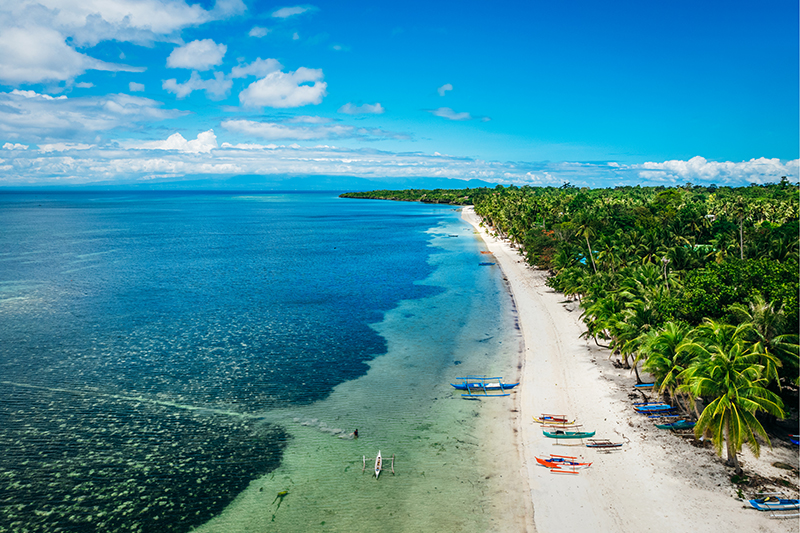
It is an archipelago of more than 7,000 islands where each region possesses its own identity, its own rhythm, and its own personality.

Palawan isn’t Bohol.

Bohol isn’t Siargao.

Siargao isn’t Cebu.

And it is precisely this diversity that gives the country its strength.

Travelers don’t come solely for beaches or lagoons. They come seeking a sense of perpetual discovery, exploration, and freedom.

As long as the Philippines is sold as a simple beach circuit, it will remain commercially underexploited.

The destination isn’t complicated.

It’s our way of presenting it that has become so.


@ Canva by Nikada from Getty Images


Malaysia: the most rational destination… therefore the least told

Malaysia suffers from nearly the opposite problem.

It may be the most complete destination in Southeast Asia.

It is modern.

It is accessible.

It is multicultural.

It has excellent infrastructure.

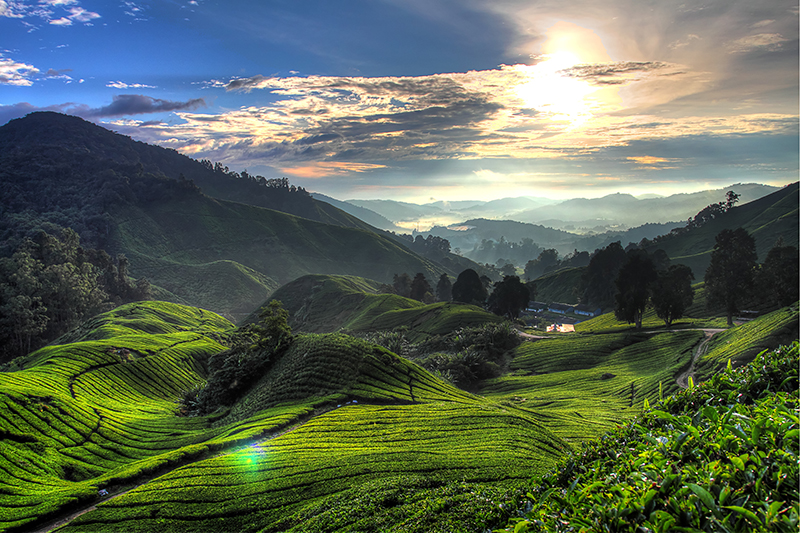
It blends modern cities, historic heritage, tropical nature, and beaches.

On paper, everything seems perfect.

And yet, it often remains in the shadows of its neighbors.

Why?

Because it generates fewer immediate fantasies.

In a world ruled by imagery, destinations that grab attention are often those that tell the simplest stories.

Bali evokes wellness.

The Philippines evokes paradise.

Malaysia, by contrast, is more subtle.

It demands more storytelling.

It demands more explanations.

It demands more staging.

Malaysia isn’t underestimated by travelers.

It is under-told by the market.


@ Canva by Coleong from Getty Images


The real topic: clients no longer buy destinations

For a long time, selling a trip meant selling a place.

Today, this model is showing its limits.

Travelers don’t buy just a destination anymore.

They buy a projection.

They buy a future emotion.

They buy a story they will want to tell when they return.

They buy a sense of freedom.

They buy a feeling of exclusivity.

They buy the impression of living something that resembles them.

And that is precisely where the current misalignment lies.

A large portion of the tourism offering continues to describe itineraries while travelers seek experiences.

We keep selling kilometers while clients want memories.

We keep selling hotels while they seek emotions.


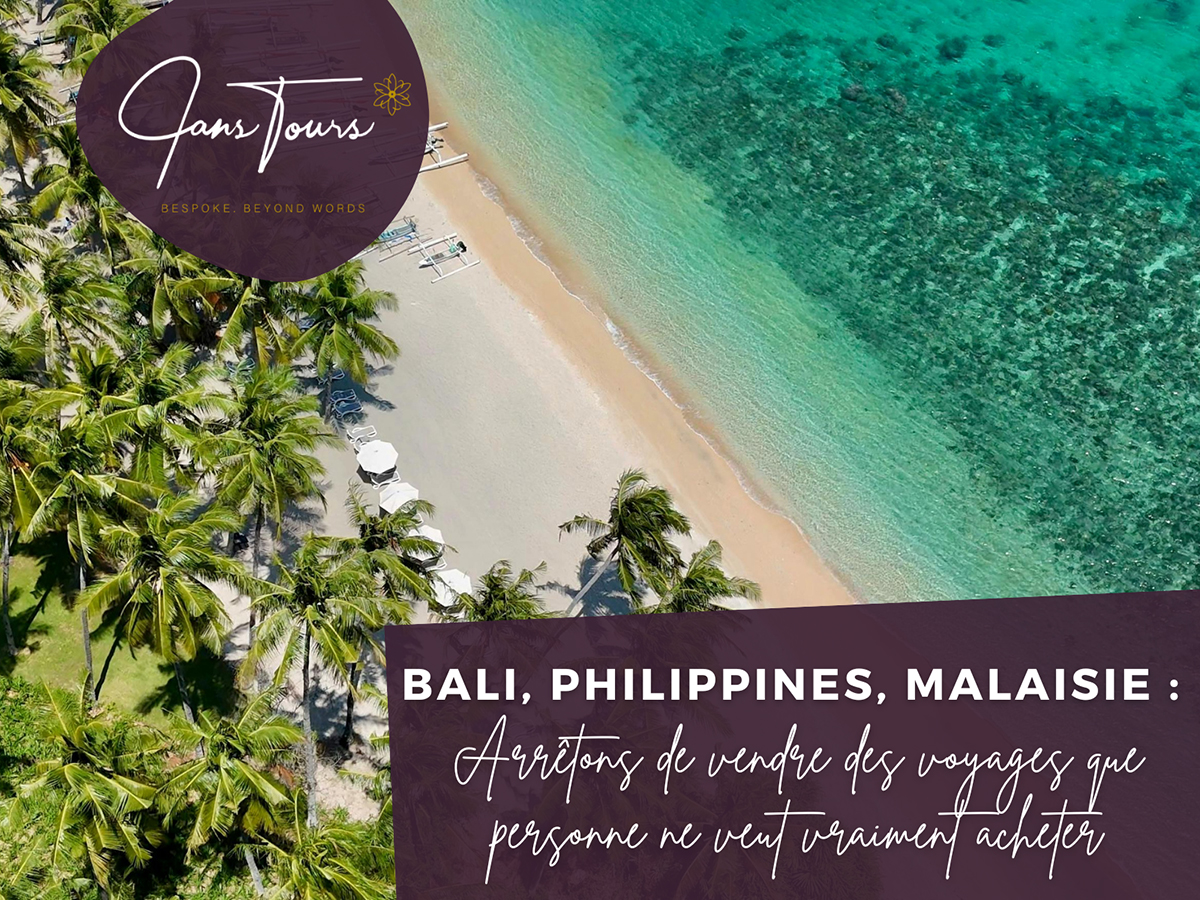
Bali, Philippines, Malaisie : arrêtons de vendre des voyages que personne ne veut vraiment acheter

Audrey Marc

Deputy Director France

+ 33 6 70 54 20 63

+ 33 1 61 30 30 06

[email protected]

jans.tours

>> JANS TOURS in the DESTIMAG Directory