



With Aurora AI and its Traveller Twin, Destination Canada makes access to tourism data easier and helps professionals better understand their audiences, test their projects, and steer their business decisions more quickly. Canada is simplifying access to its data through Aurora AI.
In tourism, data is a powerful driver of performance. Yet for tour operators, online agencies, destinations, or activity providers, extracting value from it can still demand significant time and resources.
With Aurora AI, Destination Canada aims to make this knowledge more easily accessible and directly usable. This AI ecosystem enables tourism professionals to query reliable data in natural language and rapidly obtain insights that inform their decisions.
The objective is concrete: reduce the time spent on research and analysis, better target travelers, and mitigate risks before investing in a new product or a marketing campaign.
Tourism data accessible in seconds
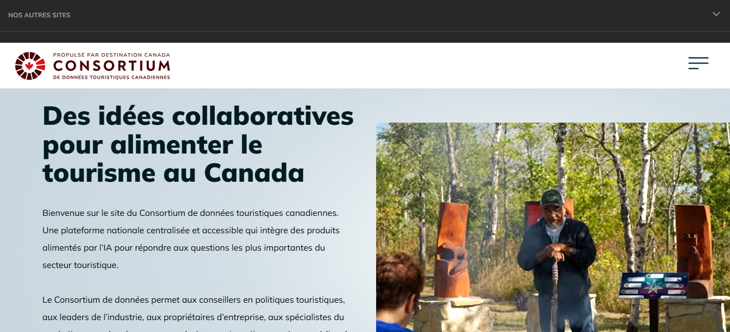
Fruit of Canada’s tourism know-how, Aurora AI rests on an unmatched understanding of travel information at global and national scales. Built by Destination Canada, Aurora AI is a knowledge network that uses Gemini Enterprise and is fueled by the Canadian Tourism Data Consortium. This consortium provides validated research, reliable data sets, and insights from Destination Canada’s partners, ensuring credibility and relevance. It was launched in 2024 and won the Best Use of Artificial Intelligence for Nonprofit or Non-commercial Purposes at the 2024 DataIQ AI Awards.
Launched in November 2025, Aurora AI combines natural language querying, predictive models, traveler simulation tools, and AI agents in an integrated system that learns, adapts, and responds.
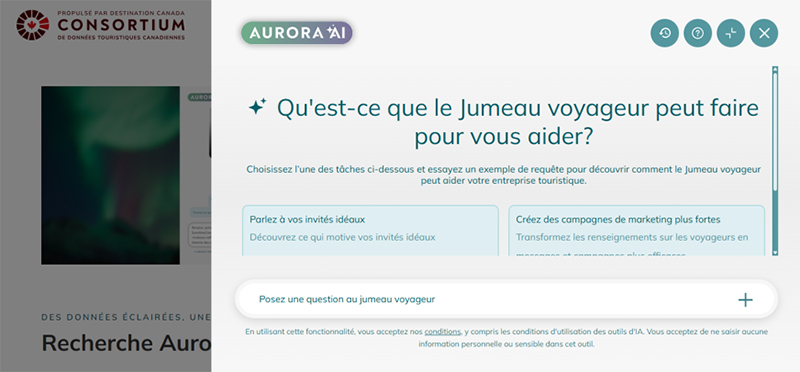
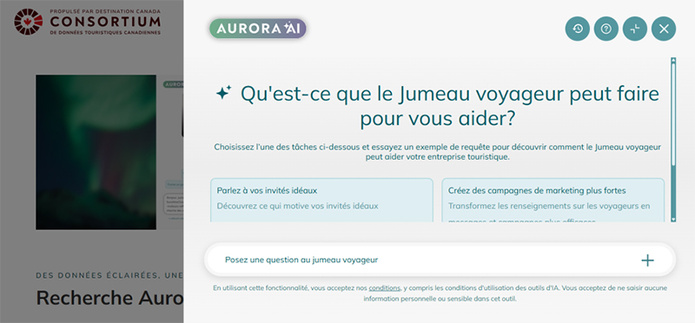
The Traveller Twin to test a project before launch
Among the features offered, the Traveller Twin lets you simulate how different traveler profiles would react. It builds on the segmentation program of the Canadian Tourism Data Consortium, created from research conducted with real travelers in Destination Canada’s ten major markets, including France.
“Its French version, launched in May 2026 at Rendez-vous Canada, can notably assist tour operators and reservation platforms marketing the destination.” explains Cyrielle Bon, CEO of Destination Canada in France
A professional can, for example, propose a stay idea, a new product, an advertising message, or a campaign concept. The Traveller Twin then helps identify the most receptive audiences, better understand their expectations, and anticipate their reactions.
The tool can also be used to refine a sales pitch or support a recommendation with structured traveler insights. The aim is to adjust a project upstream, before mobilizing production budgets or media buying.
A tool in service of return on investment
By easing the research, targeting, and testing stages, Aurora AI can help improve the effectiveness of marketing investments. It isn’t about predicting consumer behavior with certainty, but about providing extra data to make more informed decisions.
For tourism companies, the potential benefits show up in several ways: shorter analysis time, more precisely targeted campaigns, products more aligned with travelers’ expectations, and resources focused on the most promising opportunities.
This deeper understanding of audiences also serves as a differentiator. In a sector where travelers increasingly seek highly personalized offerings, the ability to quickly tailor products and messages can become a real competitive edge.
Commercial results already observed
Several Canadian tourism companies have already used the Traveller Twin to evolve their offerings.
Brett Soberg, co-founder and captain of Eagle Wing Whale Watching explains: “We leaned on the tool to identify new interests among our visitors and to explore experiences that complement our usual excursions.” By expanding their portfolio, they doubled the number of their specialized tours.
At Bay of Fundy Adventures, founder Jordan Jamison also used Aurora AI: it helped them identify refined globetrotters as the segment with the strongest potential to book guided experiences and stay in the region. They shifted their strategy from promoting individual activities to promoting a destination conducive to immersive experiences. This new approach was accompanied by a 200% rise in bookings compared with the previous year.
These results illustrate how a better understanding of traveler expectations can translate into product evolution and improved business performance.
A technological expertise serving the industry
Aurora AI is developing new agents and continuously innovating to meet the evolving needs of the tourism sector. We want to hear your feedback on your experiences with Aurora AI.
Please send your questions, comments, and ideas to the Data Consortium team by writing your feedback here.




 Publié par Caroline Lelievre