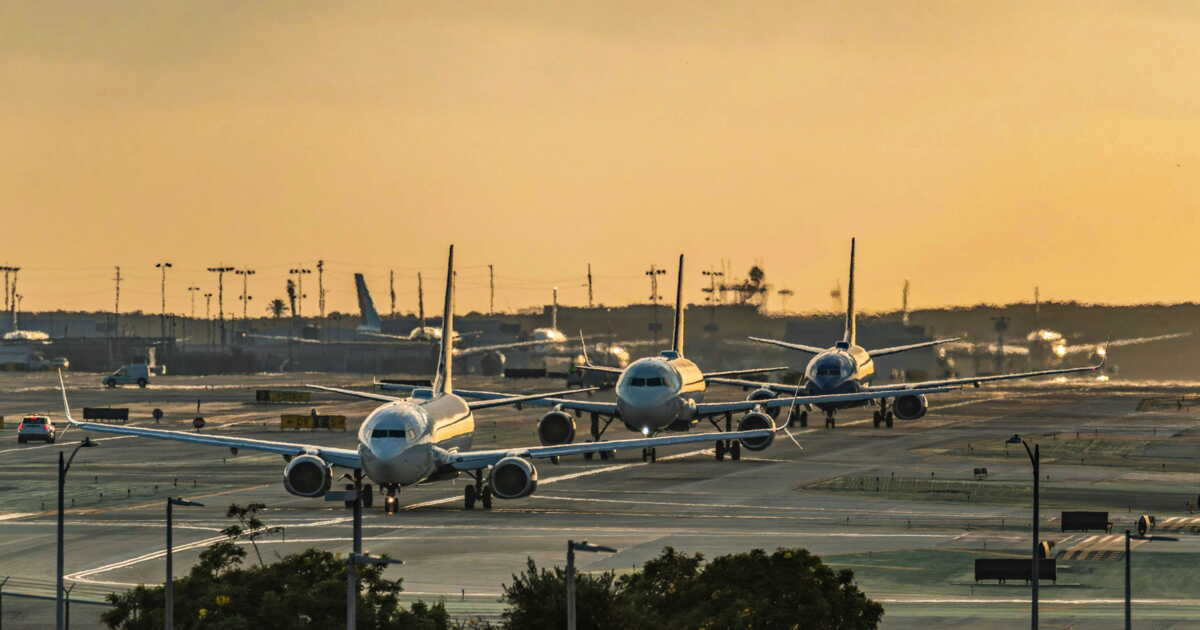
Which European Airports Are Most Affected by Flight Cancellations?

From choosing a place to stay to organizing activities and packing, a trip typically requires several months of preparation. So, what could be more unpleasant than arriving at the airport only to discover that your flight has been canceled?

A situation we want to avoid at all costs and which, fortunately, remains relatively rare, but that nonetheless affects some travelers, no matter which airport they are at.

To determine which European airports are most affected, Maaltalk, a company offering eSIMs usable across Europe, analyzed the air traffic of 115 airports over the past 30 days to identify those with the highest cancellation rates.

The United Kingdom has several airports strongly affected by cancellations

Leading the list of airports with the most cancellations is London City Airport, with 3.70% of its flights canceled during the studied 30-day period. Of the 3,597 scheduled flights, 133 were canceled, roughly one cancellation for every 27 flights. Inverness Airport in Scotland follows in second place with a cancellation rate of 3.43%. Of the 379 scheduled flights, 13 were canceled. Belfast City Airport closes the podium with a 3.17% rate, after canceling 37 of its 1,168 flights.

In fourth place, London Luton Airport shows a 3.13% cancellation rate, with 105 cancellations out of 3,358 scheduled flights. It is followed closely by Aberdeen Airport in Scotland, with 31 cancellations out of 1,002 flights, a 3.09% rate. From England to Scotland, and including Northern Ireland, this top five is therefore made up exclusively of airports located in the United Kingdom. Only in seventh place does the ranking move outside the British Isles, with EuroAirport Basel Mulhouse Freiburg, which records a 2.45% cancellation rate, with 148 cancellations out of 6,046 flights in total.

Several French airports report fewer than 1% cancellations

The two French airports with the highest number of cancellations are Bordeaux, with 48 cancellations out of 2,155, i.e., a rate of 2.23%, and Lille, which closes the top 10 with a cancellation rate of 2.20%, after six cancellations on 273 scheduled flights. Apart from these two airports, France generally performs fairly well, as several of its airports record a minimal cancellation rate. This is notably the case for Strasbourg Airport, with only two cancellations on 208 flights, a 0.96% rate. The same goes for Brest Airport, which has four cancellations on 415 flights.

Among the best-ranked French airports, Paris-Charles de Gaulle stands out, with many airlines present, reporting a cancellation rate of 0.82%, i.e., 467 cancellations on 56,612 flights. Lyon Airport records a cancellation rate of 0.78%, with 59 cancellations on 7,518 flights, while Paris-Orly shows a rate of 0.77% after 125 cancellations on 16,234 flights.
These 5 European Airports Named After Major Cities Are Sometimes Located More Than 100 Kilometers Away

When you book a flight, you may be tempted to choose Paris-Beauvais Airport instead of Orly or Charles de Gaulle because of a more attractive price. Yet, Paris-Beauvais Airport is located about one hundred kilometers from the capital, roughly a 1 hour 30 minute drive. While many French people know the quirk of this airport in the Oise region, there are several airports in Europe that are not situated in the immediate vicinity of the city they serve, as noted by the Daily Mail.

When booking your tickets for a trip to London, Stockholm or Barcelona, you may face the unpleasant surprise of having to spend a few extra hours of travel before reaching your final destination. So even if the price of the plane ticket seems cheaper, this saving can quickly be erased by a long, unforeseen shuttle or taxi ride. Consider estimating the cost of the additional journey against the savings from the flight to see if it is really worth it.

The Frankfurt-Hahn Airport

If you plan to visit Frankfurt like millions of fellow travelers, beware of being misled by the Frankfurt-Hahn Airport. Despite its name, it is far from the German economic capital, as it is located in Lautzenhausen, about 124 kilometers from Frankfurt, roughly a 1 hour 30 minute drive. To reach the city directly, it’s better to choose Frankfurt International Airport. You should allow roughly twenty minutes to reach the city center.

View this post on Instagram

Düsseldorf-Weeze Airport

Still in Germany, be careful when booking your upcoming trip to Düsseldorf. If Düsseldorf-Weeze Airport is offered, know that it is located about 80 kilometers from the city. To avoid a long extra journey, favor Düsseldorf International Airport. It will take you only about fifteen minutes to reach the city center.

View this post on Instagram

Stockholm Västerås Airport

The name may still be misleading. Stockholm Västerås Airport is actually located about 100 kilometers from Stockholm, more than an hour by car. For travelers who want to reach the Swedish capital quickly, Stockholm Arlanda Airport presents a more convenient option.

View this post on Instagram

Barcelona–Reus Airport

The capital of Catalonia also has its own “trap airport.” Despite its name, Barcelona–Reus Airport is located about one hundred kilometers from Barcelona. It officially bears the name Reus Airport. To land as close as possible to the city, it is wiser to choose Barcelona–El Prat Airport, located about a 20-minute drive from the city center.

A New Embarrassing Trend Spreading Across Airports

Fortunately, ridicule isn’t fatal! If you spot someone wearing a T-shirt that catches your eye at the airport, it’s because they’ve fallen for this new concept making the rounds on social media. It’s a challenge that involves wearing a shirt chosen by a friend, often quite conspicuous and hard to ignore. The Washington Post recently interviewed several people who took part in this trend.

Take Kate Swenson, a 43-year-old mother who, while traveling with friends, had to wear a T-shirt reading: “posez-moi des questions sur ma diarrhée explosive”. The only rule was to wear it for the entire first day, even if it made her uncomfortable. “I just remember the laughter, then regrets, then more laughter.” Some of her friends had to wear T-shirts proclaiming that they “transpiraient à des endroits inhabituels”, that they “arboraient des piercings corporels insolites”, or that they “avaient besoin d’un énorme cocktail”.

Following that, they recounted being tapped on the hand by flight attendants and laughing from strangers. Their social media post has racked up more than 83 million views on Instagram to date, and the friends said they felt “like celebrities” after being recognized on their Florida-departing cruise.

A Fun Challenge, but with Boundaries to Respect

Aarya Patel, who also took on the challenge by wearing a T-shirt that read “j’ai fait caca aujourd’hui”, said it was “a way to set the tone for the trip.” “We were finishing finals at that time. It helped us forget all that and focus on the trip”, she claimed. However, one should not forget that some airlines may refuse to transport passengers wearing clothing deemed indecent or offensive, in accordance with their terms of carriage.

That’s why one shouldn’t stretch their imagination too far. Paul Davis, a social-media and online-safety trainer based in Toronto, warned on his professional Facebook page against the “hypersexualized, aggressive and degrading” versions of this airport-shirt exchange and spoke to parents about them. He finds it cute, but only “within the bounds of good taste.”

He feared that compromising videos could harm some people and prevent them from obtaining a scholarship or a job, or that problematic clothing could trigger real-life conflicts. He also stressed that jokes about shirts referencing weapons are never a good idea. “I’d rather be cautious,” Davis said. “I remind kids every day that the Internet never forgets, and that, since it never forgets, it can be merciless”, he concluded.