
Logis Hotels Group: Eighth Consecutive Summer of Growth


Le Groupe Logis Hôtels signe son huitième été consécutif de croissance.  DepositPhotos.com/ Jirsak

MSC Croisières


The Logis Hôtels Group reports a 13% increase in its accommodation revenue during the summer season 2026, thus marking its eighth consecutive summer of growth.

This growth occurs in a context characterized by a modest rise in the average price, of 3%, while the average length of stay remained stable at 1.5 days.

The group also highlights the growth of international clientele, now the majority contributor to activity growth, as well as the evolution of destination choices in response to episodes of heat waves.


International Growth and the Quest for Cooler Climates Drive Activity

The international clientele rises by 19 % and now accounts for 41 % of customers, i.e., two percentage points more than in 2025. The French clientele remains dynamic as well, with a 9 % growth over the period.

Destination choices were influenced by the intense heat. The coastline shows an increase of 18 % and the mountains by 16 %, while the Grand Est records a rise of 32 %. The Normandy and Burgundy-Franche-Comté regions each advance by 18 %.

Air conditioning also becomes a more decisive criterion in choosing a place to stay: climate-controlled hotels exhibit eight percentage points higher growth.

Regarding areas affected by wildfires, dynamics were mixed. In Gironde, activity ends at -4 % and in the Landes at +4 %, after a more dynamic start to July. The group notes that nearly 75 % of pre-booked stays were maintained. In the Var, activity rises by 26 %, despite a slowdown inland linked to the fires.

For the return to the season, the outlook remains positive with 15 % more bookings, notably thanks to international clientele. Business clientele also grows by 11 %.
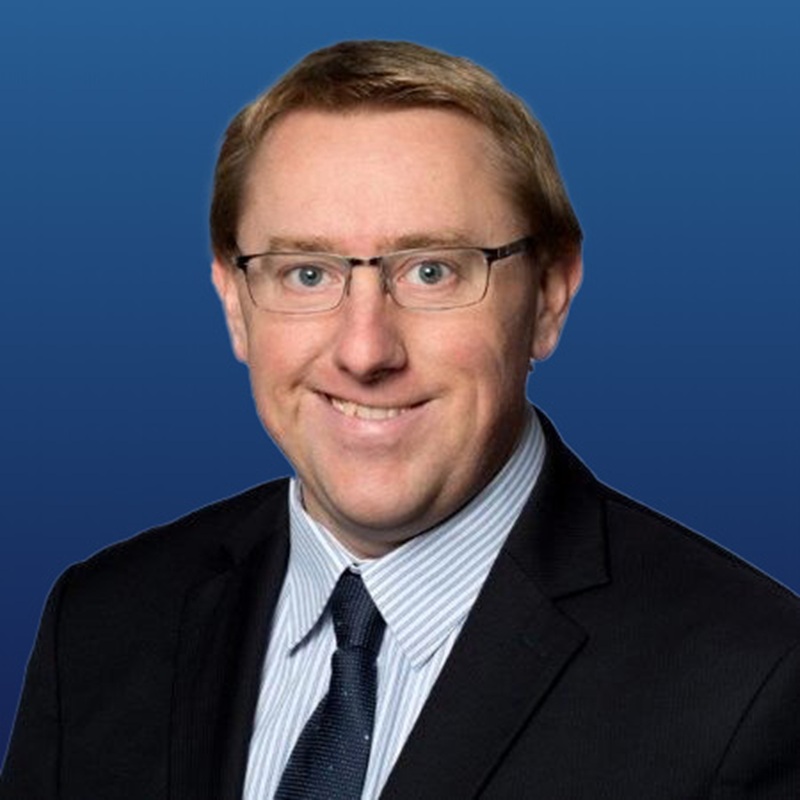
Ghislain Domi, VP GetGoing (BCD): France Set to Be One of Our Major Growth Contributors


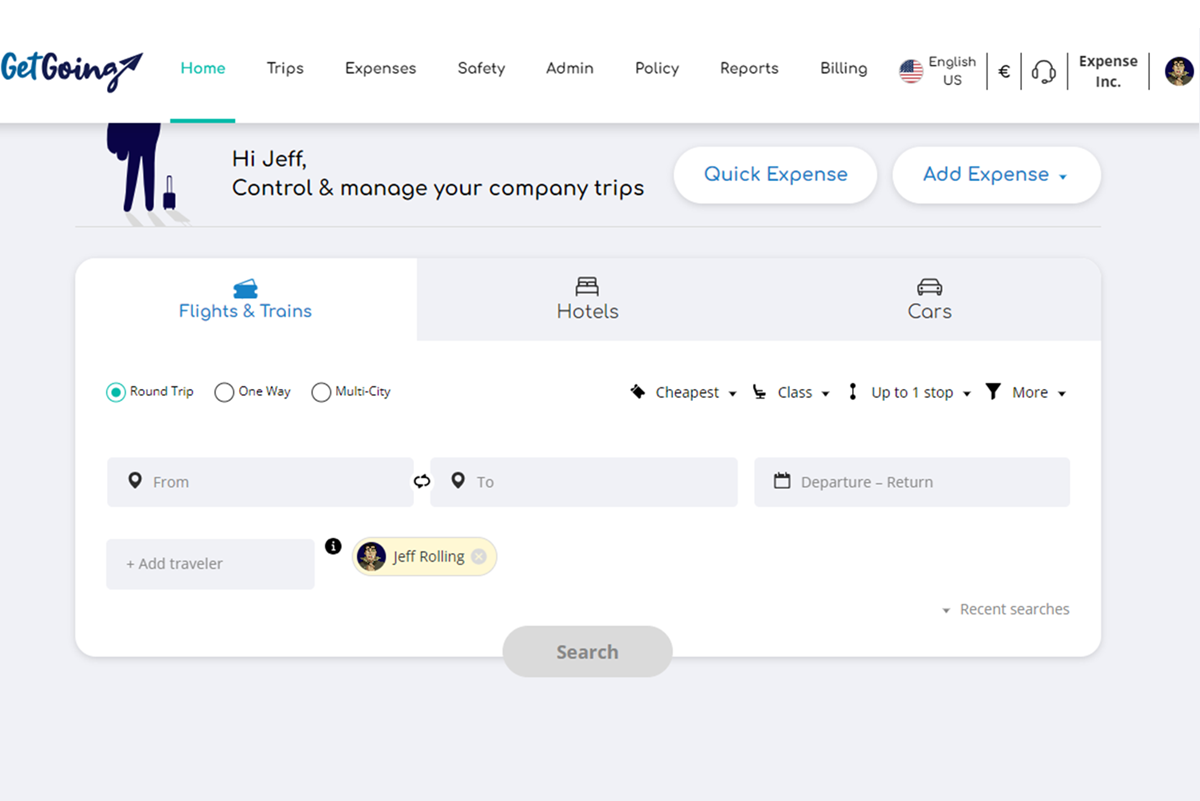
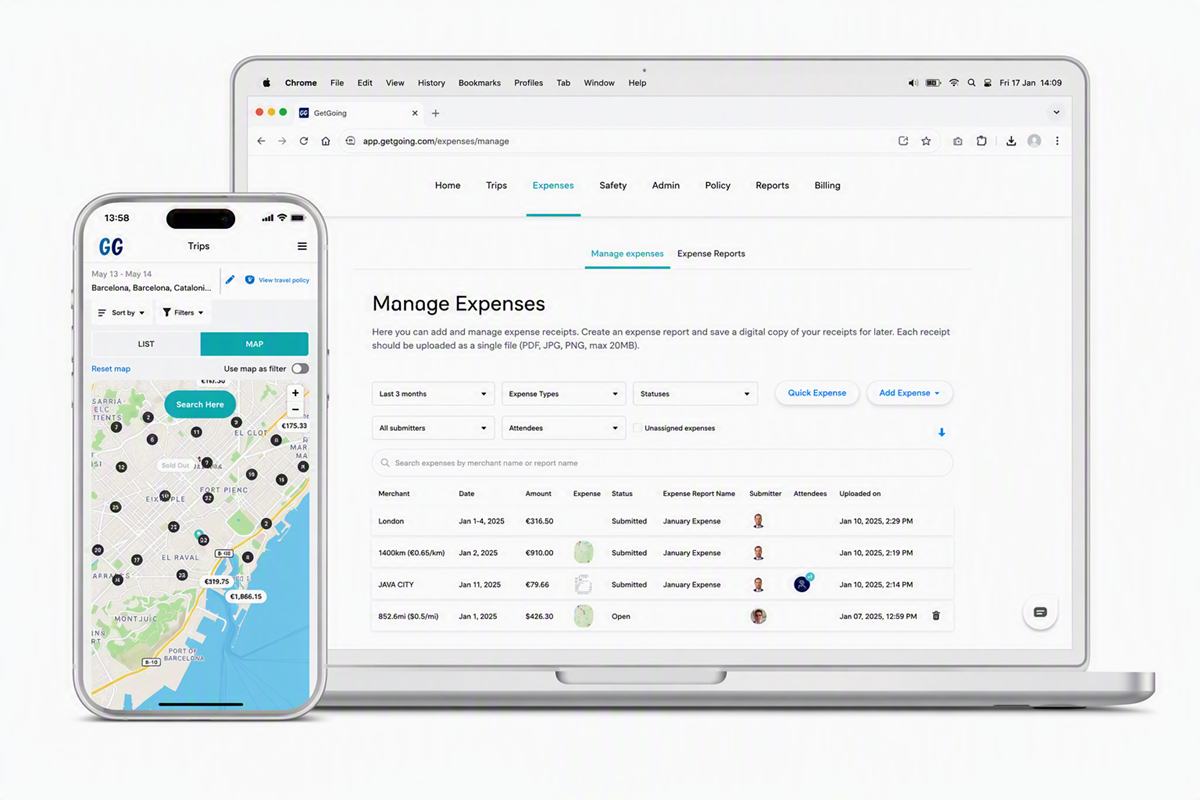
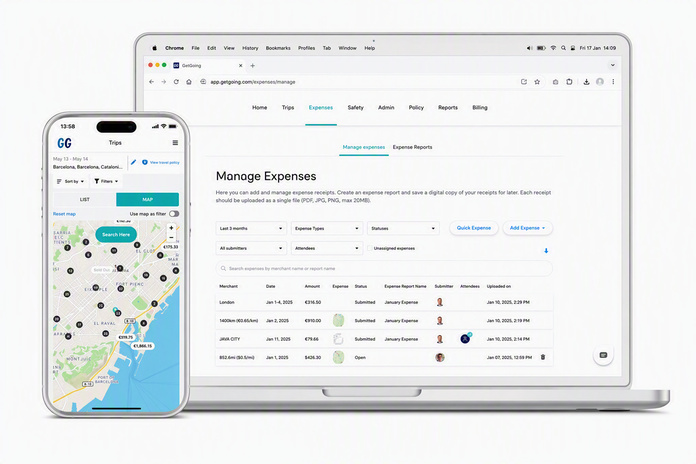
GetGoing, la plateforme de gestion des voyages d'affaires et des dépenses dédiée aux PME de BCD Travel est disponible en France depuis début 2026. @getgoing

MSC Croisières


TourMaG.com – BCD launched GetGoing on the French market at the start of the year. What is it about? Where is its deployment at?


Ghislain Domi : GetGoing was launched in Germany in 2022 and in the United States in 2023. We began rolling it out gradually in France at the start of the year, as well as in the United Kingdom, Belgium and the Netherlands.

We wanted to test the platform on the French market before communicating more broadly. Early feedback has been positive and IFTM represents a new milestone to accelerate this launch.

Growing companies reach a moment where travel management becomes too complex. They book on different sites, use Excel spreadsheets for their expenses, and assistants often have to manage travel alongside many other tasks.

Once a company reaches a certain size, they need to gain efficiency and take back control of their spending. GetGoing enables centralization of bookings, provides visibility into expenses, and reduces the administrative burden.

We also target companies that have already worked with TMCs, but for whom the tools and traditional processes have become too heavy. In such cases, their need is more about simplifying management.

TourMaG.com – GetGoing targets SMEs. Simplicity is therefore one of the platform’s main selling points?

Ghislain Domi : Absolutely. I have been in business travel for almost 20 years and have largely started with implementations of international programs. I’ve seen firsthand what can block these projects.

We wanted to approach the problem from the opposite angle: instead of shortening the implementation, we aimed to eliminate it. With GetGoing, there is no traditional implementation in the classic sense.

We can create a new client in a few minutes. Once the legal information is provided, building the base needed to start booking takes one to two hours maximum.

Of course, some topics can extend the process. A company that does not yet have a travel policy, for instance, can benefit from GetGoing deployment to define one. We can assist, but that inevitably takes more time.


“GetGoing and other BCD offerings are complementary”


Ghislain Domi est le Vice-President de GetGoing. @getgoing

TourMaG.com – Is the platform aimed only at travel managers?


Ghislain Domi : One of the goals is precisely to give travelers more control. We offer mobile apps on iOS and Android, and the idea is to cover the entire process, both for the traveler and the company.

The journey does not end when the employee returns home. Expenses, expense reports, and budget tracking must then be managed. We want to cover the end-to-end process.

TourMaG.com – Could GetGoing eventually compete with the other BCD Travel solutions?

Ghislain Domi : GetGoing and the other BCD offerings are complementary.

When a client grows or their program becomes more complex, they may need more customization, specific integrations, or customized processes. In that case, they can move toward TripSource.

We thus think less in terms of company size and more in terms of needs. GetGoing must remain a simple and effective solution for companies that primarily seek smoothness.


Air France NDC available in September

TourMaG.com – What role does artificial intelligence play in the platform?

Ghislain Domi : We are fairly selective. Our priority remains to keep a simple platform. We won’t add AI just for the sake of AI.

We use it where it provides real value, notably for receipt capture and expense reports. The traveler can take a photo of the receipt and the expense report is automatically prefilled. However, validation remains human.

AI also contributes to personalizing search results. For a flight, for example, it can determine the order in which the offers appear. But no algorithm will hide offers: we do not remove anything, we only adjust the hierarchy.

TourMaG.com – What adaptations did you have to make for the French market?

Ghislain Domi : The main adaptation obviously involves SNCF. We already had Deutsche Bahn in Germany and UK Rail in the United Kingdom. To offer a credible France-based offer, we had to include SNCF.

We are also working on Air France’s NDC. The feature is already in testing, and we are finalizing the last elements. It should be available by September.


“Around a hundred clients worldwide.”


« GetGoing représente un véritable relais de croissance pour BCD en général et pour BCD France en particulier », affirme Ghislain Domi, Vice-President de GetGoing.  @getgoing

TourMaG.com – What will be the next evolutions?


Ghislain Domi : We have a very busy road map, with several years of development ahead of us.

By the end of the year, we will particularly strengthen Travel Risk Management. We already have a map showing where travelers are located. We will develop the entire portion related to reporting, tracking, disruptions, and risk-event management.

We are also actively collecting feedback from customers to bring about regular optimizations.

Next year, we will also develop new offerings in payments, a topic that is particularly important for SMEs, and significantly strengthen the Expense module. This will include integrating credit card data, more connections with third-party systems, and greater end-to-end process automation.

TourMaG.com – How many clients are using GetGoing today?

Ghislain Domi : We have around a hundred clients worldwide.

We don’t primarily measure by client count but by business volume. Our objective is to surpass 100 million euros in business volume by 2030. We’re on a solid trajectory to reach that.

TourMaG.com – What ambition for France?

Ghislain Domi : The French market is still very small since we have just launched there. But it will be one of the major contributors to GetGoing’s growth.

Historically, BCD did not address this market directly in France. There is therefore a lot to do and enormous potential. GetGoing represents a real growth lever for BCD in general and for BCD France in particular.

TourMaG.com – Could GetGoing be deployed in other countries?

Ghislain Domi : For now, nothing has been decided. There are ideas and we will discuss them soon, but nothing has been decided or funded yet.

Future developments may not be limited to Europe. We already know how to serve the European subsidiaries of a client, even in countries where we have not yet launched commercially in a proactive manner.


Caroline Lelievre Publié par Caroline Lelievre Journaliste – TourMaG.com
Voir tous les articles de Caroline Lelievre

  • picto Twitter
  • picto Linkedin
  • picto email
Ajoutez TourMaG à votre flux Google Actualités Google Actualités icône

Arsenale Group Raises €300M to Accelerate Luxury Growth


Arsenale Group lève 300 M€ pour accélérer sa croissance dans le luxe - Depositphotos.com @ra2studio

MSC Croisières


Arsenale Group renforces its financial capacity.

The Italian group, active in the hotel and luxury travel sectors, announces that it has finalized the placement of a senior secured bond for the amount of €300 million.

With a four-year maturity, this bond carries a floating coupon indexed to the three-month Euribor, augmented by a margin of 7%.

The settlement date for the transaction occurred on June 30, 2026. The loan is also admitted to listing on the Vienna Stock Exchange.


Funding for the 2026-2030 Strategic Plan

The funds from this issue are intended to **contribute to financing Arsenale Group’s 2026-2030 strategic plan**. They will supplement the new equity provided by the group’s shareholders.

A portion of the amount raised will also be allocated to repurchasing preferred shares issued in 2022 with Oaktree Capital Management.

For Paolo Barletta, Chief Executive Officer of Arsenale Group, this operation should notably enable the group to have greater financial flexibility to support its development.

This operation constitutes a major milestone for the Arsenale Group and reinforces the strength of our long-term vision“, he notes.

According to the executive, the financing should allow the continued development of the group’s project portfolio and strengthen its position in the global luxury hotel market.


A New Step in the Growth Strategy

With this operation, Arsenale Group thus aims to support its long-term development ambitions, as the group continues to implement its strategy for the 2026-2030 period.

The success of the bond placement is presented by the group as an indicator of investor confidence in its positioning and growth prospects.

Pareto Securities assisted Arsenale Group as financial advisor in relation to this bond issue.


Amelia Brille Published by Amelia Brille TourMaG.com Editor
See all articles by Amelia Brille

  • picto Linkedin
  • picto email
Add TourMaG to your Google News feed Google Actualités icône  

Hervé Bellaïche (Catlante): Travel Agencies Are Our Main Growth Engine


TourMaG – The summer is drawing to a close. What assessment do you make of the 2026 season?

Hervé Bellaïche : The assessment is fairly positive, at least above our expectations. We were concerned because market trends suggested a difficult market that had trouble stabilizing.

In the end, we recorded a large number of last-minute bookings, about 20% more than usual. We also achieved an excellent August, the best in five years. So we are very commercially satisfied.

Travel agencies have been a great help and today constitute our main growth engine.

Beyond the commercial results, what matters most for Catlante is the customer experience, the quality of service and overall satisfaction. And in this regard, feedback is consistently excellent. Clients come back telling us they spent fantastic holidays, sometimes even “the best holidays of their lives.” That is what motivates us to go even further and to make the brand more widely known.

TourMaG – Travel agencies have thus embraced the cabin-cruise concept on a catamaran. How did you develop this distribution network?

Hervé Bellaïche :
A few years ago, Catlante was nearly exclusively sold direct. We found a second growth engine with travel agencies, thanks to the work undertaken for about two years to develop distribution networks.

It wasn’t necessarily easy. When you have a history of operating primarily through direct sales, you have to learn to work with a network of endorsers. I’ve been in the tourism industry for 20 years and for 20 years I’ve advocated this growth channel. I’m therefore very pleased that we managed to implement it at Catlante.

In the first half of the year, we’ve seen an 80% growth in travel agencies. It’s working very well, with two phenomena: some agencies are literally exploding their sales, with three- to fourfold increases over their previous level, while others still haven’t jumped aboard and are stagnating.

Our analysis is that some agencies have understood the appeal of this new type of vacation, which is popular, while others have not yet integrated this evolution.

TourMaG – The travel sector has faced the consequences of geopolitical tensions in the Middle East. Has your product proven particularly resilient?

Hervé Bellaïche :
Yes. In summer, around 90% of our production is in the Mediterranean. We have many departures from the Marseille coast, up to Saint-Tropez, but also from Corsica toward the north and southern Corsica, or Italy.

We also have departures from Palma to Minorca and Majorca in the Balearics. So these are mainly close-to-home trips. We also have a few trips to the Seychelles, which were more affected by the difficulties related to the Middle East.

Our product is resilient and even acted as a kind of travel refuge.

Some agencies have called us saying they had clients initially planned for long-haul trips or even within France, in areas hit by storms or fires, who had to rethink their plans. That perhaps explains part of the last-minute bookings.

We notably had a few families who had planned to go to the Landes region, Cap-Ferret for example, and who ultimately redirected to a Catlante trip.


TourMaG – What is the current split between cabin cruises and privatizations?

Hervé Bellaïche :
Catlante indeed does two kinds of offerings. We invented this cabin-cruise model: essentially sharing a boat, somewhat like a guesthouse on the sea. Our vessels are specifically designed for this, with plenty of space.

Clients frequently tell us they have met amazing people while still being able to live their own life. The act of sharing the boat can be a first hurdle at the time of booking, but once aboard, the initial hesitation completely fades away.

Today, roughly two-thirds of our activity comes from the cabin product. A couple, two couples or a family can take one, two or three cabins on the six cabins each boat offers. We have six cabins per boat, with a crew of two to three people.

The remaining one-third corresponds to groups or families who come together and privatize the boat.

TourMaG – Cabin cruising remains a niche product. Is it becoming more mainstream?

Hervé Bellaïche :
I can’t speak for the entire industry, but at Catlante we sense strong demand.

I believe this owes more to the way Catlante operates than to a general democratization of the sector. The company has been around for 23 years and, for 23 years, we have focused on the same thing: cabin-catamaran cruises, whether cabin-based or privatized, with crew.

Our know-how, our methods and our approach help us build client loyalty. We operate at smaller volumes compared with large tour operators—probably 10, 20 or 50 times less. We handle between 6,000 and 10,000 passengers per year.

We perform our activities in a professional manner. It is craftsmanship on a grand scale. We always depart with 12 people. Each departure is precisely shaped, personalized and customized. Yet we manage to run roughly 500 departures per year.

TourMaG – What are your prospects for the winter season 2026-2027 and which destinations will you offer?

Hervé Bellaïche :
The Caribbean is at the heart of our winter activity. The Grenadines stand out as a particularly fantastic destination to discover by boat and by catamaran.

We also propose tours around Martinique, Guadeloupe, Saint-Barthélemy and Antigua and Barbuda. We have a whole range of Caribbean destinations that lend themselves especially well to catamaran vacations.

We reach incredible lagoons, moving from paradise beaches to paradise beaches, from secret coves to secret coves. It is quite amazing.


TourMaG – How does the winter season look commercially?

Hervé Bellaïche :
Like many players, we’ve fallen a bit behind. We had a lot of momentum for the summer and managed to maintain it. For the winter, however, we sense a tendency toward last-minute bookings.

We still have quite a bit of availability for this winter. This does not overly worry us, but the activity will need to take off at the start of the autumn term. We look forward to the rentrée to boost sales and ensure that clients join us this winter.

We also tend to extend the summer season into September, or even late September, with departures in Corsica, the Balearics and more generally in the Mediterranean. We then begin the Caribbean season around mid-November. That gives us a little time to fill the order book.

TourMaG – 2027 will be an election year in France. Are you worried about the presidential elections?

Hervé Bellaïche :
Not at all. What could actually worry us is purchasing power.

We remain with prices that, relative to the product’s quality, are very well positioned. In our satisfaction surveys, which we analyze in great detail, a large number of clients tell us that the value for money is incredible.

Nevertheless, we do not want to raise prices to keep the product accessible. We prefer to increase the number of boats and grow our customer base rather than raise rates.

We are not, either, in a discounting framework. We have never done it and we will never do it.

One can be concerned about the situation of French clients and their purchasing power. On the other hand, I do not think that the fact that people must vote or fear what is going to happen will stop them from travelling. The experiences from previous years have shown us that this kind of context did not have a drastic impact on the travel industry.

TourMaG – What will be Catlante’s next engagements with tourism professionals?

Hervé Bellaïche :
We obviously continue all our familiarization tours and our actions with professionals. Our salespeople travel across France to meet travel agencies.

We are increasingly organizing familiarization trips and ship visits. It’s enough to contact Catlante and our sales team to arrange this kind of event.

We have put a lot of work into this area this year. We welcomed around 2,000 people, including nearly 500 travel agents aboard our ships to discover our product.

We will also be present at the IFTM, even though we will unfortunately not have a stand, as we do not yet have the budgets required or the critical size to do so. We will also be present at the Grand Pavois in La Rochelle at the end of September, at Cannes for the Nautical Fair, and at the Paris Boat Show in November.

Finally, we will organize in the coming months an evening bringing together our clients and our most loyal agencies, as well as a few partners and friends, to allow everyone to meet.

Because travel, too, is about that. At Catlante, it is about meeting, sharing and exchanging.

In a world that is very disconnected, what we advocate with Catlante is reconnecting with nature, switching off the phone, real reconnection and reconnecting with oneself. We want to connect and reconnect clients with one another.

Raise Awareness, Boost Sales, and Sustain Growth: Three Complementary Levers for Sustainable Tourism Growth [ABO]


Trade marketing, représentation commerciale, partenariats stratégiques : ces trois leviers ne s'opposent pas. Ils répondent à des questions différentes - Photos : WinWin Alliances Consulting et DepositPhotos.com, SergeyNivens

IFTM prenez RDV avec TourMaG


It happens, after a familiarization tour, a trade show, or a B2B campaign, that a question naturally arises in our meetings: “How many sales have we generated?”

The question is legitimate. It, however, deserves to be complemented by others.

Because behind the diversity of our actions – trade marketing, commercial representation, strategic partnerships – there are in fact three professions, three horizons, and three value-creation logics.

Distinguishing them, without pitting them against each other, seems to me a condition for the calm with which we steward our investments.


Three professions that converge without merging

Trade marketing builds brand preference among distribution networks. It is about making a destination, an airline, or a receptive partner known, and embedding in distributors’ minds a durable, fair, and memorable image.

The tools are familiar: webinars, trainings, presence at trade shows, newsletters, familiarization tours, roadshows, educational content. Success is read in awareness, engagement, quality of conversations, and memorability of the offer.

When I support the promotion of a destination on the French market in particular, it is precisely this work that occupies the largest share: to create among travel agents a refined and desirable knowledge of the country, which they can mobilize when the client raises their hand. The sale does not trigger at the moment of the webinar. It germinates.

Commercial representation pursues a different, more immediately transactional goal: to open accounts, negotiate agreements, sign contracts, accompany the first sales.

The tools can resemble one another: a lunch, a meeting at a trade show, but the objectives are different. What I do for one client by working on listing and contracting with agency networks, or what I can deliver for an airline developing its TO portfolio, falls under this logic: to convert existing preference into concrete revenue.

Finally, there is a third level, less visible and yet often decisive: strategic partnerships. Identify the right allies, structure the alliances, build a coherent annual plan, align trade, marketing, and sales around a common vision.

This is the least documented work and, in my view, one of the most decisive. It is what I had the opportunity to build at Worldia, and what my experience with territorial authorities and tourist offices taught me to observe on the institutional side.

These three professions sometimes use the same tools. They do not measure the same effects, do not operate on the same horizons, and do not produce the same proofs of success.


What research reminds us about short and long-term perspectives

This distinction of temporalities is not merely a practitioner’s intuition. It is widely documented by marketing effectiveness research.

Binet and Peter Field, in their landmark study The Long and the Short of It, analyzed nearly a thousand cases spanning thirty years of data.

Their main observation deserves thoughtful reflection: short-term activation tactics yield immediate effects but fade quickly, whereas brand-building investments yield both long-term and short-term effects. The reverse is not true.

That does not mean short-term activation is useless, far from it. It means that the two logics are complementary, and neglecting one or the other weakens overall growth.

Binet and Field propose a now-classic benchmark: roughly 60% of investment toward brand-building and 40% toward activation; a balance to adjust to contexts but whose logic remains universal.

Also read: Why do some tourism brands stay in memory… while others disappear immediately?


A B2B specificity worth keeping in mind

Our sector being predominantly B2B, an additional perspective deserves attention: the 95-5 rule, formulated by the researcher John Dawes.

Companies change supplier or service provider on average once every five years, which means that about 5% of B2B buyers are “in the market” in any given quarter, and 95% are not.

Applied to tourism, a TO product manager, a MICE buyer, a travel agency director does not renew their reference partners each quarter.

When a familiarization tour brings together twenty-five professionals, most are not in an immediate purchasing position, but they may be in eighteen months, in two years, in five years.

Dawes’ teaching is valuable: advertising, or more broadly visibility activity, works mainly by building a mnemonic link for the brand, a link that will activate when the need arises.

It is, I believe, a liberating framework. It allows us to evaluate each action by its real contribution, and not by a calendar that is not the buyer’s.


How to articulate the three levers in practice?


A question, rather than a conclusion

Trade marketing, commercial representation, strategic partnerships: these three levers do not oppose each other. They answer different questions, on different time horizons, and together contribute to the sustainable growth of a tourism brand.

The first builds memory. The second converts opportunity into revenue. The third creates the conditions for this to endure over time.

Perhaps the challenge for our executive committees is not so much choosing between these three levers as orchestrating their complementarity, by equipping themselves to evaluate each according to what it can truly produce.

And you, how do you articulate these three phases in your strategy? I would be curious to read your feedback.


Who is Adeline Musset-Sullivan?


Adeline Musset-Sullivan - Photo : WinWin Alliances Consulting
A tourism professional for nearly 20 years, Adeline Musset-Sullivan has worked in institutional, private, and SEM environments, at the crossroads of business development, strategic partnerships, and institutional relations, driven by a strong belief: well-thought collaborations are today one of the most effective growth levers in the sector.

She is recognized for her expertise in business development and public relations within the tourism sector.

Her professional approach, summed up by her motto “kindness and win-win collaboration,” is widely praised in her field.

Her career has taken her from business travel (AMEX GBT, international accounts) to territorial strategy and international promotion, before joining Worldia, where she built and led the Trade & International Partnerships division.

This trajectory has enabled her to develop a 360-degree view of the challenges facing tour operators, destinations, hoteliers, DMCs, brands, and institutions.

She founded WinWin Alliances Consulting, a firm dedicated to supporting travel players—private as well as institutional—in structuring their partnerships, gaining visibility, reaching the right decision-makers, and turning actions into measurable results (conversion, cash-in, impact).

Her approach is collaborative, pragmatic, and ground-oriented. She also works as a trainer and speaker (ESTHUA, ESCAET, INNTO France), convinced that sharing experience is a key driver to advance the sector.

Also read: Tourism: Adeline Musset-Sullivan launches WinWin Alliances Consulting

AI: Major Dangers and a Tremendous Growth Opportunity?


"Le dialogue social doit très vite s’engager sur la question de l’IA" selon Sébastien Lecornu - Depositphotos @AlexanderPokusay

CroisiEurope


There is not a single tourism industry conference or event that does not feature an intervention dedicated to artificial intelligence.

After the initial exposure and the push to avoid missing this disruptive breakthrough, speakers often go in circles on the subject.

Interventions strive to democratize its use, to alert about disengagement or the “grand replacement,” but few interrogate the changes this could trigger in our societies and in our relationship with others, with the world, with work and with leisure.

I am a child of possibility; there is progress only if it is shared. The misfortune of some is very bad for the health of others.

How can we not understand, when nature is ailing, that we are ailing? We are in the same boat. Progress only works if we resist the disenchantment of the world.

I work a lot with AI, but at what natural cost does the artificial nature of AI operate? Because water is a key question.

Water is at once the engine of our lives and the mirror of our societies, questioned Erik Orsenna during one of his talks within the Aix-en-Provence Economic Meetings.


“A historic rupture, akin to the Renaissance and the fall of the Roman Empire”

And this reflection is far from being incidental.

While France boasts of colossal contracts to build data centers on its soil, a recent American study reveals that a single such facility can consume up to 19 million liters of water per day, the equivalent of the consumption of a city with more than 120,000 inhabitants.

This is not all, because the technological progress brought about by AI also implies potential brutal and fundamental changes in our society.

AI is great, but it can lead us astray.

I greatly appreciate the minister of Taiwan’s discourse on AI, who emphasizes that there must be engineers, but above all a sense of civic responsibility, a sense of curiosity and collaboration. Not everyone will become an AI engineer, but everyone will use it.

So there are values to develop, because otherwise, yes, jobs can be eliminated, but to do what? The problem is that we face a historic rupture.

It is as powerful as the Renaissance and the fall of the Roman Empire,
explained Jean Viard, the sociologist for whom there is no longer any question of speaking about progress in our current world.

This historic moment is triggered by AI, but not only.

To this revolution are added two anthropological ruptures. The first concerns the relationship between humans and nature. Today, it is no longer humans who make history; it is nature. The second concerns the male-female relationship and the explosion of patriarchy.

Contemporary society must therefore invent a new future, a new society, by integrating these three major changes.

And in the face of AI’s development, it is necessary to rewrite a common narrative, but also reintroduce responsibility at all levels—whether among users, political leaders or businesses.

In addition, there is the crisis of information.


“The social dialogue must quickly engage on the question of AI”

The real question we must ask is this: Who designs the algorithms and with what intentions?

Because they are neither designed nor regulated in Europe.

Information will survive only if treated as critical infrastructure, on par with water, electricity or telecommunications. The information from a source existing on the cloud must be protected as critical infrastructure, so that no one can stumble upon it,
” explained Rajesh Krishnamurthy, CEO of Sopra Steria.

However, for the moment, this does not appear to be the stance of the current government or of the European Union.

Individual initiatives remain, such as that of Le Monde, the only French media to have signed contracts with AI giants.

Its boss, Louis Dreyfus, wants the regulator to take up the subject to prevent only a few newspapers from serving as sources for generative AI models.

Because, for him, the algorithms must reach readers aged 35 and under, thus renewing a readership that is aging rapidly. This is not the only opportunity represented by this technological revolution.

We are witnessing an acceleration in research, the creation of new professions and the need to generate data in a different way.

This world of terror, in which AI would replace everyone, is not yet there. We are in a transition period, in which we need high-quality data to use AI intelligently and rationally.

We must apply the fundamental principle of responsibility in all that we do, thus asking why we conduct research, for whom and how, while integrating AI
“, assessed Yasmine Belkaid, Director General of the Pasteur Institute.

To this, it will be essential to add the development of critical thinking, in a world that increasingly lacks it.

This will enable questioning the responses of AI agents and not accepting them as gospel, especially for next generations who will be born directly into this revolution.

Incidentally, for the current Prime Minister, the time has come to draft a new pact between employees and employers, integrating AI, to prepare the world of work for this rupture.

I do not see very well how one can discuss artificial intelligence and its impact on labor law if we do not engage in a five-, ten- or fifteen-year reflection.

Other countries around us are doing it.

It is evident that the social dialogue must quickly engage on the question of artificial intelligence and its impact on labor law. And this cannot wait for the presidential election.

There must already be a number of proposals on the table for us to seize and organize the political debate on this,
” set the course Sébastien Lecornu.


“AI is a weapon to kill bureaucratic jobs”

And while there have certainly been voices questioning this revolution, few have urged stopping it or slowing down.

Because for the business and political spheres, AI opens a new era, a new lever of economic growth that this disenchanted world needs.

The situation is such that American graduates protest this technology. Unable to find jobs after completing their studies, they would even turn to more manual trades less likely to be displaced by algorithms.

To read: Tourism jobs in the face of AI: technological mutation or new hospitality?

This question obviously arises in the tourism sector.

Everyone is realizing that we are entering an era of abundance of intelligence, whereas in the past, it was a scarce raw material.

We are in a kind of Spotify of intelligence, we can consume intelligence.

We are witnessing the end of humans performing supervised tasks. White-collar workers will have to immediately position themselves as supervisors to pilot AI agents. This raises the question of learning, because it used to take three to five years to become a supervisor. That step disappears.

In Western societies, we have created a large number of bureaucratic jobs. But AI is a weapon to kill bureaucratic jobs. And European and American educational systems have been designed to train young people for these jobs, whereas they will disappear
“, imagined Matthieu Courtecuisse, founder of the Sia consulting firm, based in New York.

A very dark vision, which aligns with the theories of “job apocalypse” that would accompany the deployment of algorithms throughout our lives.

For Myriam El Khomri, the former Minister of Labor in the Valls government, there is currently no visible impact on the job market.

We don’t know, and that is the conclusion of many studies.

But one thing is certain: it raises questions about technological maturity, managerial and organizational readiness, because it is above all a productivity issue.

In the automobile industry, when a new project took three years to come to fruition, it now takes nine months. This pace and evolution reveal our difficulty in organizing transitions.

Regarding training, it should no longer be viewed as a stock of knowledge acquired at the start of a career. AI must prompt us about our capacity to reorient ourselves
“, estimated, less radically, the director of CSR and strategy at Diot-Siaci.


IA : “a great danger and a tremendous opportunity for growth”

The uncertainties are numerous when we open the imagination around AI.

No one really knows what our future will look like, nor whether today’s jobs will be the same tomorrow. One thing is certain: AI should massively boost human productivity and therefore raise economic growth.

Europe can be the continent that best applies AI to its real economy.

I come from the United States, where I did a kind of AI trek. I was struck by the speed with which AI models are deployed there. Companies have taken this issue head-on.

And what makes me optimistic about jobs is our ability, with generative AI, to enhance human intelligence.

The challenge for businesses, as Éric, is to ensure that our employees become more productive, more creative and more competitive with AI. Our huge challenge is not to fear job destruction, but to work on transforming jobs and improving the employability of our staff
, stated by Éric Maumy, president of April.

To read: Arnaud Vaissié (International SOS), spokesperson for “considerably worried” bosses

The entire current issue in our economies, which are losing vitality, existing bearings and value, is to re-ignite the future through algorithms. They would open a new era of prosperity.

This is also the belief of the most recent Nobel Prize in economics.

The generative AI revolution reshuffles the labor market and raises the question of the concentration of economic power and wealth, to which one cannot be indifferent.

It can be a great danger, but it is also a tremendous growth opportunity.

AI will enable us to produce goods and services much more easily. It will also make it possible to innovate much more easily.


This force is like a wild horse. It can crash into a wall or lead you where you want to go, if you put in place the right institutions and policies.

We must move from growth by catching up, which characterized the Thirty Glorious Years, to growth through disruptive innovation and high-tech
, explained Philippe Aghion.

It remains for Europe to change its mindset, mobilize capital and promote its values without compromising them.


Countries With the Biggest Tourism Growth Since 2019: The Surprising Ranking

The rebound of global tourism is not benefiting all countries equally. Between 2019 and 2025, some destinations have recorded a dramatic rise in international visitor arrivals, while others continue to struggle to return to their pre-crisis levels from the COVID-19 health emergency. New OECD data, compiled by the Visual Capitalist data-visualization platform, highlight the big winners… and the “laggards” of this rebound.

The Middle East, North Africa and South America Lead the Recovery

Hospitality: Growth Shifts to Value Over Bookings


Le marché hôtelier français entre dans une phase de maturité - Depositphotos.com, vverve

IFTM prenez RDV avec TourMaG


According to the 2026* report on hotel distribution published by D-EDGE, the growth of the sector now relies more on value creation than on increasing the number of bookings.

The study, based on the analysis of distribution data between 2022 and 2025, highlights several structural evolutions in hotel revenue strategies.

If the number of bookings continues to rise, the momentum is gradually waning.

After an increase of 8% between 2022 and 2023, growth fell to 2.8% between 2023 and 2024, then to 2.3% between 2024 and 2025.

At the same time, value generated per booking grows faster. Revenue from bookings rose by 8.4% between 2024 and 2025, driven notably by the recovery of the average room rate.

“The French hotel market is entering a stabilization phase where performance will rely less on generating new bookings than on the ability to maximize the value of each of them“, explains Swann Couston, France Director of D-EDGE.

For hoteliers, the question is no longer just to generate more volume, but to optimize revenue per booking, the distribution mix, and the stability of revenues.


Bookings Are Being Made Earlier and Earlier

Another notable development: travelers are booking earlier. The average booking lead time increased by five days between 2024 and 2025, rising from 33 to 38 days.

Differences remain pronounced by channel. The direct channel shows the longest lead time, with 47 days on average, indicating typically more planned demand. It drops to 35 days on Booking.com and 31 days on Expedia.

The distribution structure changes little. Online travel agencies (OTAs) still account for about 70% of booking volumes.

The direct channel, meanwhile, remains around 25% of bookings by volume, but weighs more in value, with around 33% of revenue.

After a slight dip in 2024, the average daily rate (ADR) rises again in 2025 to reach €192.66, i.e., an increase of 4.28%.

This trend affects all major distribution channels, confirming that market growth now relies more on optimizing the average price and value per booking than on increasing volumes.


The GDS, a Channel That Remains Strong

In this context of overall slowdown, luxury establishments stand out. The 5-star segment shows a 6.8% rise in bookings and a 12% increase in value generated between 2024 and 2025.

According to the report, this performance reflects a progressive market polarization, where value creation concentrates more on premium and ultra-luxury segments.

The report also highlights the weight of the GDS in value creation. In France, the average ADR via this channel reaches €233, a level close to that of the direct channel. In the 5-star segment, it even becomes the most contributive channel, with an average price of around €660.

Another positive development for hoteliers: the cancellation rate declines in 2025, from 24.6% to 22.6%. This drop is notably explained by the rise of prepaid rates and non-refundable terms.

Differences remain significant across platforms. Nearly 44% of revenue generated via Booking.com ends up canceled, compared with a much lower level on the direct channel.


AI Transforms Search, Not Yet Booking

Finally, the report examines the impact of artificial intelligence on hotel distribution. While channel balances remain unchanged for now, AI already influences the early phase of the customer journey.

Travelers increasingly use these tools to search, compare, and discover properties before booking.

* The D-EDGE Hotel Distribution Report France 2026 is based on the analysis of confirmed reservation data collected via the D-EDGE platform from a constant panel of more than 5,000 hotels in France between 2022 and 2025. The study analyzes booking volumes, revenues generated, booking lead times, cancellation rates, and the performance of different distribution channels to offer a detailed reading of the structural dynamics of the French hotel market.


Amelia Brille Published by Amelia Brille TourMaG.com Editor
See all articles by Amelia Brille

  • picto Linkedin
  • picto email
Add TourMaG to your Google News feed Google Actualités icône  

Well-Being: Spectacular and Ongoing Growth [ABO]


Les jeunes consommateurs de bien-être sont de plus en plus nombreux et apprécient de plus en plus les séjours wellness - DepositPhotos.com, serhii.bobyk.gmail.com

CroisiEurope


The reasons why the wellness sector is booming are multiple, but they share common threads.

From one nationality to another, from one country to another, they reflect the malaise of a society that increasingly distrusts a salvific future and focuses on its physical and mental health to combat the onslaught of all kinds of aggressions that the media broadcast in abundance. Whether true or false!

In this peculiar era of generalized tipping points, where many lose their bearings, the McKinsey Institute, among others, offers a series of trends worth knowing for any professional involved in this sector.


Premier point : les demandes s’uniformisent de plus en plus

With the power of the Web and social networks behind it, the same wellness sensitivity and demand are expressed from country to country.

Yes, the Chinese, the Koreans, the Brazilians, the French… and other nationalities are in search of “survival kits,” arrangements, cures, and services that could relieve them.

Admittedly, the cultural history of wellness in each country influences the market. But overall, each country displays comparable offerings.


La santé en six secteurs phares

Néanmoins, notons que cette uniformité se reflète dans une classification mettant en évidence six secteurs :

the general health that everyone holds above all else ;

– suiv the sleep which, battered by modern life, is missing for many of us ;

the nutrition, for its part, has never been more obsessive, especially among the more advantaged categories ;

physical fitness has become mandatory: one must feel good in one’s skin and not show weaknesses in a world that evokes slowness but continues to live at high speed ;

appearances, therefore the beauty domain, also counts enough to devote time and money to preserve and enhance them. Whether young or older ;

mindfulness, finally, is taking more and more space in the wellness toolkit. Inspired by Eastern therapies and extreme Eastern approaches, it constitutes a full field of its own of which only a small portion has been explored and offered seriously.

Offers that could be addressed by the tourism sector in a more aggressive way, instead of being confined to increasingly luxurious but increasingly standardized hotel spa offerings.

What difference is there between the services and treatments of a Marrakech spa and a Thai spa? Even their design and interior architecture do not differentiate them. And only a few tour operators offer an innovative range of stays tailored to this type of demand.

Also read: Wellness and spas: a burst of creativity and seriousness


Les jeunes deviennent des cœurs de cible

Another important trend: generations, and especially the young.

Hounded by marketing that does not stop at traditional promotion networks but pours heavily onto social media, young wellness consumers are growing in numbers.

According to the McKinsey study, while Gen Z and millennials account for a little over a third (36%) of the adult population in the United States, they generate more than 41% of annual wellness-related spending.

By comparison, consumers aged 58 and older account for 35% of the population but only 28% of wellness spending.

A massive share that continues to rise by about 5-6% year over year!


Une mosaïque de consommateurs

Once these generalities are laid out, let us note, as always, that despite commonalities, a finer segmentation is necessary, underscoring the extreme need to monitor demand to respond to it.

What is it, again according to McKinsey?

1. The confident adherents: the least numerous

They represent the smallest share of wellness consumers (11%) and 15% of market spend, although they place great importance on wellness. But, more secure than the maximalist optimizers, they are obsessed with fitness, buy gym memberships, fitness apps, home equipment and sports nutrition products more frequently than other consumer groups. They also tend to conduct thorough research before buying wellness solutions, but remain loyal to what suits them once found. To attract these demanding and passionate consumers, it is best to offer them solid, serious deals comparable to what they use at home. They will not forgive average-quality tourism offers, risking to penalize their fitness programs.

2. The health traditionalists: a bit older

These are generally older consumers, mindful of their health and well-being, but who favor simplicity and practicality. They account for 20% of wellness product consumers and 13% of market spending. Their priority is healthy eating, taking vitamins and dietary supplements, and regular physical activity. They are, however, less open to experimentation or new technologies and solutions, such as weight-management prescriptions, telemedicine services or AI-based products. To win their trust, it is essential to meet their expectations. They are unlikely to buy a wellness product simply because it is new or trendy. Conversely, adherents of a traditional health approach focus on nutrition labels and ingredient lists. Wellness industry players must therefore adjust their positioning accordingly and emphasize high-quality natural ingredients where relevant.

3 and 4. The frail and those with health issues

Finally, these two groups (not exactly the same) account for 24% and 20% of consumers, and 22% and 10% of market spending, the smallest share of all groups. Tending to be stressed about their health and lacking motivation, particularly to maintain or lose weight, these people have “well-being” goals but struggle more to achieve them. It is therefore essential to make access to health management easier for them and less intimidating. Notably in a vacation setting.

Finally, let us not forget that there is a substantial portion of the population that is completely neglectful of its health and well-being. They pay less attention to health monitoring and buy only the essentials, while being very price-sensitive. They remain nonetheless a target to conquer.


Quid de demain ?

The wellness in its entirety – including thermalism, thalassotherapy, Ayurvedic cures, sleep, and art therapy – is probably the most promising thematic field for tourism development.

With one imperative: quality. Essential to an increasingly informed and demanding consumer, it is indispensable for an increasingly competitive offering.

Also read: New wellness trends seen by Six Senses


Josette Sicsic - DR

Josette Sicsic, journalist, consultant, speaker, has been observing the changes in the world for more than 25 years to analyze their impact on the tourism sector.

After developing the Touriscopie journal for more than 20 years, she remains on the front line of current events where she decodes the present to forecast the future. On the site www.tourmag.com, in the Futuroscopie section, she publishes several times a week forward-looking and analytical articles.

Contact: 06 14 47 99 04

Email: [email protected]

MSC Aims to Capitalize on Cruise Growth in France


Cécile Walson : "la croisière continue à gagner du terrain alors que d’autres segments ralentissent, cela montre que le produit trouve sa place au sein du tourisme" - Photo MSC

CroisiEurope


Growth remains modest, but MSC sees a underlying signal.

While the French cruise market expanded by 1.8% in 2025, the company prefers to place this figure in perspective against a global tourism market that remains under pressure.

« We are probably not going to see double-digit growth every year. But if cruising continues to gain ground while other segments slow down, it shows that the product has found its place within tourism », notes Cécile Walson, Chief Commercial Officer.

Today, growth is driven by a twofold engine : a solid base of repeat customers, but also the arrival of new clients attracted by the cruise model. « Many French people have not tried it yet. Once they embark, satisfaction and repeat-visit rates are typically very high. »


« The Reserved Price Is the Price Paid »

Selon les données mises en avant par MSC, près de 31 % des Français n’ayant jamais effectué de croisière se déclarent intéressés par l’expérience, attirés notamment par le rapport qualité-prix, les destinations proposées et la simplicité d’organisation.

Ainsi, depuis Marseille, à bord du MSC Orchestra, on trouve des cabines à partir de 399 euros par personne pour un départ le 12 juin. Et, pour un embarquement le 2 juillet sur le même navire, c’est à partir de 569 euros

Pour la compagnie, le produit bénéficie aussi d’un effet de comparaison favorable : formule intégrée, logique de club, itinérance et maîtrise du budget. MSC rappelle que son offre comprend hébergement, restauration, activités et clubs enfants.

Autre message adressé au marché : aucune surcharge carburant ne sera appliquée en 2026 sur la partie croisière opérée directement par MSC. « Le prix réservé est le prix payé », insiste la compagnie.

Cécile Walson évoque un environnement plus complexe que la seule question du pouvoir d’achat: contexte géopolitique, climat international plus incertain et recherche croissante de voyages simples à organiser.


Marseille, the Antilles… and new routes to boost demand


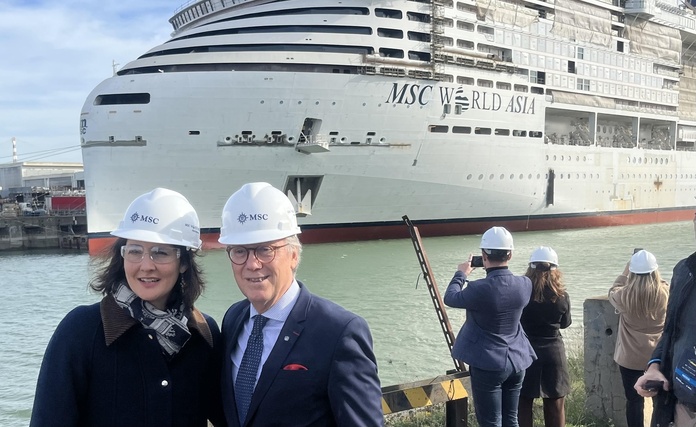
Cécile Walson et Patrick Pourbaix (MSC) lors de la mise à l'eau, le 12 novembre, du World Asia aux Chantiers de l'Atlantique. Le navire proposera des croisières de 7 nuits en Méditerranée dès décembre 2026 @LG

Although summer bookings are appearing more cautious and oriented toward last-minute, MSC notes a more favorable dynamic for the upcoming winter season.

The positioning of the MSC World Europa in the Antilles has notably triggered a strong acceleration in bookings, driven by both overseas and mainland clientele.

In parallel, the MSC World Asia will join Marseille from December 2026 to operate year-round in the Mediterranean. Yet the company is also refreshing its offer for the more seasoned customers.

Among the novelties are the opening of Alaska itineraries from Seattle and Vancouver, but also a new program departing from La Romana in the Dominican Republic, with an extended summer presence.

MSC continues to invest in Florida, notably driven by the appeal of Miami, a destination that many French travelers now combine with a few days on site before setting sail.


Laurent Guéna Published by Laurent Guéna Journalist – TourMaG.com
See all articles by Laurent Guéna

  • picto Linkedin
  • picto email
Add TourMaG to your Google News feed Google Actualités icône