Omio Group Announces Plan to Acquire Rail Europe


Omio Group annonce le projet d'acquisition de Rail Europe, image by OMIO

CroisiEurope


The Omio Group, a multimodal booking group, is launching a sector-wide consolidation phase by absorbing the Rail Europe platform on July 16, 2026.

Thanks to this merger, the newly formed group plans to sell 22 million train tickets per year and to collaborate with a network of more than 28,000 transport operators worldwide.

This transaction comes in a railway distribution market that is undergoing a restructuring, driven by European state investments in low-carbon transport infrastructure and the shift toward mobility alternatives to road and air travel.


Transaction details and operational organization

The integration of Rail Europe’s historic platform will allow the Omio Group to broaden its current offering, which already includes its consumer-facing B2C platform, its distribution service for professionals (B2B), as well as the Rome2Rio journey planner.

Rail Europe will retain its current brand identity with travelers and partners while migrating to Omio’s technological backbone and multimodal inventory. This technological transfer provides the acquirer with direct access to a network of travel agencies operating in more than 70 countries.

The operation will also lead to a reorganization of the company’s structures. The consolidated workforce is expected to reach approximately 680 employees worldwide, combining Omio’s teams with Rail Europe’s 205 staff.

However, the closing of the agreement remains subject to the regulatory information and consultation process with the bodies representing the staff, which must issue an advisory opinion on the project before any final signing.

AI: Major Dangers and a Tremendous Growth Opportunity?


"Le dialogue social doit très vite s’engager sur la question de l’IA" selon Sébastien Lecornu - Depositphotos @AlexanderPokusay

CroisiEurope


There is not a single tourism industry conference or event that does not feature an intervention dedicated to artificial intelligence.

After the initial exposure and the push to avoid missing this disruptive breakthrough, speakers often go in circles on the subject.

Interventions strive to democratize its use, to alert about disengagement or the “grand replacement,” but few interrogate the changes this could trigger in our societies and in our relationship with others, with the world, with work and with leisure.

I am a child of possibility; there is progress only if it is shared. The misfortune of some is very bad for the health of others.

How can we not understand, when nature is ailing, that we are ailing? We are in the same boat. Progress only works if we resist the disenchantment of the world.

I work a lot with AI, but at what natural cost does the artificial nature of AI operate? Because water is a key question.

Water is at once the engine of our lives and the mirror of our societies, questioned Erik Orsenna during one of his talks within the Aix-en-Provence Economic Meetings.


“A historic rupture, akin to the Renaissance and the fall of the Roman Empire”

And this reflection is far from being incidental.

While France boasts of colossal contracts to build data centers on its soil, a recent American study reveals that a single such facility can consume up to 19 million liters of water per day, the equivalent of the consumption of a city with more than 120,000 inhabitants.

This is not all, because the technological progress brought about by AI also implies potential brutal and fundamental changes in our society.

AI is great, but it can lead us astray.

I greatly appreciate the minister of Taiwan’s discourse on AI, who emphasizes that there must be engineers, but above all a sense of civic responsibility, a sense of curiosity and collaboration. Not everyone will become an AI engineer, but everyone will use it.

So there are values to develop, because otherwise, yes, jobs can be eliminated, but to do what? The problem is that we face a historic rupture.

It is as powerful as the Renaissance and the fall of the Roman Empire,
explained Jean Viard, the sociologist for whom there is no longer any question of speaking about progress in our current world.

This historic moment is triggered by AI, but not only.

To this revolution are added two anthropological ruptures. The first concerns the relationship between humans and nature. Today, it is no longer humans who make history; it is nature. The second concerns the male-female relationship and the explosion of patriarchy.

Contemporary society must therefore invent a new future, a new society, by integrating these three major changes.

And in the face of AI’s development, it is necessary to rewrite a common narrative, but also reintroduce responsibility at all levels—whether among users, political leaders or businesses.

In addition, there is the crisis of information.


“The social dialogue must quickly engage on the question of AI”

The real question we must ask is this: Who designs the algorithms and with what intentions?

Because they are neither designed nor regulated in Europe.

Information will survive only if treated as critical infrastructure, on par with water, electricity or telecommunications. The information from a source existing on the cloud must be protected as critical infrastructure, so that no one can stumble upon it,
” explained Rajesh Krishnamurthy, CEO of Sopra Steria.

However, for the moment, this does not appear to be the stance of the current government or of the European Union.

Individual initiatives remain, such as that of Le Monde, the only French media to have signed contracts with AI giants.

Its boss, Louis Dreyfus, wants the regulator to take up the subject to prevent only a few newspapers from serving as sources for generative AI models.

Because, for him, the algorithms must reach readers aged 35 and under, thus renewing a readership that is aging rapidly. This is not the only opportunity represented by this technological revolution.

We are witnessing an acceleration in research, the creation of new professions and the need to generate data in a different way.

This world of terror, in which AI would replace everyone, is not yet there. We are in a transition period, in which we need high-quality data to use AI intelligently and rationally.

We must apply the fundamental principle of responsibility in all that we do, thus asking why we conduct research, for whom and how, while integrating AI
“, assessed Yasmine Belkaid, Director General of the Pasteur Institute.

To this, it will be essential to add the development of critical thinking, in a world that increasingly lacks it.

This will enable questioning the responses of AI agents and not accepting them as gospel, especially for next generations who will be born directly into this revolution.

Incidentally, for the current Prime Minister, the time has come to draft a new pact between employees and employers, integrating AI, to prepare the world of work for this rupture.

I do not see very well how one can discuss artificial intelligence and its impact on labor law if we do not engage in a five-, ten- or fifteen-year reflection.

Other countries around us are doing it.

It is evident that the social dialogue must quickly engage on the question of artificial intelligence and its impact on labor law. And this cannot wait for the presidential election.

There must already be a number of proposals on the table for us to seize and organize the political debate on this,
” set the course Sébastien Lecornu.


“AI is a weapon to kill bureaucratic jobs”

And while there have certainly been voices questioning this revolution, few have urged stopping it or slowing down.

Because for the business and political spheres, AI opens a new era, a new lever of economic growth that this disenchanted world needs.

The situation is such that American graduates protest this technology. Unable to find jobs after completing their studies, they would even turn to more manual trades less likely to be displaced by algorithms.

To read: Tourism jobs in the face of AI: technological mutation or new hospitality?

This question obviously arises in the tourism sector.

Everyone is realizing that we are entering an era of abundance of intelligence, whereas in the past, it was a scarce raw material.

We are in a kind of Spotify of intelligence, we can consume intelligence.

We are witnessing the end of humans performing supervised tasks. White-collar workers will have to immediately position themselves as supervisors to pilot AI agents. This raises the question of learning, because it used to take three to five years to become a supervisor. That step disappears.

In Western societies, we have created a large number of bureaucratic jobs. But AI is a weapon to kill bureaucratic jobs. And European and American educational systems have been designed to train young people for these jobs, whereas they will disappear
“, imagined Matthieu Courtecuisse, founder of the Sia consulting firm, based in New York.

A very dark vision, which aligns with the theories of “job apocalypse” that would accompany the deployment of algorithms throughout our lives.

For Myriam El Khomri, the former Minister of Labor in the Valls government, there is currently no visible impact on the job market.

We don’t know, and that is the conclusion of many studies.

But one thing is certain: it raises questions about technological maturity, managerial and organizational readiness, because it is above all a productivity issue.

In the automobile industry, when a new project took three years to come to fruition, it now takes nine months. This pace and evolution reveal our difficulty in organizing transitions.

Regarding training, it should no longer be viewed as a stock of knowledge acquired at the start of a career. AI must prompt us about our capacity to reorient ourselves
“, estimated, less radically, the director of CSR and strategy at Diot-Siaci.


IA : “a great danger and a tremendous opportunity for growth”

The uncertainties are numerous when we open the imagination around AI.

No one really knows what our future will look like, nor whether today’s jobs will be the same tomorrow. One thing is certain: AI should massively boost human productivity and therefore raise economic growth.

Europe can be the continent that best applies AI to its real economy.

I come from the United States, where I did a kind of AI trek. I was struck by the speed with which AI models are deployed there. Companies have taken this issue head-on.

And what makes me optimistic about jobs is our ability, with generative AI, to enhance human intelligence.

The challenge for businesses, as Éric, is to ensure that our employees become more productive, more creative and more competitive with AI. Our huge challenge is not to fear job destruction, but to work on transforming jobs and improving the employability of our staff
, stated by Éric Maumy, president of April.

To read: Arnaud Vaissié (International SOS), spokesperson for “considerably worried” bosses

The entire current issue in our economies, which are losing vitality, existing bearings and value, is to re-ignite the future through algorithms. They would open a new era of prosperity.

This is also the belief of the most recent Nobel Prize in economics.

The generative AI revolution reshuffles the labor market and raises the question of the concentration of economic power and wealth, to which one cannot be indifferent.

It can be a great danger, but it is also a tremendous growth opportunity.

AI will enable us to produce goods and services much more easily. It will also make it possible to innovate much more easily.


This force is like a wild horse. It can crash into a wall or lead you where you want to go, if you put in place the right institutions and policies.

We must move from growth by catching up, which characterized the Thirty Glorious Years, to growth through disruptive innovation and high-tech
, explained Philippe Aghion.

It remains for Europe to change its mindset, mobilize capital and promote its values without compromising them.


Hospitality: Dida Drives Bookings Without Leaving AI-Powered Apps


Dida veut générer des réservations de vols et d’expériences directement dans l’IA - Depositphotos

CroisiEurope


Dida fait entrer l’hôtellerie dans l’ère de la réservation entièrement gérée par l’IA.

Avec Dida MCP, l’objectif est de répondre à un enjeu clé du voyage dopé par l’IA, c’est-à-dire transformer une simple recommandation en réservation confirmée, sans faire sortir l’utilisateur de l’environnement du partenaire.

Dida MCP donne accès à un portefeuille de plus de 2 millions d’établissements hôteliers dans plus de 100 pays, à destination de ses partenaires professionnels du tourisme.

Ces derniers peuvent donc faire bénéficier les internautes et les voyageurs de ce vaste portefeuille d’hôtels directement dans leurs applications utilisant l’IA, leurs agents conversationnels ou leurs plateformes clients.


Dida aims to generate flight and experience bookings directly within AI

La société insiste sur le fait qu’elle ne souhaite pas se positionner comme un acteur B2C, mais prolonger son modèle d’infrastructure B2B.

Le partenaire conserve ainsi sa marque, la relation client et la donnée, tandis que Dida opère en coulisses la connectivité, les disponibilités, les tarifs, les réservations, les paiements, les confirmations et le service.

La solution s’adresse notamment aux agences, OTA, TMC, tour-opérateurs, grossistes, banques, programmes de fidélité, plateformes e-commerce ou encore opérateurs télécoms.

Dida prévoit, à terme, d’étendre cette approche au-delà de l’hôtel, vers les vols, le transport terrestre et les expériences.

Beyond the Exchange Rate: What Top Travel CFOs Are Really Watching


© Airwallex

CroisiEurope


At the start of 2025, an interesting phenomenon unfolded in Canada. The United States announced a fresh set of tariff measures. Travel by Canadians to the United States collapsed immediately. Yet Canadian domestic tourism—road trips, lakeside cabins, national parks—surged to fill the gap. The currency shifted. Travelers moved even more.

Tannah Matus, CFO of Secret Food Tours, followed the situation with a highly professional eye. Her team had not anticipated the tariff changes, nor Canadians’ responses, nor the impact on exchange rates. What she did do, however, was build systems to monitor real travel movements and reallocate resources accordingly. “We focus more on people’s movements than on the policies behind FX implications,” explains Tannah Matus. “Is the American traveler still traveling? What share of the U.S. domestic market is occupied by domestic travel?” The currency impact matters, but changing traveler behavior matters even more. And it creates opportunities for operators who are nimble enough to seize them.

This instinct—to observe behavior rather than the Bloomberg terminal—has fueled all the Airwallex Margin Fortification Playbook 2026 conversations. The top finance teams in the sector do not build elaborate macroeconomic models. They track signals that most spreadsheets fail to capture.

With Golf Traveller, Darren Behan sees risk in the calendar, not in the market. “When a major tournament is announced, our financial architecture must be ready to support a sudden, day‑to‑day surge in multi‑currency transactions.” For a luxury operator where a single booking can exceed $20,000, missing on a currency conversion or payment timing during a peak demand period is not theoretical: it is a real competitive disadvantage with a concrete price tag.

Flash Pack’s clientele are predominantly American and female. The CFO, Oliver Lee, monitors in near real time how world events influence traveler confidence. When customers feel less comfortable about a destination (for political, security, or negative publicity reasons), bookings shift before analysts publish projections. Detecting these signals early gives operations time to rearrange itineraries, adjust marketing investments, and renegotiate supplier commitments. Lee notes that perceptions of safety and hospitality evolve faster and weigh more than exchange rates when customers decide whether to click “book.”

Adam Mitchell, Financial Controller at On the Go Tours, provides a lesson in preparation. Egypt had long been the company’s flagship destination. When the Israel‑Gaza conflict began to worry clients about the broader region, On the Go Tours had already begun diversifying. “They had already initiated a plan to broaden our portfolio,” explains Adam Mitchell. “Historically, we were heavily oriented toward Egypt. Even before tensions rose in the Middle East, we started opening other destinations, which helped when things became complicated in the region.” The lesson is clear: the time to diversify is before a crisis hits. When you need protection, it’s already too late to build it.

Jamie Tran Rico Pisa, at Transforma Travel Group, takes an unconventional tack: preparing for good news. His firm tracked how likely it was that British travelers could soon enter China visa‑free, a development likely to spur demand. “We already have many travelers traveling from the UK to China,” he says. “But we may need to bolster our operating team in China so that we feel fully prepared to absorb the surge.” Transforma runs regional discussion groups where teams share everything—from health alerts to natural disaster warnings. Information flows quickly enough to let the business adjust plans before problems explode, and to be ready when opportunities arise.

The through line is proactive intelligence rather than crisis improvisation. These teams don’t wait for an incident to occur to hold a meeting. They have embedded listening mechanisms into the daily cadence of their operations.

The question then becomes how to deploy cash while it’s available. If FX risk and operational frictions are complex, multidimensional problems, dormant cash management is, by contrast, surprisingly simple. All the CFOs interviewed for the playbook follow roughly the same approach: sweep excess working capital into yield‑bearing accounts and resist the urge to over‑complicate things.

“We have sweep accounts, short‑term accounts that generate market rates,” explains Oliver Lee. “We use rolling deposit accounts, with roughly a one‑month notice, that offer a return from major financial institutions. And that’s it.” He stresses the need not to over‑complicate Flash Pack at its current scale. Larger firms can diversify into corporate bonds or other instruments, with dedicated treasury teams to drive those strategies. “But at our size, one of our rules is to keep things simple. You don’t really earn more yield by adding complexity when you have a few million. The impact is marginal.”

Tannah Matus shares this view and notes that the current rate environment makes the math particularly attractive. With dollar deposits yielding around 4 to 4.5%, even the simplest accounts generate meaningful returns. Left idle, this excess cash is, in her words, “just a salary, money that’s sleeping.”

But travel cash flows obey a constraint not faced by most industries: client deposits, not corporate surpluses. Jamie Tran Rico Pisa makes this limit crystal clear: “We operate within a fairly narrow field, because, ultimately, these are client deposits. We must ensure that these funds are used to finance the trip.”

The regulatory framework reinforces this caution. Zoe Powell, Director of Travel, Hospitality and Leisure at Xeinadin and formerly with the Civil Aviation Authority, notes that ATOL‑licensed tour operators face strict liquidity requirements: “Typically, around 70% of client funds must be held in cash or cash equivalents, readily available.” Some operators must keep these funds in an escrow account until the client returns. These constraints cap the yield accessible, which precisely explains why all the CFOs in the playbook favor simple savings accounts over more exotic solutions.

The consensus is clear: in today’s rate environment, given the fiduciary responsibilities inherent in the travel sector, sophisticated treasury strategies offer only a marginal gain that does not justify the added complexity, risk, or sleepless nights.

Three principles emerge from these exchanges:

● Observe behavior, not just rates, because the most advanced operators look at where travelers actually go, not merely what currencies do.

● Keep yield strategies simple, since accounts like sweep and rolling deposits work reliably for most players in travel.

● Build a financial infrastructure that absorbs shocks rather than amplifying them, turning finance teams into true business partners rather than back‑office functions.

Or, more bluntly as Jonathan Wall of Xeinadin puts it: the gap between booking and settlement will always exist. What matters is what happens inside your organization, because that is where your expected profit can literally vanish.

To access the complete set of experiences from five finance leaders, covering currencies, payments, operations, and working capital, download the playbook: “Guide 2026: How to Protect Your Margins.”



Contact Airwallex


Au-delà du taux de change - Ce que les meilleurs directeurs financiers du travel regardent vraiment
To get in touch with us, please fill out this contact form

Website: www.airwallex.com

facebook linkedin twitter instagram youtube


Emerging Travel Group (RateHawk, Roundtrip) Expands Its Airline Offering With Travelport


De nouvelles fonctionnalités pour simplifier la gestion post-réservation - Depositphotos.com, Rawpixel

CroisiEurope


Emerging Travel Group, the parent company of RateHawk, ZenHotels and Roundtrip, announces the strengthening of its partnership with Travelport.

The company is expanding the integration of Travelport’s aviation content, with the aim of simplifying reservation management and post-booking operations for travel professionals.

This development is expected to enable agents and travel managers to carry out certain air-ticket related tasks more easily, such as issuing, canceling, or voluntary refunds.

The announcement comes as the peak summer season approaches, a period when booking volumes and modification requests are especially high.

Emerging Travel Group began integrating Travelport’s offering in 2025.

Airline tickets from the platform were initially added to RateHawk, a multi-product booking platform for travel professionals, and to Roundtrip, its business travel solution.


Travelport bets on integrated workflows

Users of these two platforms can also access Travelport’s GDS rates and content, as well as the NDC content from certain airlines.

The announced extension is designed to further facilitate dossier management once a booking is made, directly from the environments used by professionals.

Direct access to the various offers from airlines is essential for travel professionals, as it allows them to manage their clients’ itineraries and make changes without having to contact third-party providers“, explains Fredrik Bonnalt, head of the non-accommodation offering at Emerging Travel Group.

According to him, this integration also helps speed up the booking process and improve customer service.

For his part, Jason Toothman, Travelport’s Chief Commercial Officer, underlines the growing demand for integrated management of air content within a single workflow.

He highlights TripServices, Travelport’s platform dedicated to the creation and management of travel products, which should enable professionals to access, book and manage content more quickly.


Emerging Travel Group aims for IATA accreditation

The partnership also aligns with Travelport’s artificial intelligence strategy. The group recently announced a collaboration with Cognizant and Anthropic, some features of which will rely on TripServices to further integrate AI into travel professionals’ workflows.

In parallel with its collaboration with Travelport, Emerging Travel Group continues its development in the airline distribution market.

The group is particularly aiming to obtain IATA accreditation for several of its legal entities worldwide. The first accreditation has already been obtained in Germany.


Amelia Brille Published by Amelia Brille TourMaG.com Editor
See all articles by Amelia Brille

  • picto Linkedin
  • picto email
Add TourMaG to your Google News feed Google Actualités icône  

Discover the Giza Plateau from Marseille


Eclipso ouvre son sixième centre à Marseille avec L’Horizon de Khéops - Photo : Eclipso

CroisiEurope


Eclipso continues its development in France. The specialist in immersive experiences will open, on July 31, 2026, its sixth center at the Terrasses du Port, in Marseille.

For its installation in the Phocaean city, the brand will offer L’Horizon de Khéops, a virtual reality expedition dedicated to ancient Egypt.

After Lyon, Paris, Bordeaux, Lille and Nantes, Eclipso thus continues its national rollout. Marseille becomes the fourth French city to host L’Horizon de Khéops, after Bordeaux, Paris and Lyon.


Eclipso: a 45-minute immersion at the heart of the Gizeh Plateau

Created by Excurio, the immersive experience has already attracted more than two million visitors worldwide. Prices range from 24.50 to 29.50 euros.

L’Horizon de Khéops invites visitors to explore the Gizeh plateau and the Great Pyramid of Khufu, one of the Seven Wonders of the Ancient World.

Equipped with a connected virtual reality headset, participants are transported to the foot of the great pyramid, where they begin a guided expedition led by an avatar named Mona.

To read: Virtual reality: another way to travel?

For 45 minutes, the experience offers to discover different aspects of Egypt during the IV Dynasty.

Visitors can notably soar above the Gizeh plateau, reach the pyramid’s summit to enjoy a 360-degree view, then explore its corridors and burial chambers, including the Queen’s Chamber.


An experience developed with experts in ancient Egypt

The journey also includes a voyage along the Nile, during which participants witness the funeral rites of King Khufu (Khéops) and an embalming ceremony designed to give an overview of ancient Egyptian funerary practices.

The uniqueness of the experience lies in the freedom of movement offered to participants. In a space of over 700 m², everyone can move freely thanks to their avatar and share the expedition with other visitors, whether as a family or with friends.

L’Horizon de Khéops was developed after several years of on-site research and data collection. The project notably benefited from the collaboration of Egyptologist Peter Der Manuelian and his team at the Giza Archives Project, affiliated with Harvard University.

To read: Travel in virtual reality: a substitute for real tourism or an ecological imperative?

Archaeological, architectural, and historical data were used to reconstruct the Gizeh plateau and the various environments visited during the experience.

The creation of the immersive universe and the information delivered by the virtual guide Mona were also overseen by specialists in ancient Egypt.

Having already been presented at the Institut du Monde Arabe in 2022, where it was notably visited by the President of the Republic, Emmanuel Macron, the experience now settles permanently within an Eclipso center.


Amelia Brille Published by Amelia Brille TourMaG.com editor
See all articles by Amelia Brille

  • picto Linkedin
  • picto email
Ajoutez TourMaG à votre flux Google Actualités Google Actualités icône  

Mirai Integrates Multi-Room Booking into Its AI Assistant Sarai


Mirai fait évoluer Sarai pour gérer les demandes de plusieurs chambres - Depositphotos.com, sdecoret

CroisiEurope


Mirai upgrades its AI assistant and its conversational reservations engine Sarai.

The solution can now handle requests for reservations of multiple rooms within a single conversation, without forms or intermediate steps.

A client can thus directly formulate a request such as: “I need two rooms for a family with children”. Sarai is then able to identify the need, manage the booking, and continue the exchange in natural language.

This feature is available across all channels on which Sarai operates, including the webchat, WhatsApp, email, Instagram and telephone.

It is also accessible via ChatGPT, thanks to Apps, and Claude, via MCP.

Mirai states that it is included at no additional cost for customers of its reservations engine.


Multi-room bookings account for 18% of revenue

For hotels, requests involving multiple rooms represent a significant commercial challenge.

According to Mirai’s data up to July 2026, bookings for two rooms or more account for 9.07% of the total reservations made via the web engine.

They nevertheless generate 18.45% of the nights and 18.44% of the revenue linked to rooms. Their value weight is therefore almost twice their volume weight.

The demand is also present on conversational channels. During the last 30 days, 7.03% of availability requests processed by Sarai involved multiple rooms.


Group requests turned into qualified leads

The new feature also accounts for requests that exceed the number of rooms that can be booked online directly.

In this case, Sarai explains to the client the online booking limits, collects their contact details as well as the details of their stay, and then generates a qualified lead for the hotel.

The request is then visible in real time in Lobby, the AI infrastructure dashboard of Mirai, and triggers an email notification to the establishment.

For Mirai, this approach allows transforming a request that could have been abandoned with a traditional booking engine into a business opportunity at the moment the client expresses their purchase intent.

Handling multi-room bookings was essential in conversational reservations. Today, customers express their need with all their details and their complexity in natural language, and expect the hotel to know how to respond“, explains Pablo Delgado, CEO America of Mirai, in a press release.

According to him, available data show that hotels capable of handling these complex requests are able to attract higher-value clientele.


Amelia Brille Published by Amelia Brille TourMaG.com editor

See all articles by Amelia Brille

  • picto Linkedin
  • picto email
Add TourMaG to your Google News feed Google Actualités icône  

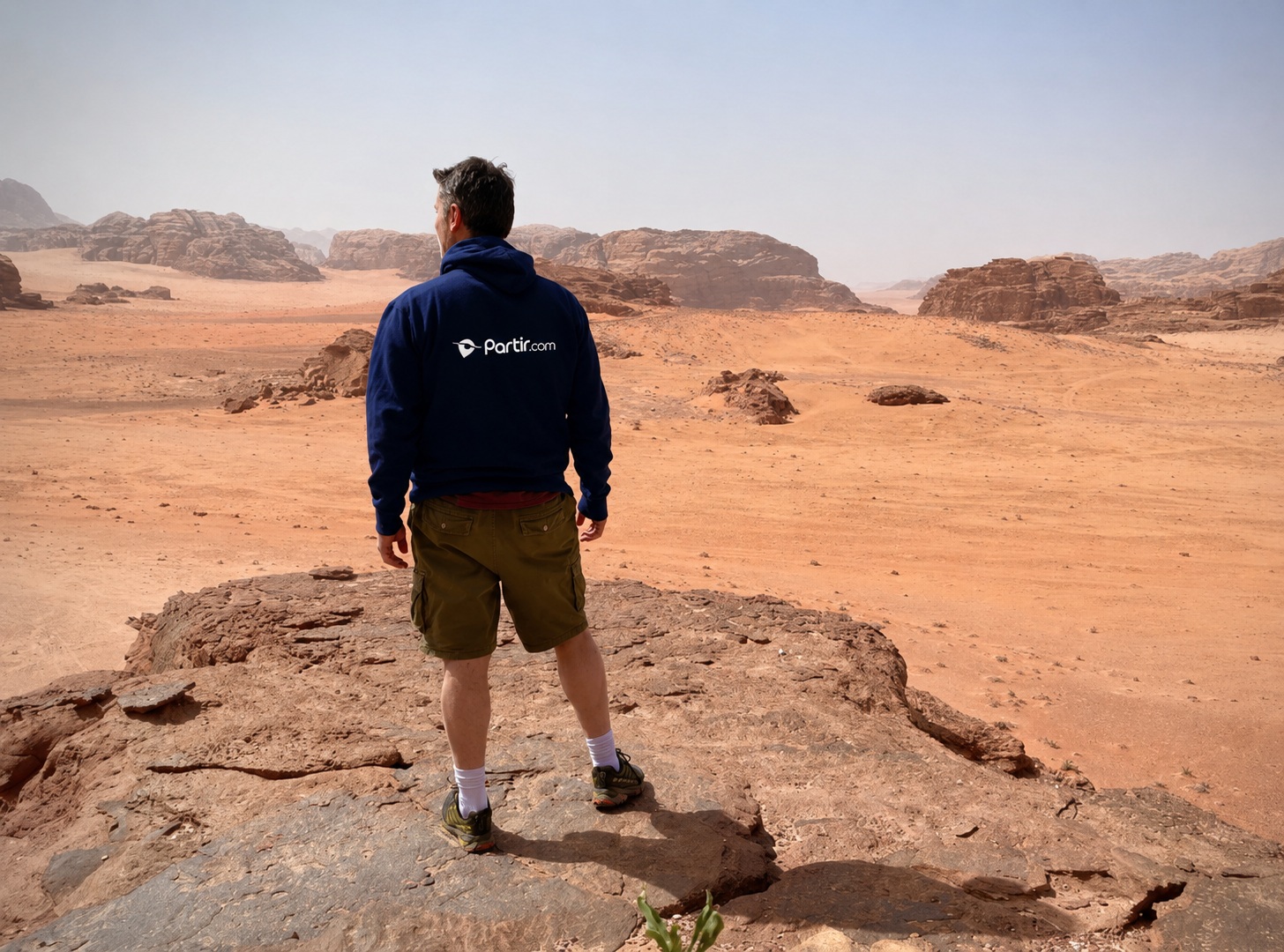
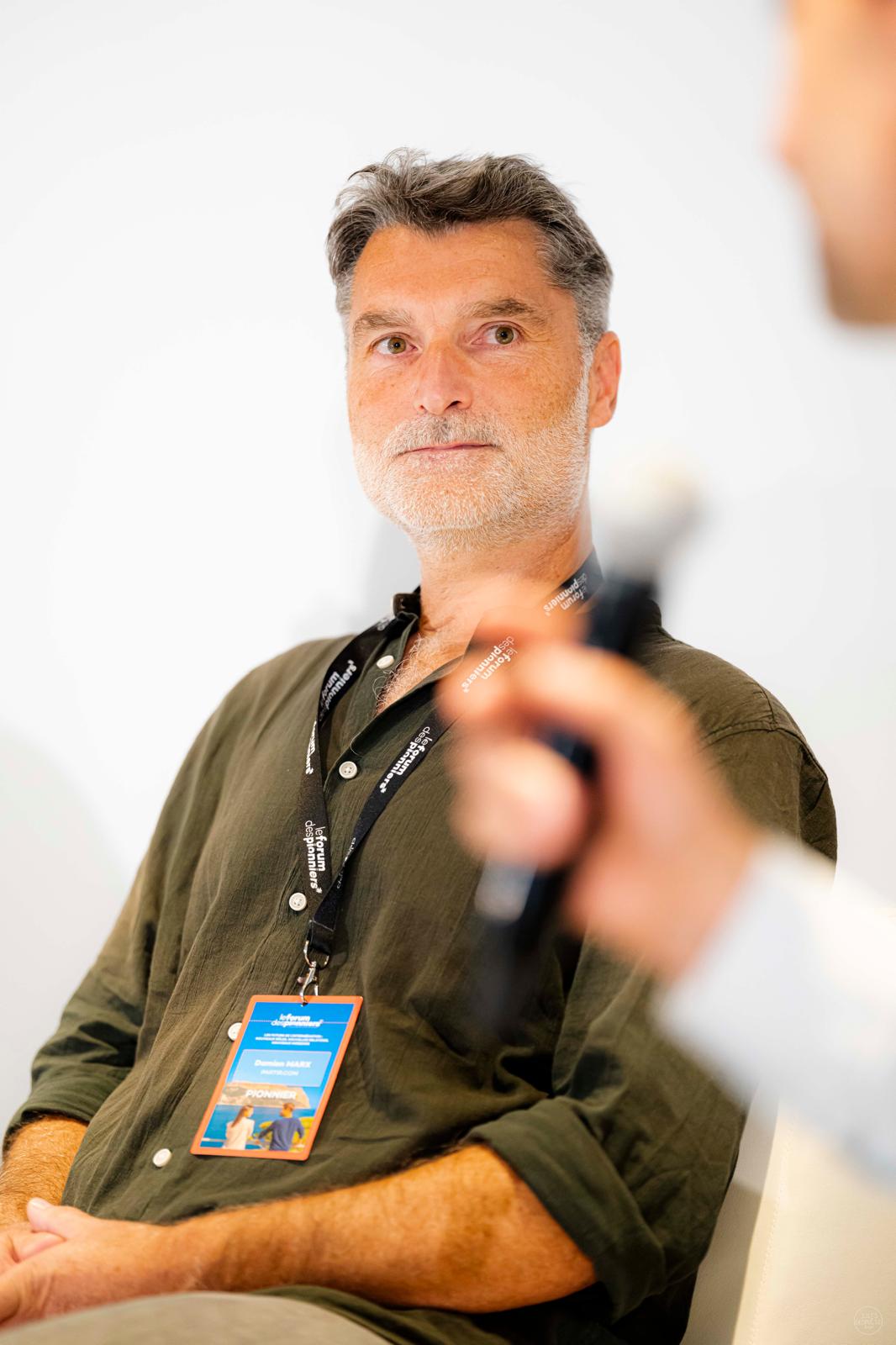
Damien Marx: AI Is a Lever, Not a Threat for Partir.com


Partir.com permet de créer des voyages sur-mesure (aussi pour les agents de voyages) - Photo : Damien Marx

CroisiEurope


He began his career at a time marking the end of the travel agencies’ golden age.

In 2000, Damien Marx was recruited as a web project manager at Coface, the French export credit company. At that time, the Internet ran through dial-up modems that sang a small tune which the first geeks have not forgotten.

Only 14% of the French population had access to what would become the revolution of this new century. Travel agents watched with skepticism as these teenagers transformed their parents’ garages into start-ups.

I graduated at the moment of Internet’s explosion. I went to engineering school, then spent fifteen years in a subsidiary of Banque Populaire, where I started as a developer, before becoming IT manager and leading large teams.

At the same time, I created a sports social network to find partners for tennis matches. In fact, it was a bit like Facebook—you had your friends whom you met on the courts.

It arrived too early; there weren’t enough Internet users
“, recalls Damien Marx.

This tennis Facebook became the LinkedIn of the yellow ball, after organizing a Lyon-based decision-makers tournament, but in 2003 Tennis Défi—its real name—shuts down its servers.

Be that as it may, this first initiative, far from a large group, planted a seed in the head of the IT manager. He wants to give more meaning to his daily life and to leave a field where he does not truly thrive.

To read : When Rothko and Zao Wou‑Ki reveal the invisible in travel according to Damien Marx


Partir.com: a search engine for… destinations

He takes advantage of Coface’s restructuring to regain his freedom.

We are in the mid-2010s, travel explodes online, yet with some gaps.

I start from the observation that, ultimately, organizing a trip is complicated. There was a need and I was passionate about this sector.

At that time, searches were limited to two criteria, destination and date. Yet traveling is much more complex. There are already the composition of participants—family, couple, etc.—, activities, the temperature or the expected weather. Do I want to go swimming?, etc.

I then set out to create a destination search engine. There were nearly 50 criteria to make one’s choice
“, he explains.

From this premise, Partir.com was born.

The platform evolves month by month and through the founder’s developments. Starting from the lean startup approach—advances by iterations—he always adds more content and services for Internet users.

Quite quickly, the site carves out a place alongside players such as Génération Voyage or Le Routard. Because travel has numerous virtues. It can be an escape, a liberating moment, a step of redemption, or the journey that changes a life by allowing you to meet the person who will share part of your path.

For Damien Marx, it mainly allowed him to find… his business model.


Partir.com: a business model found… during a trip!


Sur Partir.com, "nous avons trois volets : je m’inspire, je m’informe et je compare" explique Damien Marx - Photo : Jules Despretz

Back then, with my ex-partner, we went to Sri Lanka. I had found the contact of a local guide somewhere on a forum. We thus found ourselves at an airport in Sri Lanka with my two five-year-old sons, waiting for a person I had simply emailed.

After a moment of doubt, the experience was incredible; it resembled what Evaneos does today
“, recalls Damien Marx.

A few weeks later, with memories in disarray, the Lyon family returns home. And the leader’s vision evolves: “the guides, the receptive operators, on the other side of the world, cannot always have a website or market in France. At the same time, Partir.com’s clients wanted to go directly,” he confides.

The site then becomes a genuine millefeuille, with bricks added one atop another.

It is at once a source of inspiration, a travel guide, a comparison tool, and a platform for direct connections between travelers and tourism professionals, whether receptive operators, tour operators, travel agents, etc.

We have three pillars: I get inspired, I get informed and I compare. I start from travelers’ needs, offer a tool or a service, then adjust and improve things.

This method allowed me to work on SEO, because SEO is ultimately about answering users’ search intents and shaping how to deliver that answer.

The aim was therefore to provide a reliable response, with a quick and visual reading, all on an easy-to-use site
“, continues him.

To read : Dubai: “There exists a striking contrast between the situation and life going on” (Video)


Partir.com allows the creation of tailor-made trips (also for travel agents)

Through these two years under unemployment benefits, Damien Marx polishes and develops his site, which quickly becomes a national reference.

With my savings, I bought the domain name, which belonged to someone who posted travel photos in Argentina. It took me two years and a lot of work for it to take off. Then I was able to create jobs, employing nearly 50 journalists.

I continued working with Maéva Hugot, for 7 years now; she handles communication, video and card creation, but also relations with agencies and content improvement.

These two years of unemployment were quite profitable for the State
“, testifies this avid reader of TourMaG.com, in a context of questioning social gains.

The site finds a good place on Google, the audience is there. The growth is steady, approaching 10 million visitors per year.

Today, the arrival of AI is still no obstacle to this. It is even more a lever for development.

Thanks to the work of our editors, we offer only verified information, and we add a layer of tools that AI does not have.

And while ChatGPT provides textual responses, we try to be more visual, to offer maps and infographics, so as not to compete head-to-head with AI. For now, the audience is slightly increasing, even if I expect to lose some on easy queries.

Before, I developed everything by myself. Now, I rely on AI. I have become a project manager who oversees the work of five or six virtual developers who are AI agents. The editors also have a supervisory role over content generated by large language models
“, explains Damien Marx.


Partir.com: facing AI, the platform will publish paper guides…

He continues: ““Over all these years, the most notable evolution is the leap in personalization.

We have integrated a planner to create itineraries based on travelers’ desires and the database of our journalists, plus profile management. It’s new, but it allows us to better know travelers and retain their searches.

Now, it is really possible to create a tailor-made trip. It is completely free. I would like to meet travel agencies and propose this tool to them
“, reveals the founder of Partir.com.

The tool is designed to be very ergonomic and easy to use. In just a few clicks, it can generate an itinerary that cross-references journalists’ data. It will also aim to push partner offers for destinations chosen by travelers.

It’s not all, because in the face of the risk that AI represents, Partir.com is building an ecosystem to assert its brand.

During Covid, a YouTube channel was created.

The images are then selected from video libraries, assembled by an editor, and accompanied by narration by a voice actress. The channel earns a respectable following, with 5,000 hours of viewing and 100,000 views per month.

This notoriety is at the heart of the entrepreneur’s concerns. After YouTube, the Lyonnais wants Partir.com to go beyond screens.

“”I try to always stay one step ahead. We will release a paper guide called Atlas of Travel Ideas. I would also like to create guides with “new perspectives,” where the traveler learns to look, to feel differently, becomes an actor of the journey and better understands things.

With AI, the main risk is a loss of trust from users, so I want to develop the brand and trust. And, consequently, be better ranked on Google and AI,” concludes Damien Marx.

In the end, the new world and the old are not that disconnected.


Manawa Acquired by Austrian CheckYeti to Create a European Outdoor Activities Giant


Manawa a été rachetée par Checkyeti, marketplace autrichienne dédiée aux expériences de plein air et de nature - DepositPhotos.com, lightpoet

CroisiEurope


Manawa scales up.

The French platform specializing in booking outdoor activities joins Checkyeti, the Austrian marketplace dedicated to outdoor and nature experiences.

The new entity provides access to more than 27,000 activities offered by more than 8,000 providers across Europe.

The operation marks a new step in the consolidation of the European outdoor activities market.

“”Rather than simply getting bigger, the transaction combines geographic strengths, product portfolios, technologies and established relationships with providers” , the two companies say in their press release.

For Manawa, this operation should notably bring “the size, technology and resources needed” to accelerate its development. “Together, we share the ambition to build the first European platform dedicated to outdoor and nature experiences“, declares Timothée de Roux, its chief executive.


A project launched with the support of the Banque des Territoires

Behind this operation lies a project launched amid the health crisis.

In 2021, Alentour was officially created as part of the tourism recovery plan, with the support of the Banque des Territoires, and in partnership with Amadeus and Dawex.

The aim was then to digitalise the offering of leisure activities in France and to better connect local providers with hoteliers and tourism institutions.

Hotels, campsites, tourism offices and other players can thus offer their clients locally bookable activities online. The platform should also enable small and medium-sized enterprises in the sector to gain visibility and access a new distribution channel.

At launch, Alentour offered more than 2,500 activities bookable in nearly 200 hotels, mainly on the Côte d’Azur.

The project was then to be progressively rolled out in other territories.


The shift toward outdoor experiences

The strategy evolves in 2022 with the acquisition of Manawa.com, a platform specialized in outdoor and adventure activities. In 2024, Alentour ultimately adopts the name Manawa and concentrates its development on this market.

Canyoning, paragliding, diving, canoe-kayaking, boat trips, mountain activities or even unusual experiences gradually enrich the catalog.

The company then set ambitious goals. It targets more than 10,000 activities connected by the end of 2024 and a turnover of €100 million by 2027-2028.

Growth is indeed on track. Revenue rises from €10,000 in 2022 to €81,000 in 2023, then to €2.28 million in 2024. Yet accounts remain loss-making. Net income stands at -€9.56 million in 2022, -€4.07 million in 2023 and -€3.79 million in 2024. EBITDA also stays negative in 2024, at -€2.92 million.

The trend clearly improves, but at this stage the company has not yet achieved a profit.

The strong growth of activity continues to be accompanied by , as Manawa pursues its investments and expansion.


“A new step” for the Bank of Terrritoires

With the Checkyeti deal, Manawa enters a new phase of its development.

Alentour SAS becomes an operating company of the Checkyeti group, while the Manawa brand is retained and continues to be led by its current team.

The Banque des Territoires remains a minority shareholder of the new entity.

For Camille Rives, head of tourism at the Banque des Territoires, this operation constitutes “a new step in the company’s development“. “By remaining a shareholder, we continue to support its long-term growth and the emergence of a leading European platform dedicated to outdoor and nature experiences“, she adds.

The new group now aims to accelerate its investments in digital distribution, artificial intelligence, and automation. The stated objective is to better support the thousands of independent providers in the sector, still largely under-digitized.


Amelia Brille Published by Amelia Brille TourMaG.com Editor

See all articles by Amelia Brille

  • picto Linkedin
  • picto email
Add TourMaG to your Google News feed Google Actualités icône  

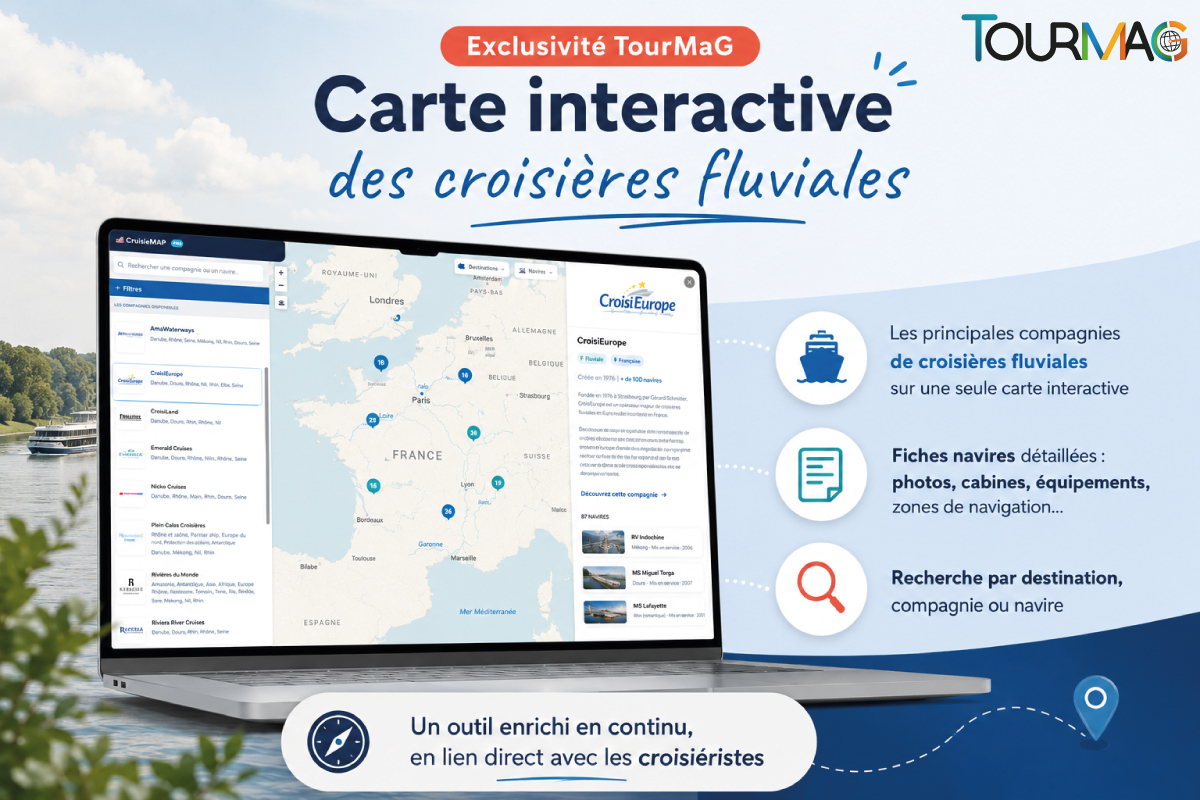
CruiseMAP: The Interactive Map for River Cruises


18 cruise companies, more than 300 ships and 29 rivers

Thinking to complement our feature on River Cruising, launched in mid-June, CruiseMAP now references 18 river cruise companies and more than 300 ships, spread across 29 rivers and waterways around the world: Rhine, Danube, Seine, Rhône, Douro, Nile, Mekong, Mississippi, Garonne, Loire, Volga, Amazon and many others.

For each company, the tool provides access to a detailed profile presenting its full fleet.

For each vessel, a technical data sheet gathers all essential information: passenger capacity, number of cabins, year of service, length, crew, as well as a description of the ship and its navigation zones.

When available, the profiles are enriched with photo galleries (exterior views, cabins, public spaces) and deck plans.


Filters to Find the Right Vessel

The tool offers an advanced filtering system to refine the search: river, range (from Economy to Ultra-luxury), onboard amenities (spa, pool, restaurant, fitness, jacuzzi, wifi, etc.).

A search engine also lets you instantly locate a company or vessel by name.


A Living Tool, Continuously Enhanced

CruiseMAP is continually expanding: new companies referenced, ship profiles updated, photos added.

The objective is to build the French-speaking reference database on river cruising, serving tourism professionals.