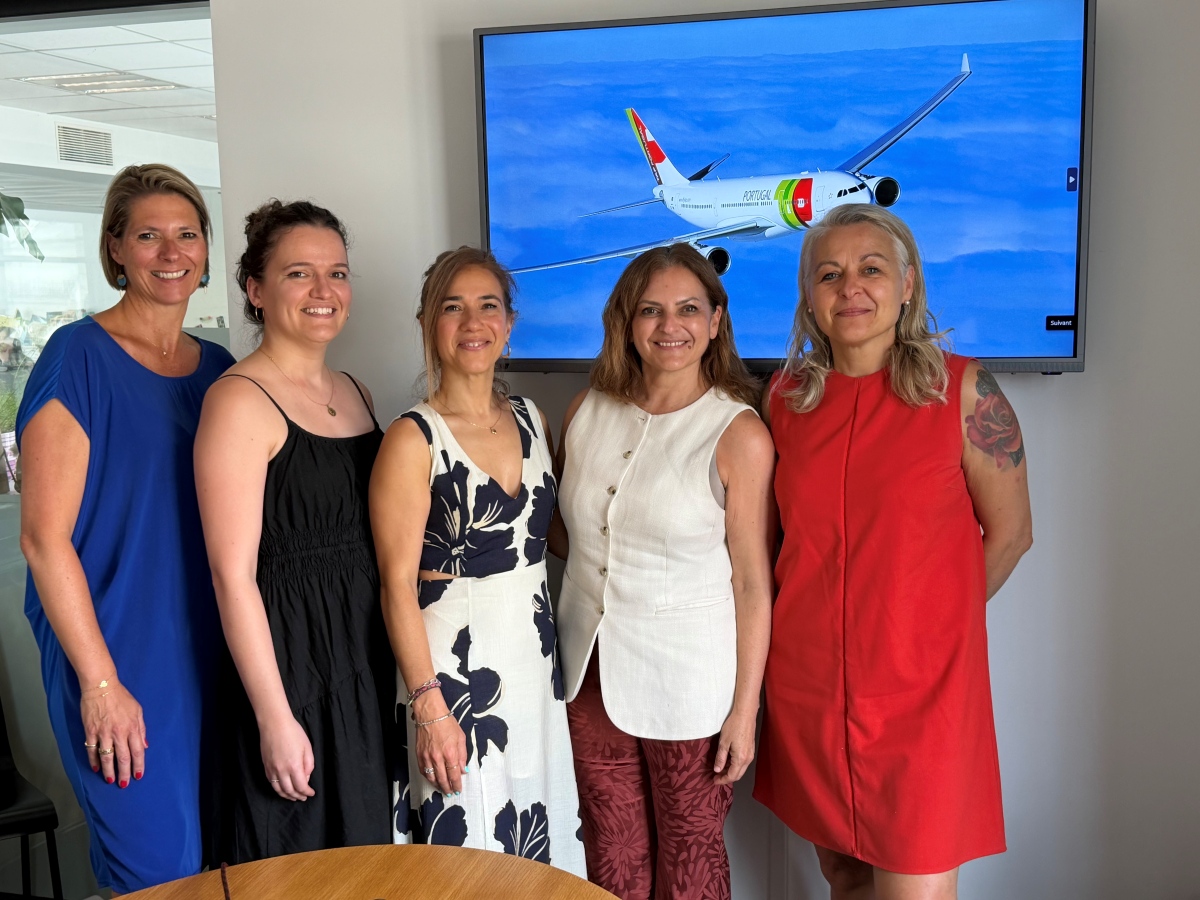


Based in Madrid, Paloma Utrera was in Paris last week.
The opportunity to meet her and her teams for a discussion about major sector developments, such as evolving travel habits, connectivity challenges, and the market’s new dynamics.
In this context, and within TAP Air Portugal, we also discussed the French market and the connections from the mainland, the growing role of Portugal as a hub between Europe, South America and Africa, the evolution of the onboard product and the opportunities offered by a stopover in Portugal.
The opportunity to meet her and her teams for a discussion about major sector developments, such as evolving travel habits, connectivity challenges, and the market’s new dynamics.
In this context, and within TAP Air Portugal, we also discussed the French market and the connections from the mainland, the growing role of Portugal as a hub between Europe, South America and Africa, the evolution of the onboard product and the opportunities offered by a stopover in Portugal.
TAP Air Portugal: 132 weekly flights between France and Portugal
TourMaG – You took over from Rino Morosini at the beginning of this year 2026, a strategic year for TAP. How is this transition unfolding?
Paloma Utrera : Rino did an excellent job and I arrived in Paris to “inherit” the position, so to speak. There was first the inauguration of our business lounge in Paris, which, as a reminder, is TAP’s only lounge outside of Lisbon.
This is important for us. There was also the launch of our onboard service Economy Prime last month in June on our long-haul flights. It is a product we wanted to offer to our clients, our corporate passengers, and all those who do not travel in business class but still desire a differentiated onboard experience.
We are, in this regard, very satisfied with the market response to this product, whose success should continue to grow from September when corporate traffic becomes more dynamic.
I also commend our communications team here in France for doing an excellent job highlighting our brand, the quality of our product, and the performances of our onboard crews.
TourMaG – Regarding your offering between France and Portugal, could you remind us what you provide?
Paloma Utrera : This summer, our airline operates 132 weekly flights between France and Portugal, with direct services between Lyon, Marseille, Nice, Toulouse and Lisbon. Thus we cover the southern part of France, and for Paris we offer 56 weekly frequencies, what we call a shuttle to Lisbon and Porto.
TourMaG – How do you approach the summer season at TAP?
Paloma Utrera : This summer, the entire industry recognizes the challenge posed by the international situation and rising costs. Nevertheless, our structure is solid and our performance in France and overall is quite solid.
Our results for the first four months of the year are up by 11% compared with the previous year in terms of revenue, and passenger numbers have risen by 6.4%.
We have also improved load factors by 5% versus last year, reaching 84%. These are good results for this pre-summer period, which is not the peak season.
TourMaG – Portugal, like other southern destinations, is also a safe-haven destination?
Paloma Utrera : Yes, that is an important point to emphasize, and we also see growth in other markets such as the United States and Brazil, for which we recently opened a new destination in July: Curitiba, the capital of Paraná state.
We are also continuing to open new routes: Terceira in the Azores, and Praia, the capital of Cape Verde, from Lisbon.
From Lisbon, in addition to Curitiba, we have also opened Athens, an important route for us that has been very well received by the market in Greece.
Our strategy is to consolidate these routes and open others. In October, we will also launch São Luís, Maranhão, in Brazil, an exciting destination featuring, among other things, the Lençóis Maranhenses natural site, which is very interesting.
Paloma Utrera : Rino did an excellent job and I arrived in Paris to “inherit” the position, so to speak. There was first the inauguration of our business lounge in Paris, which, as a reminder, is TAP’s only lounge outside of Lisbon.
This is important for us. There was also the launch of our onboard service Economy Prime last month in June on our long-haul flights. It is a product we wanted to offer to our clients, our corporate passengers, and all those who do not travel in business class but still desire a differentiated onboard experience.
We are, in this regard, very satisfied with the market response to this product, whose success should continue to grow from September when corporate traffic becomes more dynamic.
I also commend our communications team here in France for doing an excellent job highlighting our brand, the quality of our product, and the performances of our onboard crews.
TourMaG – Regarding your offering between France and Portugal, could you remind us what you provide?
Paloma Utrera : This summer, our airline operates 132 weekly flights between France and Portugal, with direct services between Lyon, Marseille, Nice, Toulouse and Lisbon. Thus we cover the southern part of France, and for Paris we offer 56 weekly frequencies, what we call a shuttle to Lisbon and Porto.
TourMaG – How do you approach the summer season at TAP?
Paloma Utrera : This summer, the entire industry recognizes the challenge posed by the international situation and rising costs. Nevertheless, our structure is solid and our performance in France and overall is quite solid.
Our results for the first four months of the year are up by 11% compared with the previous year in terms of revenue, and passenger numbers have risen by 6.4%.
We have also improved load factors by 5% versus last year, reaching 84%. These are good results for this pre-summer period, which is not the peak season.
TourMaG – Portugal, like other southern destinations, is also a safe-haven destination?
Paloma Utrera : Yes, that is an important point to emphasize, and we also see growth in other markets such as the United States and Brazil, for which we recently opened a new destination in July: Curitiba, the capital of Paraná state.
We are also continuing to open new routes: Terceira in the Azores, and Praia, the capital of Cape Verde, from Lisbon.
From Lisbon, in addition to Curitiba, we have also opened Athens, an important route for us that has been very well received by the market in Greece.
Our strategy is to consolidate these routes and open others. In October, we will also launch São Luís, Maranhão, in Brazil, an exciting destination featuring, among other things, the Lençóis Maranhenses natural site, which is very interesting.
Lisbon, Europe’s premier hub to Brazil
TourMaG – Brazil is truly a flagship destination for you.
Paloma Utrera : Yes, indeed. We now have 15 direct destinations to Brazil from Lisbon, which is well connected to all of our European routes.
We are also developing Porto as a hub for long-haul destinations. We now aim to consolidate and grow in these markets. In the United States, a new development: after opening Los Angeles, we will open Orlando in the autumn.
TourMaG – Lisbon, a truly strategic hub?
Paloma Utrera : Absolutely. Look at our geographic position. I can say we are practically at the “center of the world.” The best place to connect Europe, North America, South America, but also Africa where we have many destinations.
TourMaG – What are the advantages of a stopover in Lisbon?
Paloma Utrera : What truly makes the difference is that we offer a 10-day stopover window in Lisbon or Porto between your connecting flights, to discover another destination in Portugal, a hop to the Azores for example, with a favorable fare and discounts up to 50% on restaurants, hotels, tours, outdoor activities, and cultural sites.
This is our Portugal Stopover program, which has been named the world’s best stopover program by Global Traveler for the eighth consecutive year.
TourMaG – The fleet evolution is also a TAP Air Portugal project?
Paloma Utrera : We currently operate a fleet of 99 aircraft, one of the most modern fleets thanks to our Airbus Neo, and we are working to replace our oldest aircraft and also to increase the number of planes (A320neo, A321neo, A330neo).
A modern fleet is part of our environmental strategy that we are developing. Modern aircraft, but also recyclable products onboard. Everyone is involved, and we have managed to reduce our CO₂ emissions by 12% since last year.
Paloma Utrera : Yes, indeed. We now have 15 direct destinations to Brazil from Lisbon, which is well connected to all of our European routes.
We are also developing Porto as a hub for long-haul destinations. We now aim to consolidate and grow in these markets. In the United States, a new development: after opening Los Angeles, we will open Orlando in the autumn.
TourMaG – Lisbon, a truly strategic hub?
Paloma Utrera : Absolutely. Look at our geographic position. I can say we are practically at the “center of the world.” The best place to connect Europe, North America, South America, but also Africa where we have many destinations.
TourMaG – What are the advantages of a stopover in Lisbon?
Paloma Utrera : What truly makes the difference is that we offer a 10-day stopover window in Lisbon or Porto between your connecting flights, to discover another destination in Portugal, a hop to the Azores for example, with a favorable fare and discounts up to 50% on restaurants, hotels, tours, outdoor activities, and cultural sites.
This is our Portugal Stopover program, which has been named the world’s best stopover program by Global Traveler for the eighth consecutive year.
TourMaG – The fleet evolution is also a TAP Air Portugal project?
Paloma Utrera : We currently operate a fleet of 99 aircraft, one of the most modern fleets thanks to our Airbus Neo, and we are working to replace our oldest aircraft and also to increase the number of planes (A320neo, A321neo, A330neo).
A modern fleet is part of our environmental strategy that we are developing. Modern aircraft, but also recyclable products onboard. Everyone is involved, and we have managed to reduce our CO₂ emissions by 12% since last year.
A slice of the cake?
TourMaG – Aviation industry observers are waiting for decisions on TAP’s capital entry by a major player. Two large groups are in the running: Air France-KLM and Lufthansa. Do you have a preference?
Paloma Utrera : (smiling) No, not a preference. The aviation world is highly competitive, and we need to partner with a major group. It will be a government decision that selects the best option.
TourMaG – We won’t know your preference. And if I ask what your favorite cake is: Black Forest cake, a German cake, or the chocolate éclair, a French pastry?
Paloma Utrera : (laughs) I like both a lot!
Paloma Utrera : (smiling) No, not a preference. The aviation world is highly competitive, and we need to partner with a major group. It will be a government decision that selects the best option.
TourMaG – We won’t know your preference. And if I ask what your favorite cake is: Black Forest cake, a German cake, or the chocolate éclair, a French pastry?
Paloma Utrera : (laughs) I like both a lot!
 Published by Christophe Hardin Journaliste AirMaG – TourMaG.com
 See all articles by Christophe Hardin


Add TourMaG to your Google News feed 














 Published by Amelia Brille