
Cognac: I Tested the Chais Monnet Hotel & Spa 5-Star


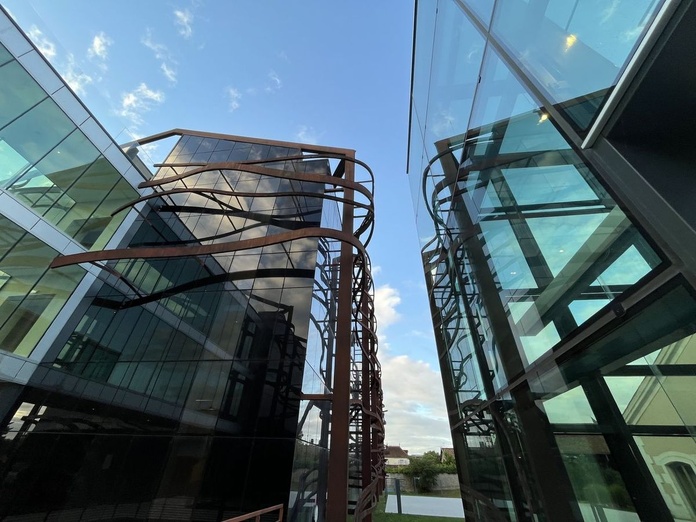
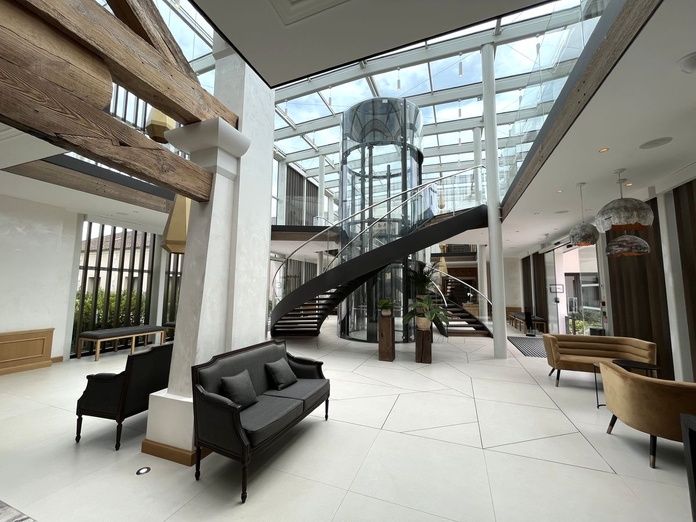
Un espace d'accueil fait de verre et d'acier Photo : PB

Costa Rica


It is at the Hôtel Chais Monnet & Spa, a elegant 5-star with 92 rooms and suites that the monumental portal carved from stone opens, marking the entrance at 50 Paul-Firino-Martell Avenue in Cognac.

A member of the prestigious network The Leading Hotels of the World, this luxury hotel was the first – and, to date, still the only – in the heart of the “capital” of the famous cognac.

It has not always been this way. From 1838 to 1952, these premises housed a renowned cognac distillery. Several owners came and went, but one has gone down in history: Jean-Gabriel Monnet.

Undoubtedly this merchant was, in his time, prudent and highly prosperous thanks to the exceptional quality of his cognacs that had conquered every continent. However, his fame also stems, in part, from being the father of … his son, named Jean.

Born in Cognac in 1888 and entering the family business at a very young age—with success—Jean Monnet later began a career as a banker on Wall Street in the United States, then took the helm of the family business between the two world wars.

After 1945, Jean Monnet would embark on a brilliant political career, becoming one of the “fathers” of European construction, which earned him burial in the Panthéon.


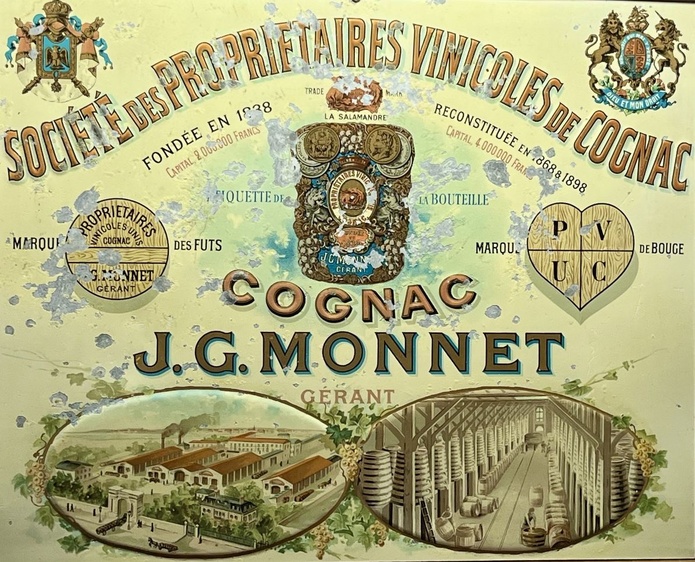
A “Monnet corner”, in homage to the family saga
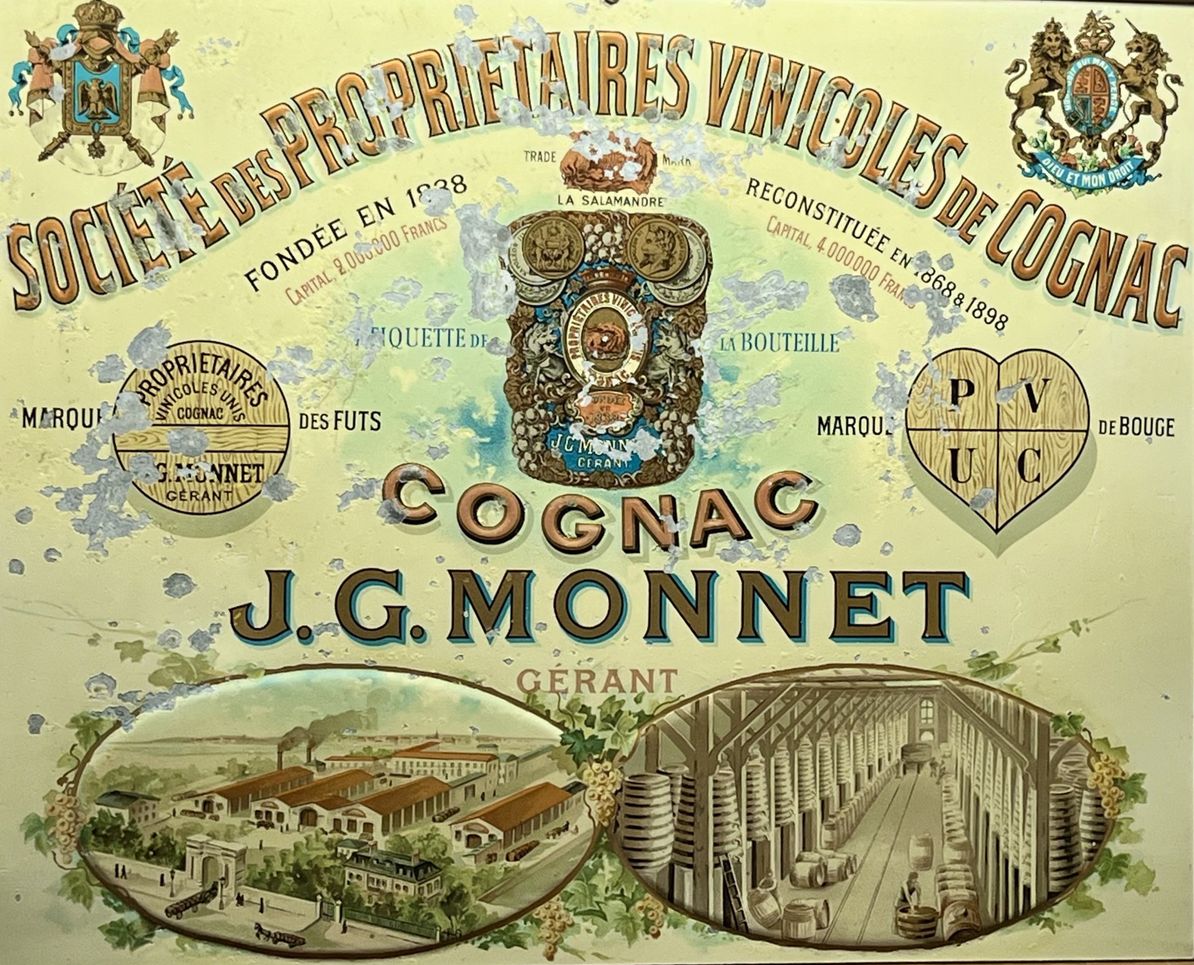

Une affiche historique présentée au "Monnet Corner". Photo Paula Boyer

Whatever the reason for the stay, anyone who checks into the Chais Monnet Hotel & Spa is confronted with this exceptional destiny.

Near the lobby, a “Monnet corner” evokes the family saga. And in the gardens stands the handsome townhouse of the Monnet family, now devoted to an art gallery and to the works of painter Emmanuel Pierre.

As prestigious as this family saga is, the history of these Chais now sits in another universe. Indeed, the Monnets kept their distillery until 1962.

Afterward, it passed from hand to hand: to the German firm Scharlachberg, then to Hennessy, which ceded it in 2004 to the Cognac municipality.

Since then, various projects, sometimes extravagant, for reconversion circulated until the Anglo-Iranian businessman Javad Marandi, owner of the Soho Farmhouse in England, agreed, in 2016, to invest 60 million euros to transform the site into a luxury hotel. Two years of work were required to reach the goal, in 2018.


A striking architectural gesture
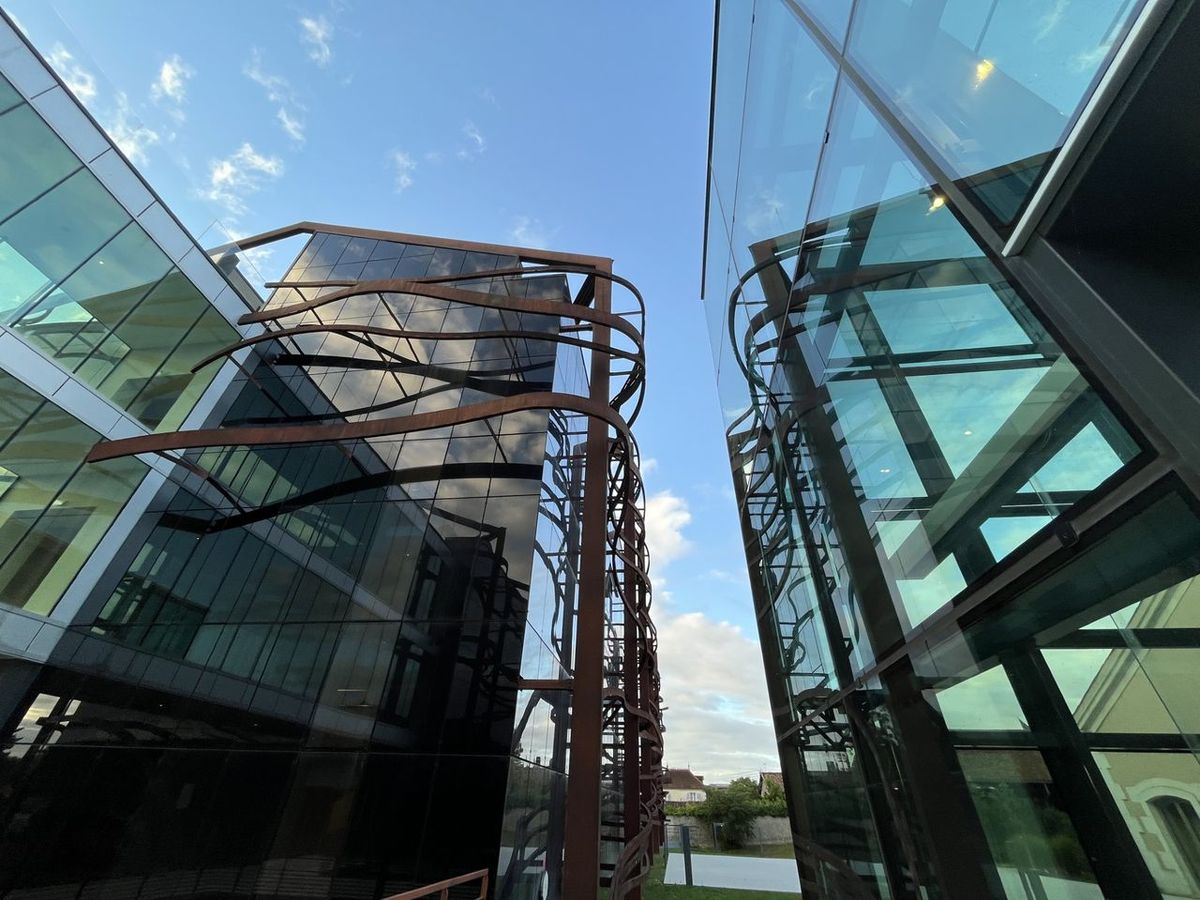

Sur la façade du bâtiment contemporain, des vrilles en acier corten. Photo : Paula Boyer

The least one can say is that architect Didier Poignant, of the Parisian firm Ertim, who was entrusted with the transformation, pulled off a masterstroke.

Indeed, this architect boasted serious references: the Royal Monceau, the Grand Hôtel Intercontinental and The Hoxton in Paris, the Hôtel du Jeu de Paume in Chantilly, etc. He faced a formidable challenge, since it involved converting an industrial building (rare) from the first half of the 19th century, listed as French Industrial Heritage, into a hotel complex.

Rather than demolish, Bernard Poignant set about preserving and rehabilitating the site’s treasures — the Grand Chai des foudres and the two spacious aging cellars of 1500 m² — to valorize the robust framing, then to open up the perspectives and volumes.

The four existing cellars are now connected by a glass-and-steel passage, where today all the main hotel reception functions are gathered. A metal staircase leads to the upper floor.

Starting from there, a long journey under a glass roof, flanked on both sides by a vegetated basin where the sound of water can be heard, leads to a courtyard where the only contemporary building of the hotel complex proudly rises.

The glass façades of this building are covered with spectacular corten steel tendrils, evoking grapevines. It houses rooms, a conference hall as well as a vast wellness area including a spa awarded by the renowned Condé Nast Johansens guide.

Its massage rooms (three standard, one double) offer personalized treatments based on the organic products of Kos Paris.


Classic French chic
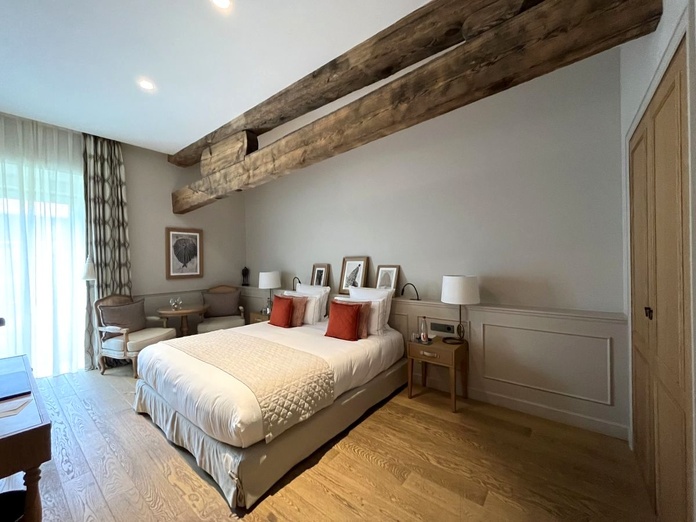

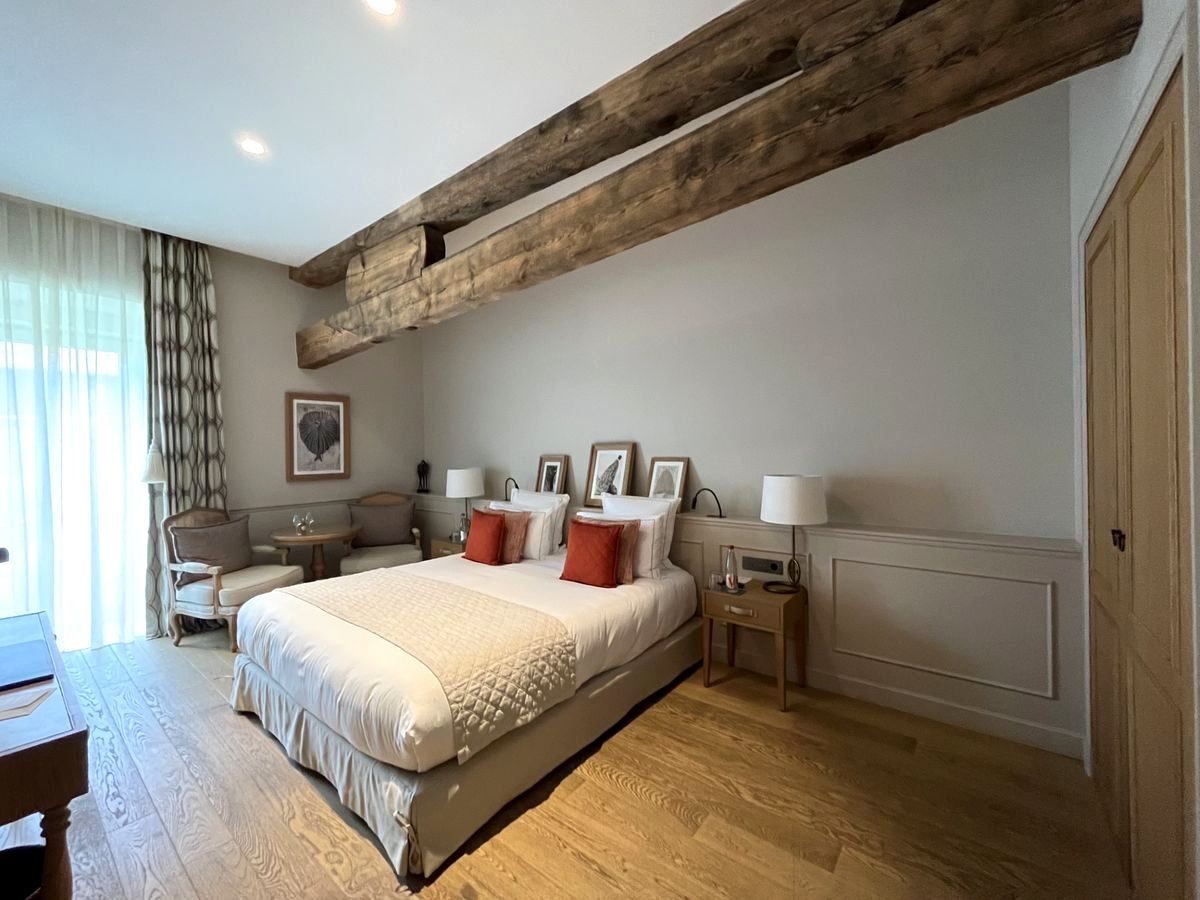
Dans les chambres, les puissantes charpentes sont bien mises en valeur. Photo : Paula Boyer.

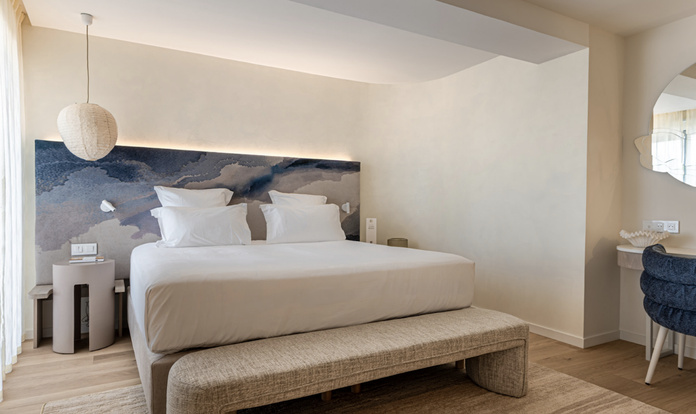
Spread across several buildings, all bright and pleasantly spacious, the 92 rooms and suites feature a décor in chic French classical style. Yet, the blend of noble materials and natural textures keeps alive the traditional Cognac charm.

The elegant spaces (28 to 38 m2) of the 50 Deluxe rooms (from around €280) are distributed between the contemporary building “Les Ceps” — on the first or second floor — and the historic building, “Les Chais,” either on the first floor or on the ground floor.

The 21 first-class rooms (39 to 47 m2), equipped with a bathtub and a shower, are also split between “Les Ceps” and “Les Chais.”


The 21 suites
which can accommodate up to three adults, are likewise distributed between the two buildings.

If the 11 “Junior” rooms range from 49 to 62 m2 (from around €500), the 9 “Suites” are precious 68 to 87 m2 enclaves, featuring a private lounge that allows for both private meetings and business appointments.

As for the presidential suite named Jean-Gabriel Monnet, it aims to offer, over 170 m2, the essence of the Chais Monnet hotelier know-how, with privileged access to a private treatment cabin.


Cognac’s only Michelin star
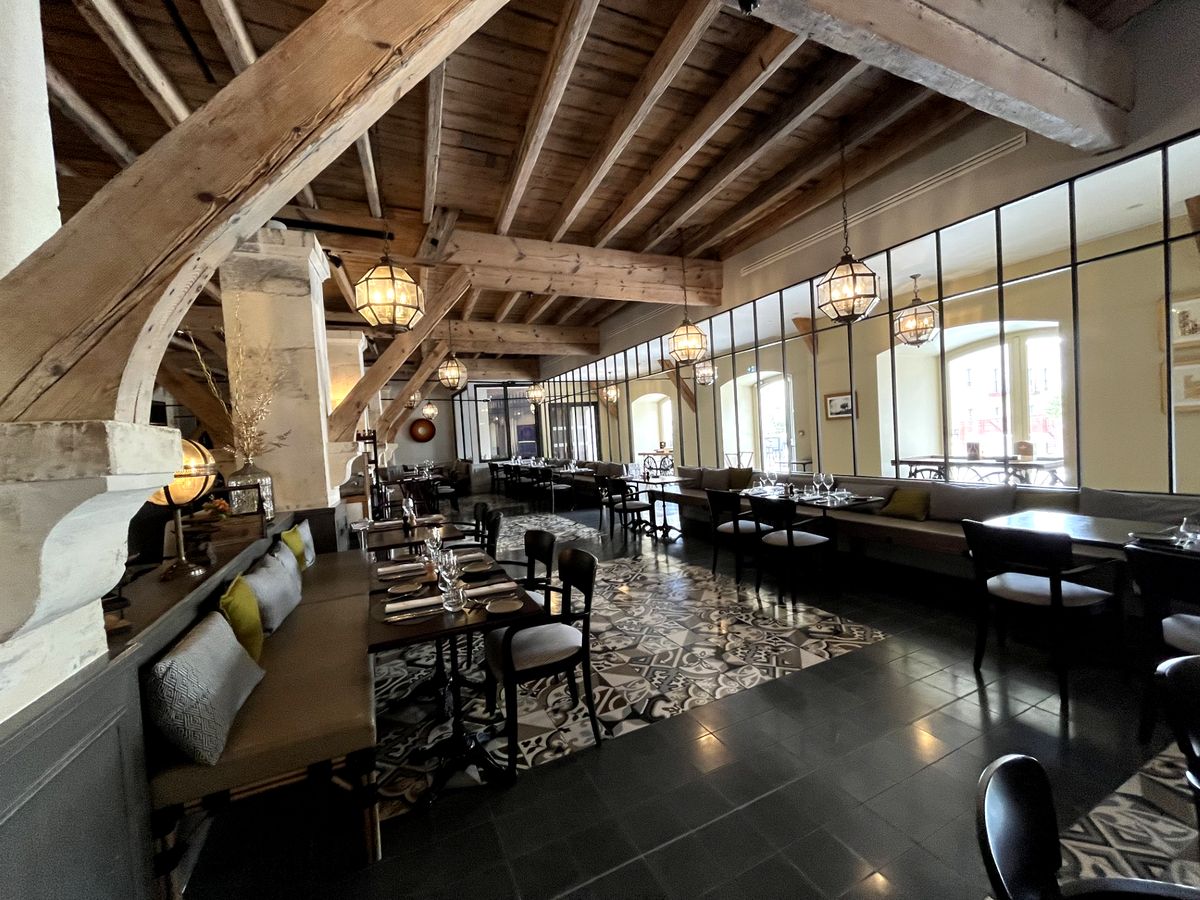

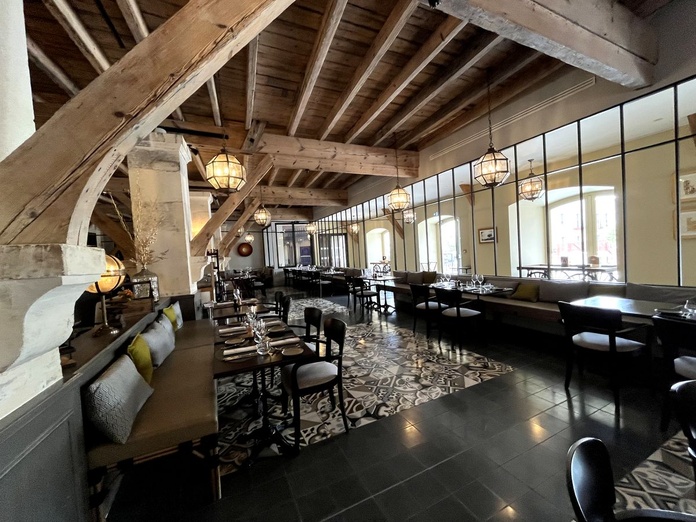
"La distillerie" abrite une brasserie à l'offre culinaire travaillée. Photo : Paula Boyer.

The Chais Monnet & Spa hotel also offers a varied array of spaces for indulgence and relaxation.
In “La Distillerie”, the atmosphere is half brasserie, half loft. It is a place where you gather beneath imposing beams for a refined breakfast buffet, then for lunch (from 12:00, 38 € package) and, later, for dinner (from 19:00, a 47 € menu) in a warm and convivial setting, enhanced by the vast glass roof and the cement tiles on the floor.

The cuisine, unfussy and bold, draws from the great French tradition; plates are generous, well crafted, and punctuated by delightful surprises—this amuse-bouche with crystal bread, salmon rillettes, and oyster gel decorated with a playful pink flower.

Gourmets, for their part, treat themselves to the restaurant “Les Foudres,” which since 2021 has earned Cognac’s sole Michelin star. Elegant attire is required. Expect around €80 for a three-course menu.

Housed in a building steeped in history, under centennial foudres, this gastronomic table invites, from Wednesday to Sunday inclusive, from 19:00 to 21:30, to meet the men who elevate the terroir and its traditions.

Chefs Mathis Debize and Alexandre Mornet distill a symphony of flavors in dishes that aim to be works of art.


Undeniable strengths… but a delicate context


PAULA BOYER Publié par Paula Boyer Responsable rubrique LuxuryTravelMaG – TourMaG.com
Voir tous les articles de Paula Boyer

  • picto Twitter
  • picto Linkedin
  • picto email
Ajoutez TourMaG à votre flux Google Actualités Google Actualités icône

After Montenegro, Banyan Tree Announces Its European Ambitions


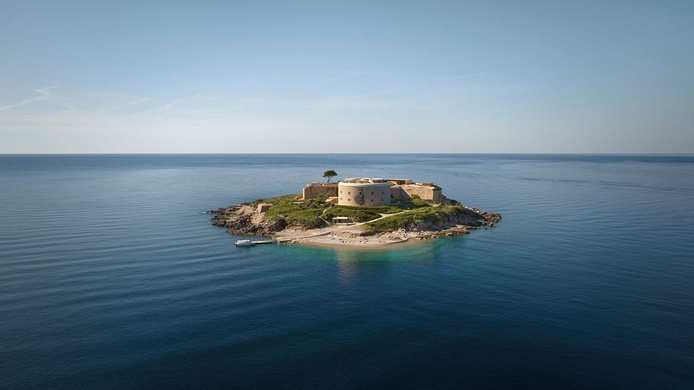
Mamula Island by Banyan Tree est juché sur un ilot isolé dans la baie de Kotor, au Monténégro. © Banyan Tree

Costa Rica


Since 2025, Banyan Tree, the flagship brand of the Singaporean-origin hotel group Banyan, has established its first address in Europe, specifically in Montenegro: “perched on an isolated islet, Mamula Island by Banyan Tree is installed in one of the three forts built in the mid-19th century to protect the Bay of Kotor”, details Kishan Chandnani, the new Global Head of Brand Marketing and Management.

The Bay of Kotor is part of the UNESCO World Heritage list. The fortress sits between sea and sky, on Mamula Island, dating from the period when Montenegro was under Austro-Hungarian rule.

It had been abandoned for quite some time. Before it could become an elegant five-star property, seven years of restoration work were required under the impulse of Samih Sawiris, a billionaire Egyptian businessman, who has been the majority shareholder of FTI Group since the Covid crisis and is already known for his tourism investments, notably in Montenegro, Egypt and Morocco.


Regenerative travel


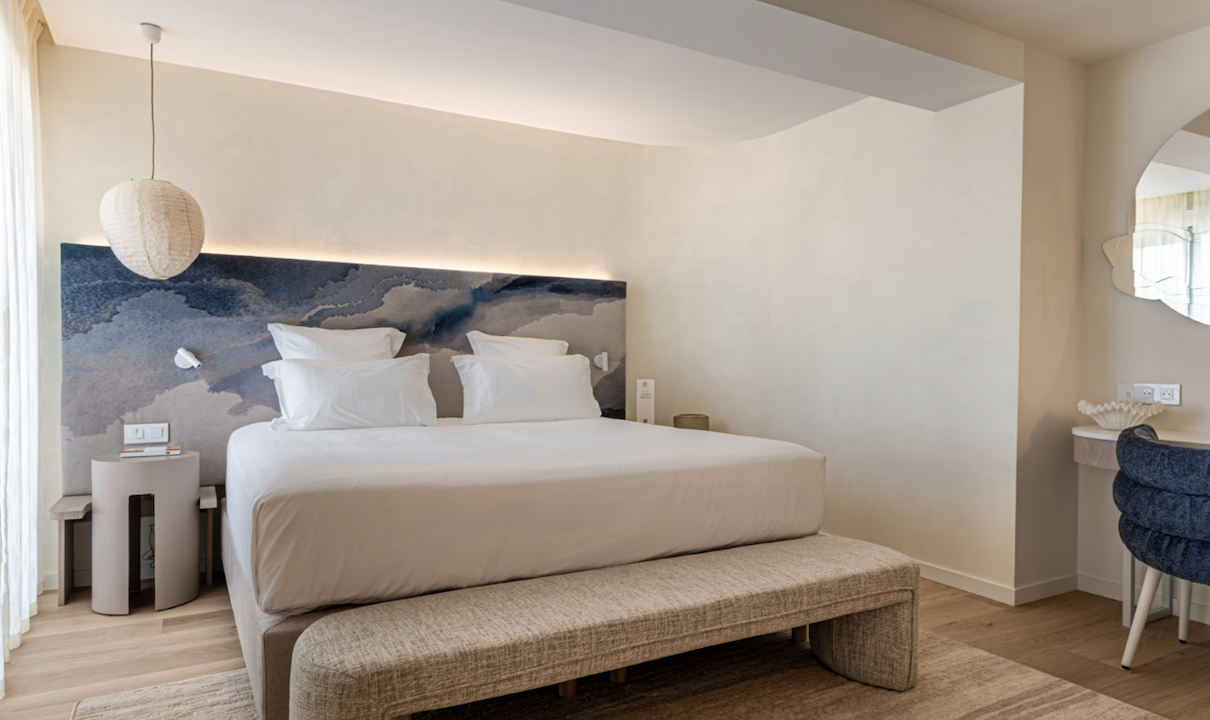
Une chambre du Mamula Island By Banyan Tree © Banyan Tree

Open from April to October and accessible only by private boat or helicopter, Mamula Island by Banyan Tree promises ultra-luxury experiences and can, upon request, be fully privatized for weddings or private events.

This private retreat of 32 rooms and suites (from €700 per night in the shoulder season and €1,471 in high season) with views over the Adriatic Sea features a beach, a Spa installed in the fortress’s central tower, three pools, three restaurants, and a bar. Resident artists are invited, and opera nights are held there.

Mamula Island by Banyan Tree targets a very high-end clientele seeking an authenticity that “luxury hotels don’t always offer”.

Banyan Group has no intention of stopping there. The brand now carries ambitious plans for Europe, both in Western and Eastern Europe. « We are on the lookout for new opportunities, provided they align with our philosophy », insists Kishan Chandnani.


A singular venture that began in Thailand


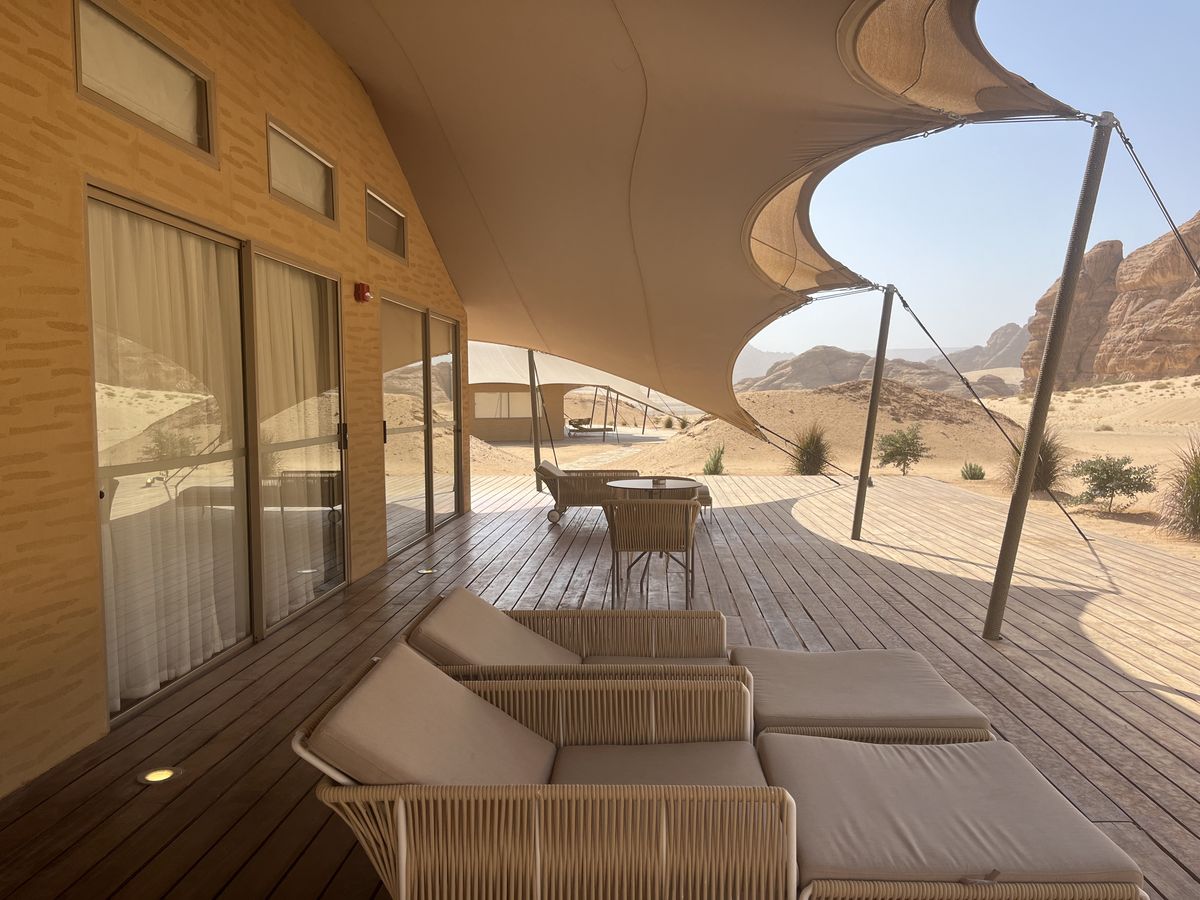
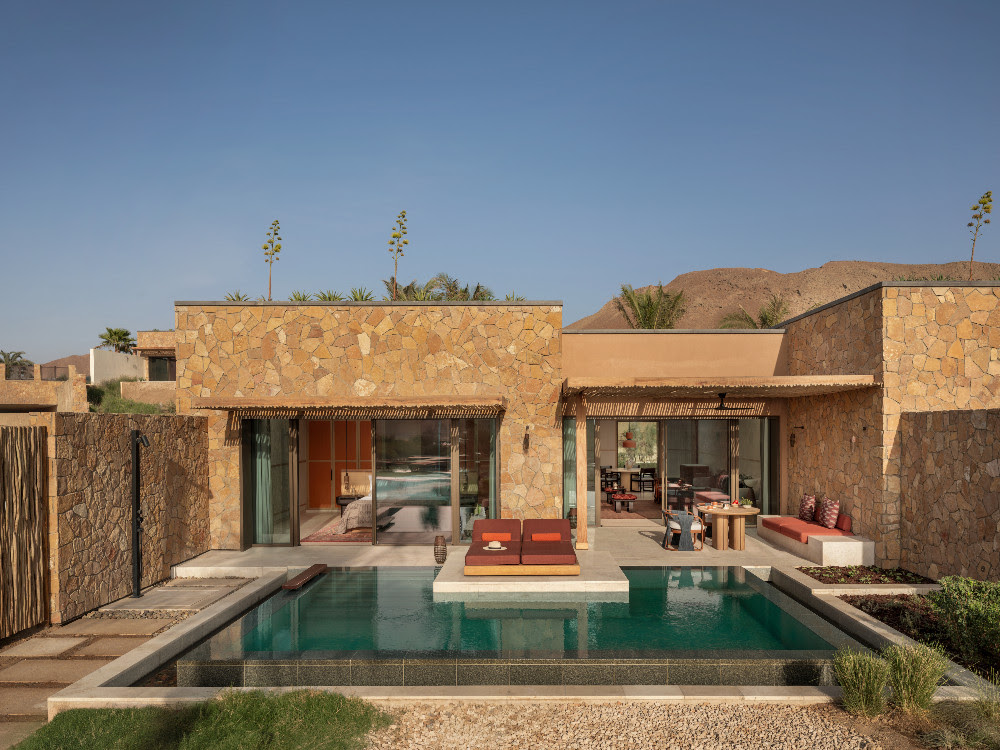
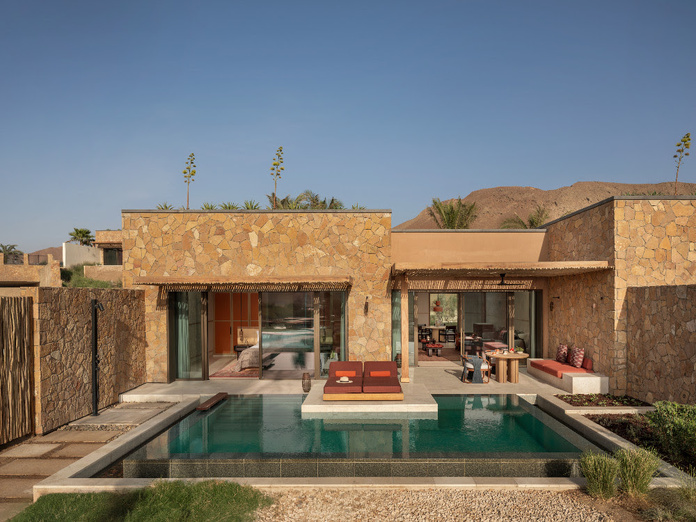
Banyan Tree AlUla s'intègre merveilleusement dans l'environnement désertique de la vallée d'Ashar © PB

In a world that is increasingly fast-paced, Banyan Tree seeks to give its guests time to slow down and reconnect with what they love. Kishan Chandnani speaks of “regenerative travel.”

< b> The brand has stayed true to this approach since its beginnings. Banyan Tree is, in fact, a unique adventure born in 1994 at the initiative of two Singaporeans, Ho Kwon Ping and his wife Claire Chiang.

< b> This adventure first rooted in Thailand. In 1984, during a holiday at Bang Tao Bay on Phuket’s west coast, in the Andaman Sea, the couple discovered a vast tract of land nestled in a secluded lagoon. Enchanted by the beauty of the site, they bought it, believing it to be the perfect place to build a nature hotel.

Unfortunately, Ho Kwon Ping and his wife were disappointed: the land had been polluted by the discharge from a tin mine. They had to implement an environmental regeneration program by introducing native plants and planting nearly 7,000 trees.

It was only ten years later that they were able to construct their very first five-star complex, the Banyan Tree Phuket: 173 luxurious private villas, nestled in lush greenery.


Banyan Tree: luxury in nature


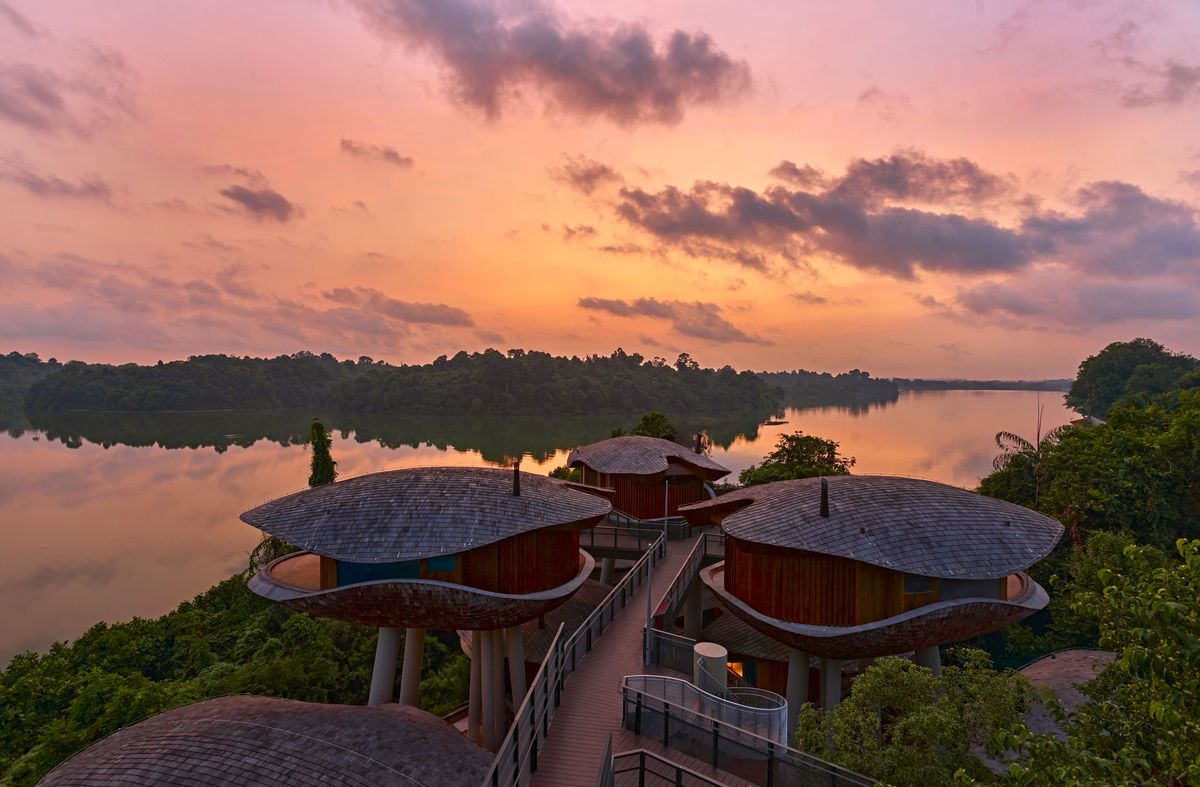
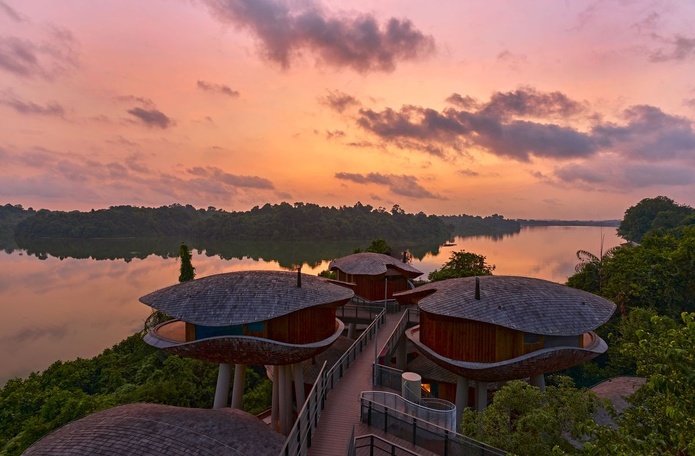
Avec Mandai Rainforest Resort by Banyan Tree, la marque a enfin pris pied à Singapour. © Banyan Tree

By betting on authentic and eco-friendly luxury on an island — Phuket — known for mass tourism excesses, Ho Kwon Ping and his wife established themselves as pioneers.

Even though, today, the Banyan Tree brand also develops urban hotels in key markets like Bangkok, Dubai, Doha, the aim of harmonizing with the environment continues to guide the design of its hotel complexes, not unlike Six Senses (IHG).

Wherever they are, Banyan Tree properties are anchored in the spirit of the place.

This is the case with Banyan Tree AlUla, in Saudi Arabia. Wrapped in the silence of the Ashar desert valley, its 72 standalone villas, cloaked in canvas, display the sandy hues of the surrounding dunes and neighboring sandstone towers.

They confirm Banyan Tree’s intention to immerse itself in local history — here, the Nabataean civilization — combining service excellence with environmental respect to offer unique experiences to travel connoisseurs.

This is also true of the Mandai Rainforest Resort by Banyan Tree, which marked in November 2025 the brand’s debut in Singapore, in the heart of a nature reserve. Its 338 rooms and 24 Tree Houses shaped like seeds perched in trees were designed in harmony with nature, as were the wellness offerings, retreats, and guided walks.

This Resort has also earned the BCA Green Mark Platinum certification for its low environmental impact.


Reconnect one’s soul to wildlife


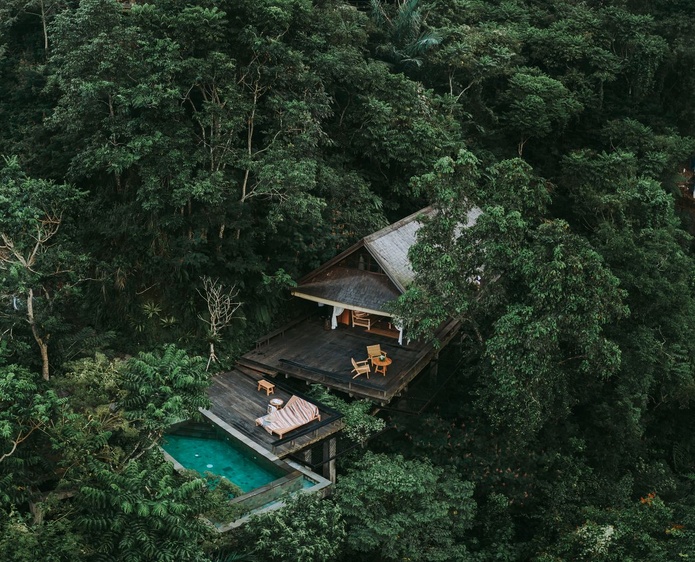
Les villas de Buahan, A Banyan Tree Escape sont guidées par la philsophie "ni murs, ni portes". © Banyan Tree

Similar concerns have shaped Ubuyu, A Banyan Tree Escape, which will, next August, become the brand’s very first safari retreat.

Located in Tanzania, this intimate eco-luxury refuge inviting “to reconnect one’s soul with the wild” comprises only six villas. Built by artisans and inspired by Maasai architecture, they blend into the surrounding savanna where wildlife roams freely.

However, the most accomplished expression of Banyan Tree’s nature-led luxury surely lies, since June 2022, in Bali, Indonesia.

Guided by the philosophy “no walls, no doors”, the 16 wooden private villas, decorated with handcrafted items from Buahan, A Banyan Tree Escape, invite a deep communion with the rice paddies, the tropical forest, and the Ayung River that surrounds them.


In partnership with AccorHotels


PAULA BOYER Published by Paula Boyer Head of LuxuryTravelMaG – TourMaG.com
See all articles by Paula Boyer

  • picto Twitter
  • picto Linkedin
  • picto email
Add TourMaG to your Google News feed Google Actualités icône

La Maison Anne de Bretagne Finalizes Its Move Upmarket


La Maison Anne de Bretagne repense son offre hôtelière avec 15 chambres - Photo La Maison Anne de Bretagne

Costa Rica


The Maison Anne de Bretagne, a property managed by Mathieu Guibert and Claire Bâcle, reopened its doors on July 3, 2026 after several months of work.

Located facing the ocean, the hotel has revised its lodging offer by deliberately reducing its capacity from 19 to 15 rooms.

This transformation forms part of a strategy to upgrade its positioning. The establishment now offers 13 Junior Suites and two superior rooms, with sizes ranging from 25 m² to over 50 m².

The renovations notably involved regrouping certain rooms to create larger spaces and to offer even broader views of the maritime landscape.

According to Claire Bâcle, the house manager, this choice aims to prioritize the quality of hospitality over volume. The reduction in the number of rooms should allow more personalized guidance for guests and strengthen alignment with the establishment’s gastronomic offering.


La Maison Anne de Bretagne: a hotel experience conceived in continuity with its culinary table

At the helm of La Maison Anne de Bretagne, Mathieu Guibert intends to embed this evolution within a holistic vision of hospitality.

The chef aims to make the hotel a continuation of his culinary universe, giving particular attention to the entire stay, beyond the dining experience.

The stated objective is to offer a lodging experience more oriented toward calm, comfort and discovery of the territory, in an environment where the sea plays a central role.

The interior design was carried out by interior designer Caroline Tissier.

The transformation of La Maison Anne de Bretagne will continue in the winter of 2026-2027 with the opening of a wellness space. This new offering will complement the property’s positioning, which hinges on an experience combining accommodation, gastronomy and rejuvenation.

The hotel lists rates starting at 297 euros per night.


Amelia Brille Publié par Amelia Brille Rédactrice TourMaG.com
Voir tous les articles d’Amélia Brille

  • picto Linkedin
  • picto email
Ajoutez TourMaG à votre flux Google Actualités Google Actualités icône  
Pearl Resorts Debuts New Film Highlighting Its Vision of Polynesian Luxury


Pearl Resorts unveils a new brand film dedicated to French Polynesia and the identity of its properties.

Through this video, the group seeks to present a travel vision centered on cultural immersion, natural landscapes, and Polynesian hospitality.

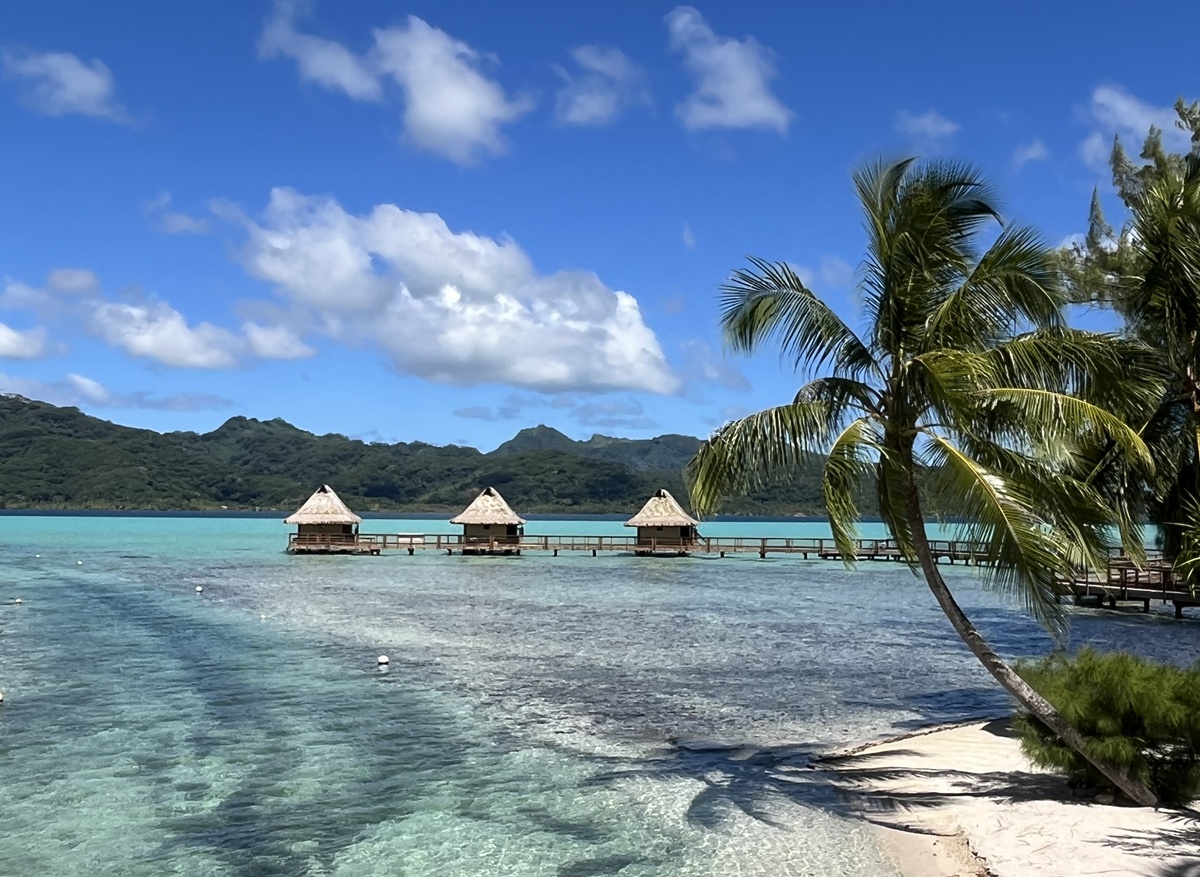
The film showcases the destination’s various facets beyond the images traditionally associated with lagoons and overwater bungalows. Volcanic reliefs, lagoons, the ocean, as well as the traditions and encounters with local populations take a central place in this production.

This video marks the first installment in a new content series that will progressively highlight Pearl Resorts’ five properties.

The group thus intends to present its hotels as the different stages of an itinerary across the Polynesian archipelagos, from the Marquesas Islands to the Tuamotus, including the Windward Islands and Vahine Private Island.


A Definition of Luxury Oriented Toward Experience

According to Pearl Resorts, this approach aims to elevate a travel experience built on discovering local culture, the transmission of know-how, and the authenticity of exchanges.

Through this new film, Pearl Resorts also asserts its concept of luxury, which it associates more with the lived experience than with material offerings.

The group highlights a hospitality model inspired by Polynesian culture, where sharing, transmitting knowledge, and human relationships play a significant role in the experience offered to travelers.


Amelia Brille Published by Amelia Brille TourMaG.com Editor
See all articles by Amelia Brille

  • picto Linkedin
  • picto email
Add TourMaG to your Google News feed Google News icon  

Marriott International to Launch Its First The Luxury Collection Resort in Marseillan, France


Marriott International et Propriétés & Co prévoient d'ouvrir en 2029 un complexe hôtelier et résidentiel haut de gamme à Marseillan - Photo Marriott International

Costa Rica


Marriott International continues to expand its luxury portfolio in France.

The American group has signed an agreement with Propriétés & Co to develop a The Luxury Collection resort complemented by branded residences in Marseillan, in the Hérault region.

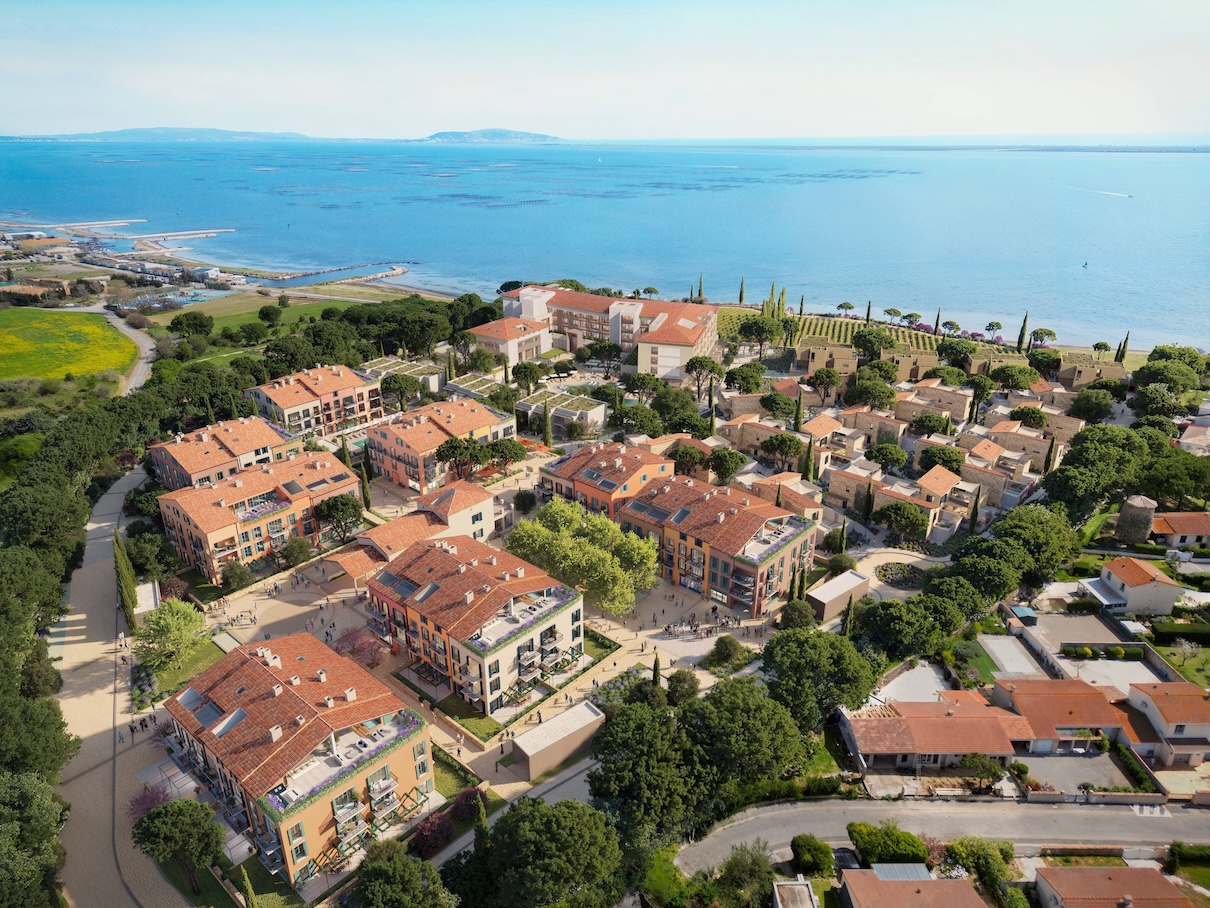
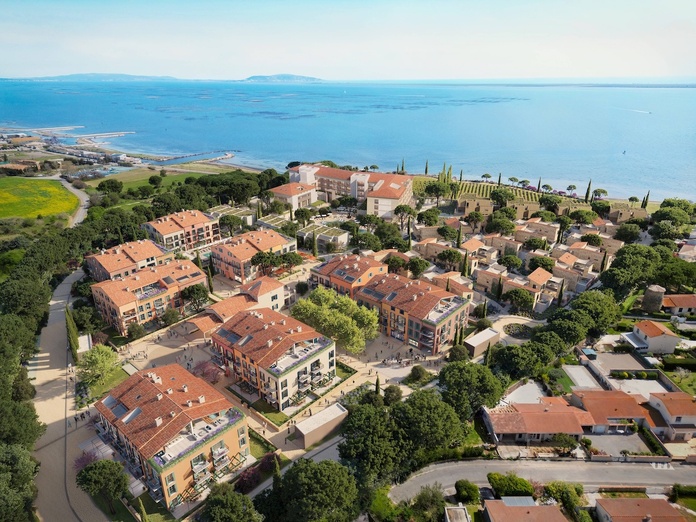
Set on a site spanning more than six hectares along the Thau lagoon, the complex is slated to open according to the announced timetable in 2029. The project aims to integrate with the local fabric and to highlight the maritime, viticultural and landscape heritage of this Languedoc destination.

The forthcoming complex will feature a 72‑room hotel as well as 189 branded residences intended for owners and travelers. The residential offering will include lagoon‑front villas, pool villas, garden suites, apartments and penthouses.

Residents will benefit from access to the resort’s infrastructures and services within a hybrid hospitality and luxury real estate model.

On the dining front, nine concepts are planned, including an oyster and sashimi bar, a fine‑dining restaurant, a French café and a vineyard‑centered bar.

The program also features a 2,000 m² spa and wellness center inspired by Roman baths, several swimming pools, an art gallery and retail outlets.


A first for The Luxury Collection in residential development

For Marriott International, this operation marks a strategic milestone in the French market. The project will represent the group’s first branded residences in France.

The signing of this project marks an important milestone for Marriott International as we continue to expand our luxury portfolio in Europe’s most coveted resort destinations,” notes Alexandra Goguet, Vice President Development France & Benelux at Marriott International, in a press release.

The group believes Marseillan brings together the attributes sought by international clientele thanks to its natural setting, cultural heritage and position within the leisure destination segment.

For his part, Miguel Espada, president of Propriétés & Co, explains that the ambition is to create “a European benchmark in the resort realm” by leveraging local identity rather than transforming it.


An architecture inspired by Mediterranean heritage

The architectural concept is entrusted to Slowlife Architects, while the interior decoration will be carried out by the Spanish designer Lázaro Rosa-Violán.

The ensemble will draw inspiration from the region’s winegrower houses, featuring stone façades, wooden shutters, wrought iron details and terracotta tones. The interiors will emphasize natural materials, craftsmanship and the codes of luxury hospitality.

Located about 35 minutes from Montpellier-Méditerranée Airport, the resort will offer views over the Thau lagoon, Mont Saint-Clair, Sète and the Mediterranean Sea.

The site also highlights the territory’s natural strengths, with more than 300 days of sunshine per year, a network of cycling paths and nearly 8,000 hectares of protected natural spaces.

Upon opening, scheduled for 2029, the Marseillan complex will become the fourth property in France under The Luxury Collection brand, following the Prince de Galles, a Luxury Collection Hotel; Hôtel de Berri Champs-Élysées, a Luxury Collection Hotel; and the Hotel du Couvent, a Luxury Collection Hotel.


Amelia Brille
Published by Amelia Brille TourMaG.com Editor

See all articles by Amelia Brille

  • picto Linkedin
  • picto email
Add TourMaG to your Google News feed
Google Actualités icône

Borgo Monchiero: Atmosphere Core Enters Europe


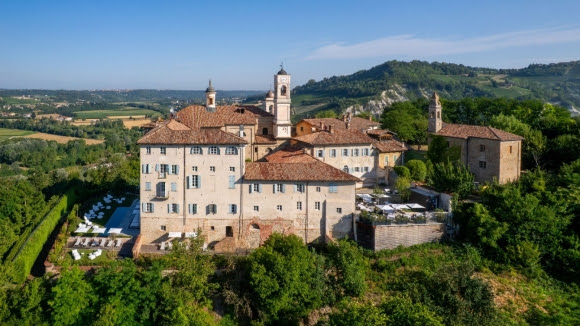
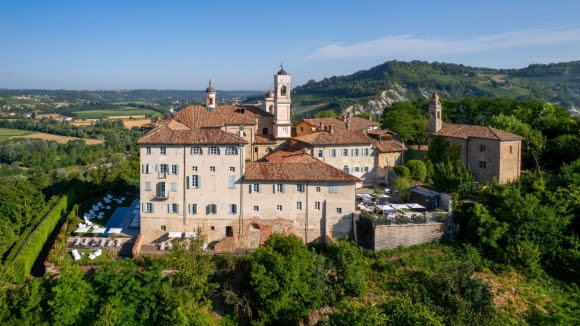
Atmosphere Core signe son entrée en Europe, monastère du XVIIIe siècle, photo by Atmosphere core

Costa Rica


Travelers seeking authenticity, wellness, and haute cuisine have found their new indispensable Italian destination.

Porté par la philosophie selon laquelle chaque pierre raconte une histoire, ce projet de réhabilitation redéfinit l’hospitalité haut de gamme en plein cœur de la province de Cuneo grâce à une collaboration étroite avec la Surintendance archéologie, beaux-arts et paysage.

The imminent opening on July 16 marks the official launch of Atmosphere Core’s first European address, which revives the soul of a village nearly forgotten through an exclusive offering of 25 rooms and suites, a spa area with a panoramic pool, a dining room crafted by a Michelin-starred chef, and a highly personalized guest experience provided by a dedicated host from the airport.

Led by Franco Giampetruzzi and Gian Maria Debenedetti, the project was conceived to meticulously respect the historical identity of the site.

The architectural direction has been entrusted to architect Stefano Tardito.

Salil Panigrahi, cofounder and CEO of Atmosphere Core, emphasizes that its opening is a particularly meaningful moment for them: our long experience in international hospitality, combined with our global expansion strategy, has led us to establish important collaborations with European companies and prestigious Italian brands, culminating in the launch of our first destination in Europe and the second Heritage by Atmosphere property.


A Residential and Gastronomic Experience Crafted Without Compromise

The establishment offers an exclusive capacity of 25 rooms and suites, distributed evenly between the historic monastery building, where the old monastic cells have been repurposed while preserving original materials, and the Villa structure, which presents residential yet aristocratic and luminous elegance.

The pinnacle of the accommodation offering is the Prieur Room, a spacious apartment with interconnected rooms, perfectly suited for families or small groups.

For large events or exclusive weddings, the estate also provides the possibility of complete privatization, relying on spectacular outdoor spaces such as panoramic terraces, an infinity pool, and the Santuario della Madonna del Rosario dating from 1752 for religious ceremonies.

Gastronomy holds a central place in the experience thanks to Executive Chef Giorgio Servetto, proud of his previous Michelin distinctions.

In the restaurant housed within the old building, he offers a creative table that revisits Piedmontese culinary tradition, complemented by private dinners and immersive tastings in the village’s most history-laden spaces.

Wellness is not left out with a dedicated space comprising a panoramic pool offering sweeping views of the surrounding hills, a heated water cistern beneath vaulted ceilings, as well as a sauna and a sensory shower.

Finally, art and terroir exploration complete this exceptional stay. The village revives its cultural past by integrating works from 20th-century Piedmontese masters such as Eso Peluzzi and Claudio Bonichi, and by transforming the desacralized chapel into an elegant museum accessible by appointment.

From the moment of arrival at the airport, visitors are welcomed by a dedicated host and can enjoy a tailor-made programme of experiences ranging from truffle hunting to journeys by vintage car or Vespa through the vineyards.

Saudi Arabia: Six Senses Opens Its Second Luxury Sanctuary


Arabie Saoudite : Six Senses implante son deuxième sanctuaire de luxe, Six senses AMAALA, photo by Six senses

Costa Rica


The Six Senses brand opens its second property in Saudi Arabia, following the launch of Six Senses Southern Dunes.

This project is set on a coastal site spanning 4,140 m², notable for its cliffs and mangroves, in a region where tourist infrastructure and local service standards are still being developed.

Neil Palmer, Chief Operating Officer of Six Senses, comments on this opening: « AMAALA offers us an exceptional seafront setting to bring this philosophy to life. Here, well-being naturally fits into the rhythm of each day, allowing our guests as well as our residence owners to slow down, reconnect, and experience the Red Sea in a profoundly human way. »

The property is led by Bryce Seator, General Manager, and can be reached by road from AlWajh Airport in 45 minutes or by air via the Red Sea International Airport.


Infrastructure, Dining and Environmental Features

The wellness offering rests on a 1,100 m2 spa featuring treatment rooms with lagoon views, an outdoor Watsu pool, a sound dome, and a longevity area equipped for cryotherapy and PEMF therapy.

The complex’s dining is provided by three main venues. The Soraya restaurant offers Nippo-Latin American fusion cuisine, while the Joud space serves Mediterranean and Middle Eastern specialties.

To complement this culinary offering, the Beach Shack focuses on seafood and grilled dishes. In keeping with local specifics, the menu features only botanical beverages, infusions and non-alcoholic fermented drinks.

Environmentally, the establishment uses solar energy and aims for LEED Platinum certification for its construction methods. The teams have also established a technical space, named Earth Lab, which serves as a venue for recycling workshops and the making of artisanal products.

Relais & Châteaux: Two French Properties Among the Ten New Entrants


Relais & Châteaux s'agrandit avec l'arrivée de dix nouveaux établissements - Photo : Maison des Cimes

Costa Rica


The Relais & Châteaux association officializes the accession of ten new properties in the hotel and gastronomy sector joining its network.

These incorporations illustrate the brand’s commitment to celebrating the cultural diversity and heritage of each region.

Laurent Gardinier, president of Relais & Châteaux, reiterates the organization’s stance: « Our Association has embarked on a sustainable path, one that contributes, through dining and hospitality, to building a world that is more respectful, more supportive, and in harmony with living beings. »

Among the ten new entrants are two French establishments. Beginning with La Maison des Cimes in Malbuisson, in the Jura, which will open in August 2026.

Located on the shores of Lake Saint-Point, this eight-room hotel (including two suites), from 250€ per night, is led by chef Matthias Marc. It houses the fine-dining table La Table des Cimes and the traditional bistro Le Bistrot des Bûcherons (to open in November 2026).

Inside and outside, Relais & Châteaux La Maison des Cimes adopts the local architectural codes. True to the spirit of the building once a carpenter’s workshop, wood reigns on the walls and floors of the six rooms and two suites, each offering a Nordic bath on its balcony.

And then, Megève Bois, a 13-room chalet (including 1 villa and 5 suites), from 700€ per night, which provides direct access to the La Princesse ski lifts, leading to Mont d’Arbois. It features a gourmet restaurant, The Andrew, and a second refined Franco-Italian dining option, Le Simon, as well as a well-equipped spa (steam sauna, Himalayan salt relaxation room, body and facial treatments, including a ritual immersion in a heated Alpine hay bed).


Who are the other new members?

The collection welcomes eight more addresses with varied profiles :

Verride Palácio de Santa Catarina (Lisbon, Portugal): This 18th-century palace restored comprises 18 rooms and suites, along with a roof-top terrace overlooking the Tagus. The cuisine is led by chef Fabio Alves across the Suba and The Lisbon Club 55 restaurants.

Masseria Auraterrae (Polignano a Mare, Italy): This 18th-century historic estate in Puglia features 22 rooms and a restaurant that highlights seasonal Adriatic produce.

Quintonil Restaurant (Mexico City, Mexico): This two-Michelin-starred dining destination under chef Jorge Vallejo with his partner Alejandra Flores offers a contemporary interpretation of traditional Mexican cuisine.

Relais Villa Corallo (Sant’Omero, Italy): Nestled in the Abruzzo region, this 19th-century 11-room residence presents terroir-focused cuisine from Zunica 1880, a Michelin-starred restaurant.

Hiiragiya (Kyoto, Japan): Run by the same family for seven generations, this 23-room ryokan offers an immersion into traditional Japanese hospitality, with dinners served in a Kyo-Kaiseki style room.

Villa Florhof (Zurich, Switzerland): This historic building underwent three years of renovation under Lalique’s direction. It offers 13 rooms and a gastronomic dining room led by chef Christian Jürgens.

Wilderness Reserve (Sibton, United Kingdom): This 2,500-hectare estate in Suffolk presents several lodging formats (manor, cottages, and thatched-roof houses) totaling 29 villas and 8 rooms, complemented by the dining rooms The Dining Room and Fire Feast.

The Nell New York (New York City, United States): Located at 10 Rockefeller Plaza, this Art Deco-inspired hotel with 134 rooms (opening planned for autumn 2027) houses a fine-dining restaurant on the 17th floor with views of the Rockefeller Center, a 325 m2 spa, and a tasting salon.

Atout France Launches 2027 Palace Candidacy Campaign


Atout France lance la campagne de candidature pour la distinction Palace 2027, photo by Atout France

Costa Rica


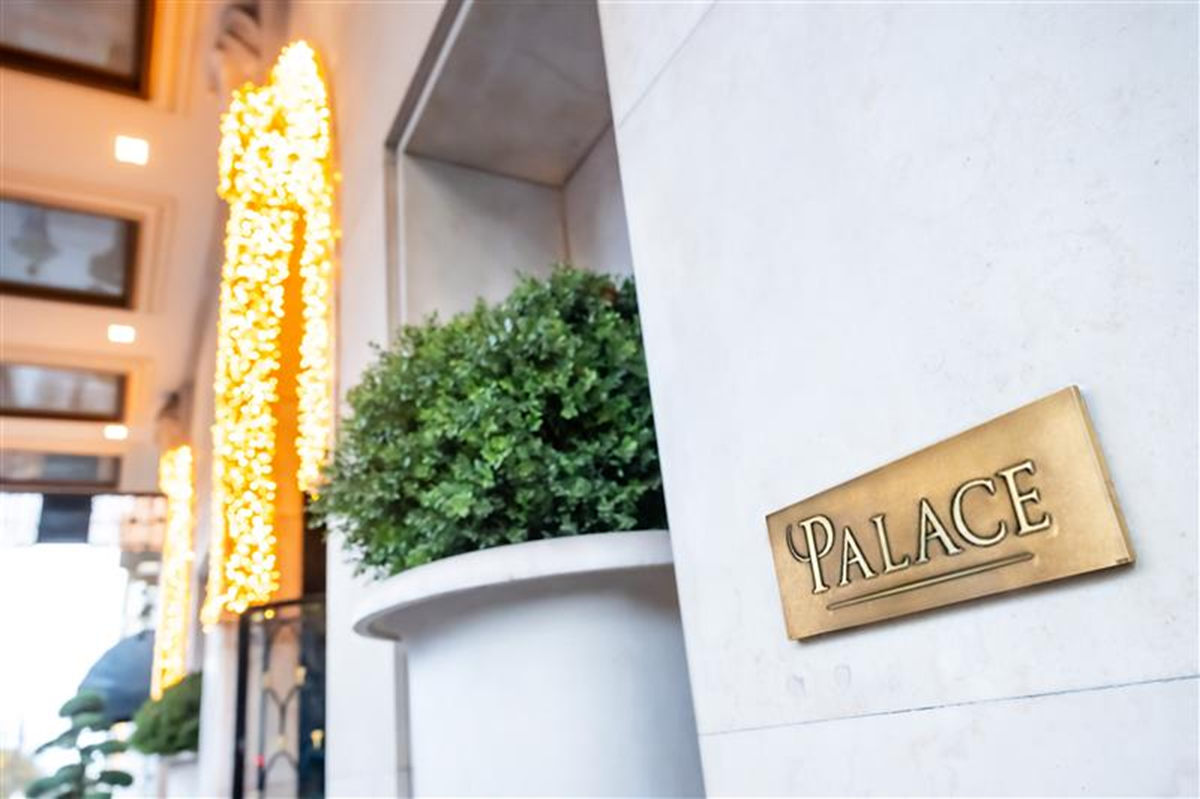
The Palace distinction, established during the overhaul of the hotel ranking to distinguish the elite among five-star establishments, is about to renew its roster of holders.

The national network currently counts thirty-three certified establishments, after the addition of six new addresses at the beginning of the summer.

This honorary distinction, formerly awarded for a longer period, is now granted for a strict duration of three years by the minister in charge of Tourism, on the conclusive opinion of a specialized attribution commission.

To read: Palace Label: “The aim is to attract ultra-luxury clientele to France”


The historical foundations and objectives of the distinction

The creation of the Palace distinction followed the comprehensive modernization of the French tourist accommodation offer, initiated in 2009.

While the introduction of the fifth star aimed to harmonize French standards with international frameworks for high-end hospitality, it soon became evident that a category of establishments with extraordinary characteristics needed to be singled out.

The Palace distinction was thus designed as a promotional tool to highlight exceptional properties on a global ultra-luxury market that is increasingly competitive.

In order to preserve the rarity of this label, the State implemented in 2024 a structural reform of the attribution criteria.

In addition to reducing the validity of the title to three years, the new provisions increased the operating seniority required before applying and restricted the possibilities of waivers when examining the ranking criteria.


The technical eligibility criteria imposed on applicants

For its file to be processed by Atout France, a candidate hotel must imperatively meet four cumulative eligibility criteria, otherwise the application will be immediately rejected.

The first criterion concerns the length of activity: the establishment must demonstrate at least 24 months of continuous operation for a newly created hotel, or a minimum of 12 months if it is a reopening after total refurbishment that required a long-term closure.

The second criterion requires the candidate to hold a current five-star rating.

The third criterion governs the size of accommodations, requiring a minimum surface area of 26m2, bathrooms included, for each room. An exception to this size rule is tolerated for a maximum of 10% of the hotel’s total room count.

Finally, the fourth criterion requires the validation of all the enhanced criteria of the five-star ranking grid. These options on the general grid become mandatory for Palace eligibility, such as the presence of a spa, a fitness area, a valet service, or a minimum ratio of suites within the hotel, with a tolerance margin limited to a single unvalidated criterion.


The preparation of the application file

The application submission is carried out digitally by creating a personal space on Atout France’s digital platform. The technical dossier to be assembled must by regulation include several supporting documents.

This includes first the official application form properly completed, accompanied by the complete report and the control grid stemming from the latest five-star category inspection. The operator must also attach an official document by which they undertake to cover all costs related to the inspectors’ stay and to provide the corresponding invoices.

The centerpiece of the file consists of a presentation “book,” transmitted in digital format or in two paper copies.

This document aims to demonstrate how the establishment meets the 12 exceptional assessment criteria defined by ministerial decree, such as the building’s history, the aesthetics of the premises, or the legendary character linked to famous personalities. Hotels may supplement this submission with annexed documents illustrating their CSR policy, their commitments to the quality of working conditions, or their internal training plans.


The progression of the evaluation and control procedure

From receipt of the file, the instruction process unfolds in two distinct and eliminatory phases. The first phase is purely administrative: Atout France conducts a technical verification of the four eligibility criteria. If the file is validated, it is then transmitted to the Palace distinction allocation commission.

The second phase rests on a on-site qualitative evaluation. Two members of the allocation commission, experts in the hotel sector and the art of living, carry out inspection visits within the establishment to attest to its exceptional character. Their assessments are based on a subjective “faisceau d’indices” spanning overall aesthetics, the quality of personalized hospitality, the gastronomic offering, and the coherence of the guest experience.

Following these inspection visits, the candidate establishment is summoned for an official audition lasting up to 30 minutes in front of all commission members.

This step allows the hotel’s management to defend its file before the commission proceeds to voting. If the commission’s opinion is favorable, the Palace distinction is formally granted by decree of the minister in charge of Tourism.

Summer Hotels Accelerates Expansion on the French Riviera After Opening Its Capital to Investors


Summer Hotels accélère son expansion sur la Côte d’Azur, Depositphotos.com  Auteur nito103

Costa Rica


The pace of external growth is accelerating for Summer Hotels.

On Thursday, July 9, 2026, Summer Hotels officially announced the acquisition of the Best Western Plus Hotel Cosy Nice, a four-star property ideally located. This operation marks the very first tangible milestone of the growth plan announced earlier in the year, during the fundraising conducted with Bpifrance, Sofipaca (Groupe Crédit Agricole) and BNP Paribas Développement.

Thanks to this integration, the operator now anticipates revenue exceeding €42 million excluding tax for the entirety of 2026, which represents a 15% growth compared with the 2025 financial year.


A strengthened presence in the heart of Nice

Ideally located in the immediate vicinity of Nice-Ville railway station, Avenue Jean Médecin and tram lines, while only a few minutes’ walk from the famous Promenade des Anglais, the property benefits from a premier location.

It is perfectly sized to attract a dual business and leisure clientele, thanks to its 42 rooms, its seminar spaces, and its services tailored to both French and international travelers.

This operation strengthens Summer Hotels’ footprint in Nice, which becomes its main hub of activity with now eight hotels in operation. True to its operating model, the group’s management plans to progressively support the property to optimize its commercial potential and its operational management.


New opportunities already under study in the PACA region

This transaction marks only a step in the long-term expansion plan driven by the leadership. The equity infusion raised in the first quarter was precisely aimed at equipping the company with the resources needed to swiftly seize opportunities in the Côte d’Azur market.

The group confirms that other acquisition dossiers are currently under study in Provence-Alpes-Côte d’Azur to continue strengthening its position among the region’s leading hotel players.

In a joint statement, Laurent Rossi and Audrey Denis, Chief Executive Officers of Summer Hotels, reaffirmed this ambition:« We had announced at the beginning of the year our intention to accelerate our development through the strengthening of our equity. This acquisition shows that this approach is already underway. The Cosy Nice hotel is a perfectly complementary addition to our portfolio, and we are actively pursuing the study of new opportunities to sustainably support the group’s growth. »