
Air France Delays Groups Portal Upgrade to September 2026


Air France n’acceptera plus les agences non IATA à partir du 1er septembre pour les groupes - Depositphotos @AndresSernaPulido

CroisiEurope


This was a decision that had caused quite a stir among group specialists.

Last week, we revealed that Air France had decided to restrict access to TIGRE Web, its platform dedicated to group bookings, to only IATA-accredited agencies.

This decision was to take effect on July 1, 2026.

The Entreprises du Voyage conducted active lobbying to grant more time to the affected agencies.

Since then, we have reached out to Air France. We asked them to reassess their position and, at minimum, to provide more time for agencies to undertake the necessary steps.

They assured me they are working on the matter. I am hopeful that the company will postpone at least its decision to September 1.
“, we were told by Valérie Boned.

The message was well received and the instruction was applied.


Réservations “groupes” : Air France reporte sa décision

Initially planned for July 1, 2026, the implementation of this change is postponed to September 1, 2026 to give the affected agencies extra time to organize themselves“, the carrier announced in an email sent to sales points.

The message recalls that, after this date, non-IATA-accredited agencies will no longer be able to make new reservations “groups” via TIGRE Web.

They will benefit from limited access to ensure monitoring, management, and finalization of dossiers already confirmed before early September.

It will therefore be necessary either to obtain IATA accreditation, increasingly difficult to obtain, or to rely on a professional possessing the precious credential.

And obtaining it takes time, but it also requires administrative steps and training the teams in the use of a GDS.

Air France justifies this approach by the volonté of “structuring and securing the group reservation processes for the Company.”

We are going to become dependent on an issuing agency. Our request will be processed when it can be, sometimes several hours later. And we will no longer be able to book flights as soon as they open.” If we are not responsive, yield tariffs rise quickly, lamented last week a group tour operator.

This decision comes almost at the worst moment, as players face distrust from customers confronted with a geopolitical and economic crisis.


The fact of adding commercial validations to dossiers that have become more complex due to the war in the Middle East could slow the activity of distributors already worried about a noticeable drop in bookings.

Air France’s tougher stance toward group organizers is the result of a process that had already led the company to drastically shorten the window to confirm a group.

In the same breath, SNCF suspended its site dedicated to group travel earlier this year.
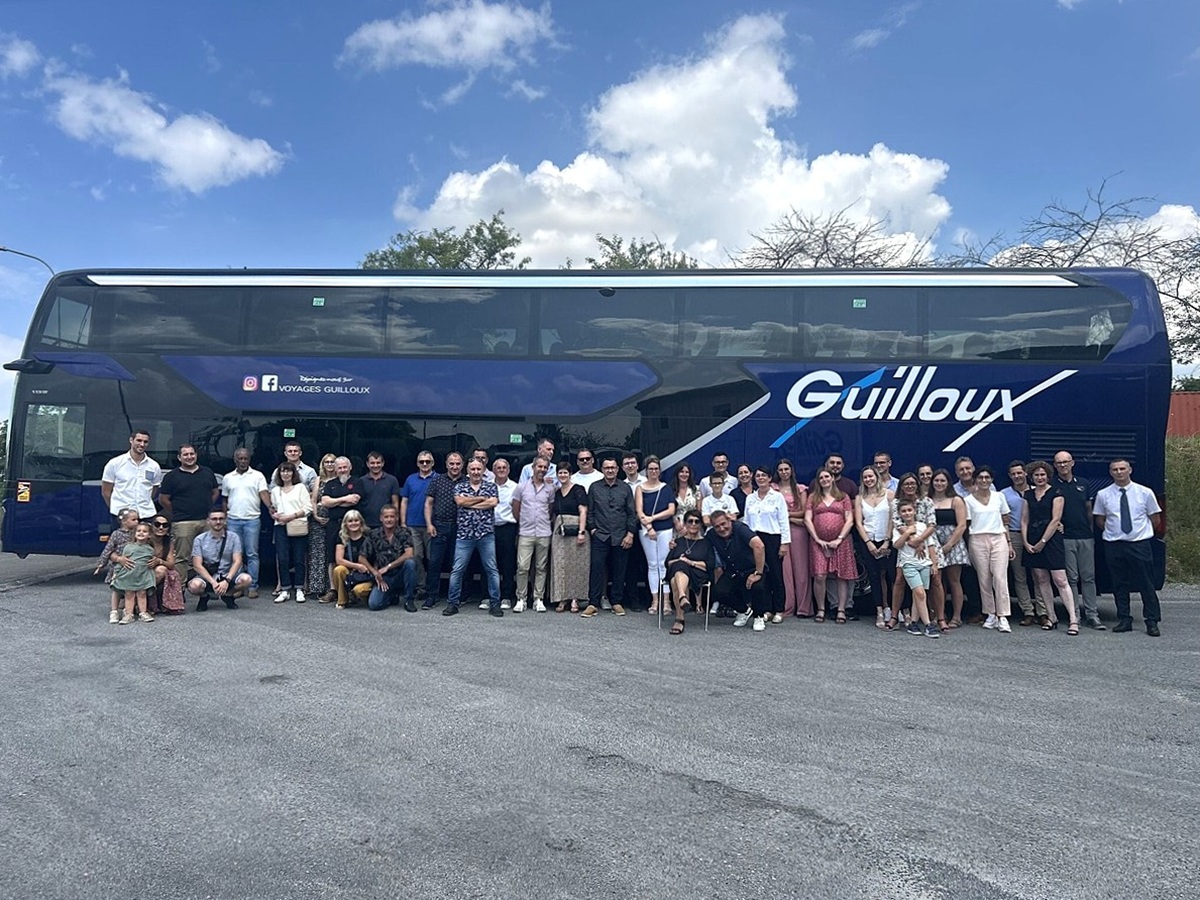
Voyages Guilloux: The Coach Operator Building a Network of Travel Agencies in 2026


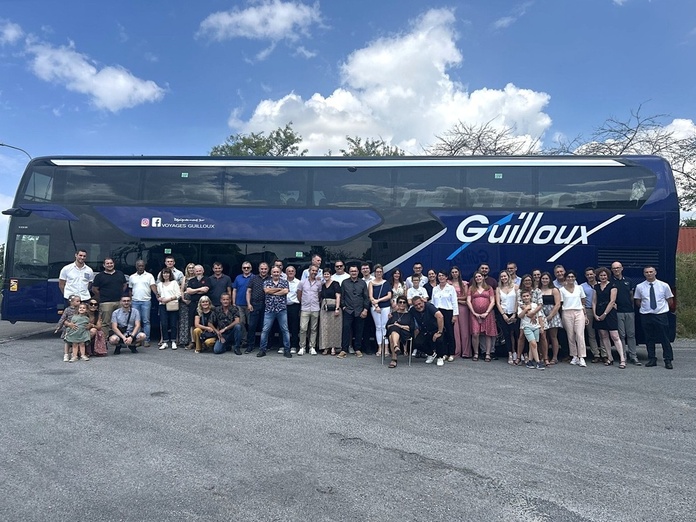
Voyages Guilloux : le chiffre d'affaires a été muliplié par six depuis 2020 - Crédit photo : Guilloux Voyages

CroisiEurope


He was a high-level athlete, even earning national and international medals in judo.

Beyond his physique, that of a top-level athlete who competed in the under-100-kilogram category, Adrien Guilloux makes tourism professionals take notice with his authentic, no-nonsense speech.

But that’s not all, because the proud representative of the 3rd generation of Guilloux at the helm of the coach operator has decided to leave his mark on his mandate.

He has chosen to follow the successes of his competitors, such as Borini, Voyages Bentz, VIC Transport or Fouché Travel, who recently invested in distribution by opening or acquiring travel agencies.

We run the family business with my brother and one of my cousins.

I am the president of a new company called Voyages Guilloux, founded in October 2025, which gathers the activity of travel agencies, groups and business tourism.

It should be noted that distribution activity is new for us, as it dates from January 2026. We used to sell air travel that was resold by tour operators and group organizers, we were not in control of our distribution.

Then, at the beginning of the year, we opened our own travel agencies
“, recounts Adrien Guilloux.


Voyages Guilloux: A Mini-Network Under Construction

And while brochures have always been part of the major appointments for the coach operator, he never fully embraced this travel distribution activity.

Then the handover from the 2nd to the 3rd generation also provided an occasion to make a statement.

We already had plenty of requests.

With my brother and my cousin, we took the helm of the company after Covid, in 2022. We have massively expanded the entire transport side; we now had to do the same for tourism.


We had attempted to take over the Jacqueson agencies, located 200 meters from our headquarters. It didn’t happen, but that didn’t change our ambition
“, explains the manager.

Thus, instead of starting from an existing mini-network, the three thirty-somethings decided to start from scratch.

There was indeed the sales point in Rethel, in the Ardennes, housed at the company’s headquarters, which for thirty years had been selling groups to CSEs, local travel agencies, and GIRs, but not leisure in BtoC.

This was followed by the openings in Vitry-les-Reims and Châlons-en-Champagne.


We have been Havas Voyages franchisees for means since last January.

In fact, we already had a tourism activity with our groups that kept growing. It rose from 800,000 to 6 million euros since 2021. We want now, with our agencies, to continue and consolidate this development.

Our primary objective is to sustain what has been put in place, because we opened them almost in the thick of a crisis. For the moment, things are going rather well.

Then, later, we want to widen the network, i.e., open more. We are not inclined to be everywhere in France, only in our home basin.

We would like to develop tour-operator sales and bespoke travel, because we now have a small team that knows this business
“, states the young boss, setting the course.

A positive dynamic that enabled more than 12,000 people to travel in 2025.


Voyages Guilloux: “We Visited Richou Voyages, Salaün and Buchard”

There are now four people, in addition to management, ensuring the operation of this new entity and the travel agencies.

And before looking further to potential openings, Adrien Guilloux must digest this launch, especially in a context of traveler psychological crisis and geopolitical tensions.

But then, how do you launch a new activity in 2026?

The coaches, we know how to fill them.

It is interesting to explore a new field; it is stimulating for the teams and the management. We work with the Havas Voyages cooperative and use its services, but our brand remains under our own name.

To tell you the truth, we have followed the advice of Richou Voyages.


We visited their offices to understand the system they have put in place and to ensure this development. Moreover, we visited many sector companies before launching.

We visited colleagues, such as Salaün or Buchard Autocars, in Switzerland. We targeted family-owned companies that have done well in this activity, to learn their strengths and weaknesses
“, continues the president of Voyages Guilloux.

It’s not industrial espionage, but study trips to gain experience and make the right decisions.

Which shows that the big family of tourism or at least the coach operators still exists, even in 2026.

Moreover, the visit to their Swiss peer and in Brittany helped forge contacts and open doors to collaborate.

The choice of premises, like for some historic coach operators, to house the new agencies adheres to a set of criteria.

They are located on the outskirts of major cities to benefit from easy access and a closed parking lot that allows boarding of clients heading to local airports or directly onto the company buses for departures.


Voyages Guilloux: “We Took a Mimetism Approach”

Like in top-level sports, we mimicked, looking at what was being done best elsewhere and reproduced it in our own way.

We structured our teams to face this growth. We created the company and staffed it accordingly, then we rely on seasoned teams and on Aurélien Garnotel, our head of sales.

I think we are a company with values. We did not attend business school; we have the values our parents and top-level sport instilled in us.

We set targets, fight to achieve them, and we stand united
“, explains the one who is also president of a professional judo club in his region.

And if he took the family business forward after Covid, Adrien Guilloux has juggled for years his work in his parents’ company and his judo career.

Like his brother, he has roamed the dojos of France and abroad to pursue his dream of glory on the tatamis. That dream ended in 2019. The transition therefore happened quite naturally.

We have grown up in it since we were little. We used to clean the coaches when we were young children. Then I officially joined the company at 21 years old, so that’s 16 years now.


I used to be a driver for many years; I still help out when needed.

In the past, we didn’t have the time to take over the company or to invest 100% due to our careers, but we were involved and observing.

We were able to be high-level athletes thanks to the family business, because we couldn’t really live off that passion“, he thanks.


Voyages Guilloux: Revenue Has Been Multiplied by Six Since 2020

And like any sports enthusiast, Adrien Guilloux loves a challenge.

The coach operator, specializing in leisure travel, does not serve any scheduled routes. It employs about forty staff and 18 coaches, plus a few shuttles. It isn’t a sector giant, but it is a locally significant business.

It is somewhat rarer to be oriented solely toward tourism in 2026.

Afterwards, we carried out major operations, such as with France Judo and the Paris Grand Slam, or the 1,800 surgeons of France who went four days to Belgium to demonstrate.

We have experienced very strong growth in recent years. We have gone from six coaches in 2020 to 18 today, and turnover has been multiplied by six.

We first need to structure to absorb this growth, which has been made possible because the company has been well managed
“, he notes.

Three new vehicles have been delivered in recent days. In this sector, many players faced difficulties during the health crisis. Nevertheless, many remain ambitious, notably by opening travel agencies.

And as with peers, this is primarily a family story. The company, which began as a driving school, was created in 1959 by their grandparents, before becoming a training school for all permits. They bought their first touring coach in 1983.

The second generation developed language trips and group tours, thanks to Adrien’s father, uncle and aunt.

My grandmother stopped working at 85, just four years ago. My father still handles quotes and still drives, my uncle oversees training for heavy vehicles, and my aunt is at the driving school.

It isn’t easy; you have to fight, but when it was time to restart after Covid, the cash flow was there. We were able to restart stronger.

We were born under a lucky star.
The generation before us did a good job, managed the business as a family, and we will strive to do the same“”, concludes Adrien Guilloux.


EDV Barometer: Orchestra – Reservations Fall 18% in May as Summer Slowdown Widens

French Vacation Observatory — June 2026

The Travel Agencies of France — Orchestra / Travelsoft

June 2026

The summer of 2026 looks set to be challenging for travel distributors. The latest edition of the French Travel Companies Observatory (EdV) and Orchestra confirms a clear slowdown in bookings. May departures still temper the overall drop.

Regarding departures through the end of May, the number of files is down 1.7% compared with the same period in 2025, while the business volume falls by 1.3%. The average basket edges up slightly by 0.4% to reach €1,555. It is worth noting that a significant portion of May travel had already been booked before the worsening situation in the Middle East.

France itself even records a 6.4% increase in business volume, while the medium-haul segment remains broadly stable. By contrast, the long-haul sector remains under pressure, with the number of files down 11.5% and turnover down by nearly 10%.

Destinations in the United States (-34.3%), Mexico (-22.7%), and Cape Verde (-12.6%) are among the hardest hit. Conversely, Albania (+342.6%), the Dominican Republic (+14%), and Croatia (+12.6%) continue to grow.

Summary:
– Bookings plunge in May
– An ever more retreating summer

Observatory — June 2026

Departures in May 2026

Market activity shows a slight dip: files down 2%, business volume down 1%, and the average basket nearly steady at €1,555. It should be noted that a significant share of May departures had already been booked prior to the deterioration in the Middle East situation.

Key indicators for departures through the end of May:
– Business volume: -1.3%
– Number of files: -1.7%
– Average basket: +0.4% (€1,555)

Geographic zones — departures May 2026 vs 2025

Top 20 destinations — departures May (number of dossiers vs 2025)

Note: A geographic breakdown and the list of top destinations are shown to illustrate regional and market concentration, with France and major outbound corridors highlighted.

Section 2 — May 2026 Reservations

Reservations in May 2026 show a sharp retreat: business volume down 21%, number of files down 18%, and the average basket down 4% to €1,632. The average lead time also contracts to 63 days, down 4 days versus 2025, signaling that bookings are being made increasingly closer to departure amid geopolitical uncertainties.

Key indicators for reservations in May 2026:
– Business volume: -21.3%
– Number of files: -17.9%
– Average basket: -4.3% (€1,632)
Lead time to departure: 63 days (-4 days vs 2025)

Geographic zones — reservations May 2026 vs 2025

Top 20 destinations — reservations May (number of dossiers vs 2025)

Geographic patterns and popular destinations for May reservations are presented, illustrating shifts in demand by region and corridor.

Section 3 — Summer Holidays 2026

Summer 2026 (July–August) reservations are down by 10.5% compared with 2025, both in terms of dossiers and business volume. The average basket remains stable at €2,710. All zones show declines, with long-haul the most affected, posting a 20% drop in dossiers.

Key indicators for Summer 2026:
– Business volume: -10.5%
– Number of dossiers: -10.5%
– Average basket: +0.0% (€2,710)

Geographic zones — reservations summer 2026 vs 2025

Typologies of travelers — Summer 2026

A snapshot of traveler types for the summer shows the following profiles:
– Solos: 3.1% of dossiers; -15.7% in dossiers; €1,700 on average
– Duos: 34.3% of dossiers; -11.8% in dossiers; €2,302 on average
– Families: 48.0% of dossiers; -10.1% in dossiers; €2,753 on average
– Groups: 14.5% of dossiers; -7.6% in dossiers; €3,748 on average

Categories of stays — Summer 2026

The distribution of stays by category for the summer shows:
– Packages: -9.8%; Basket up 1.2% to €2,772
– Accommodations: -11.8%; Basket up 0.1% to €1,141
– Circuits: -15.9%; Basket down 3.9% to €5,823

Top 10 destination cities — Summer 2026

Top 10 destination cities for the summer of 2026 are presented, illustrating the geographic spread of demand across leading urban and resort destinations.

Footer

Source: Observatoire des Vacances des Français — The Travel Companies of France (Les Entreprises du Voyage) · Orchestra / Travelsoft — June 2026
Data drawn from travel agencies using the Orchestra platform (20+ brands, minimum of 2 years).

Blue Flag 2026: Which Beaches and Marinas Are Blue Flag Certified?


Le Pavillon Bleu, dévoile son palmarès 2026 le lundi 18 mai à Saverne - Photo : Pavillon Bleu

CroisiEurope


The Pavillon Bleu label unveils its 2026 standings on May 18 in Saverne, in the Bas-Rhin. A first for this national ceremony, held on a waterway site.

The Saverne port, labeled since 2018, had notably received the Thomas Joly Award in 2020 for a project to revegetate the riverbanks in favor of biodiversity.

Developed in France by Teragir, the Pavillon Bleu has for more than 40 years distinguished beaches and pleasure ports engaged in sustainable tourism initiatives.

The label rests on several criteria related to water management, biodiversity preservation, pollution reduction, and visitor awareness.

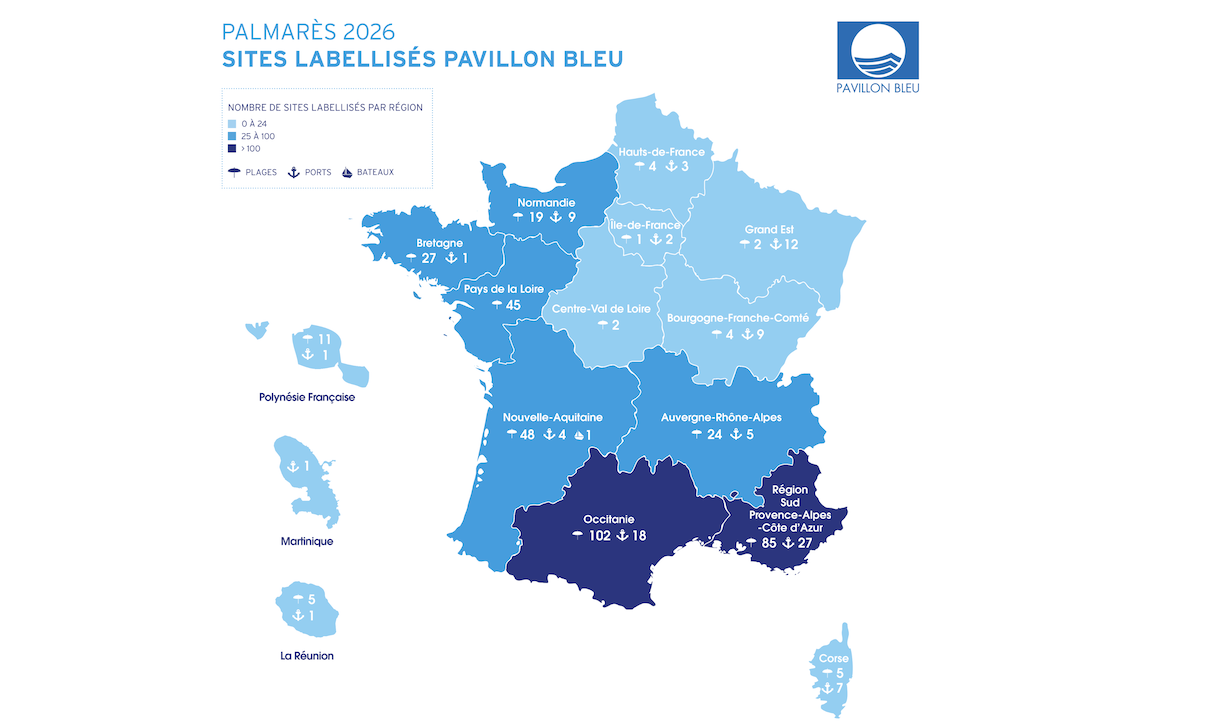
This year, 485 French sites obtain the label, comprising 384 beaches, 100 ports de plaisance and one boat. The sites concerned may fly the Blue Flag throughout the 2026 season.


Les régions littorales toujours en tête

France thus maintains its position among the five countries with the largest number of labeled sites in the world.

The program, carried internationally by the Foundation for Environmental Education, is now present in 50 countries and brings together more than 5,300 labeled beaches, ports and boats.

The 2026 list confirms the strong presence of the major coastal tourist regions in France. Occitanie tops the list with 120 labeled sites, ahead of the Provence-Alpes-Côte d’Azur region with 112 sites.

Nouvelle-Aquitaine accounts for 52 distinguished sites.

Several new sites also join the ranking this year, among them the ports of Saint-Léger-sur-Dheune, Nevers, Charleville-Mézières, Buzet, the Old Port of Golfe Juan and the Jacques-Yves Cousteau port in Castelsarrasin.

On the beaches side, Le Tréport, Carqueiranne and Saint-Symphorien-de-Thénières are among the newly labeled municipalities.

A boat also earns the label: the Atalaya catamaran from Explore Océan, based in Hendaye, offering sea outings dedicated to cetacean watching.


Le tourisme fluvial mis en avant

Choosing Saverne to host the national ceremony highlights the growing importance of inland waterways in sustainable tourism strategies.

According to Teragir, river and lake spaces now account for more than a third of the labeled sites.

The Pavillon Bleu emphasizes several advantages of these territories: generally lower environmental pressure than coastal areas, a role in maintaining ecological corridors, potential for soft mobility, and a contribution to the economic revitalization of river-adjacent municipalities.

This evolution also aligns with travelers’ new expectations, who favor shorter getaways, slow tourism, and experiences reconnecting with nature.


Deux initiatives réunionnaises récompensées

The Thomas Joly Prize, which annually rewards biodiversity initiatives, distinguishes in 2026 two Réunion-based projects.

The City of Saint-Leu is rewarded for its biodiversity preservation and awareness strategy within the framework of its Municipal Biodiversity Atlas.

The Port of Saint-Gilles-les-Bains is, for its part, distinguished for its involvement in the campaigns “Nights Without Light” and “Days of the Night,” aimed at reducing light pollution and preserving nocturnal biodiversity.


Amelia Brille Published by Amelia Brille TourMaG.com Editor
View all articles by Amelia Brille

  • picto Linkedin
  • picto email
Add TourMaG to your Google News feed Google News icon  

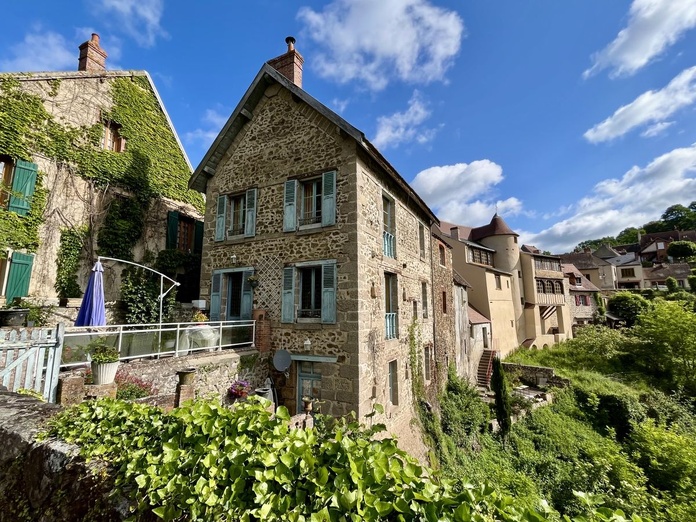
In the Footsteps of George Sand: Walking in Indre, Berry


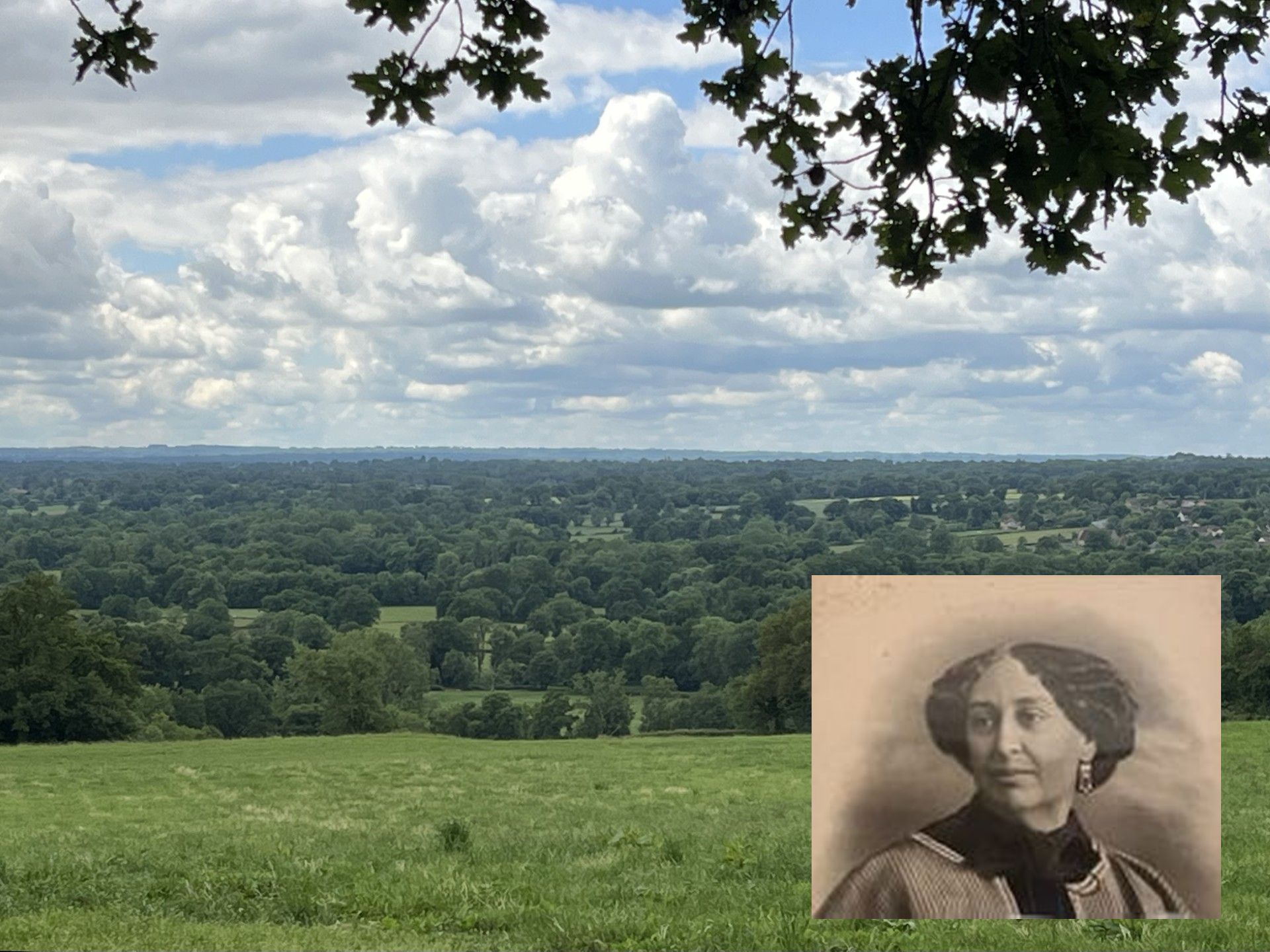
Le pays de George Sand est un pays de bocage. Dans Vallée-Noire, a-t-elle écrit, "une légère vapeur argente les lointains" - Photo PB

CroisiEurope


There are writers who are inseparable from a territory. George Sand is among them.

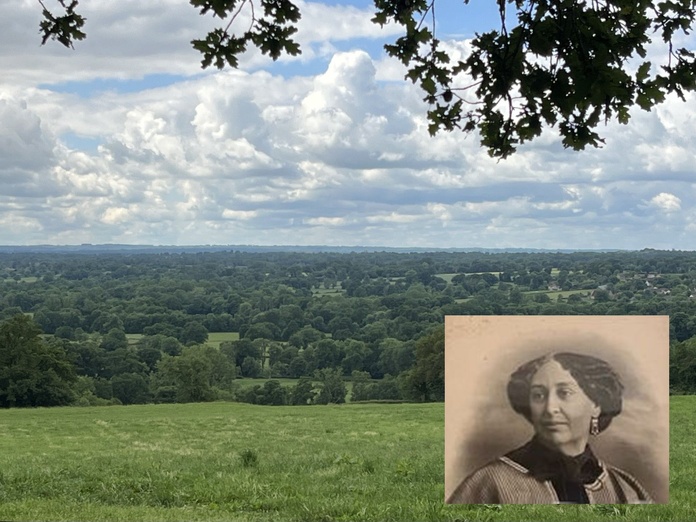
Fifteen decades after her death, on June 8, 1876, in her home at Nohant where she spent most of her life, the green landscapes of Boischaut-sud — this region of the Berry lies in the Indre department and thus in the Loire Valley region — are not spectacular. Yet they remain inextricably linked to the writings of this committed woman.

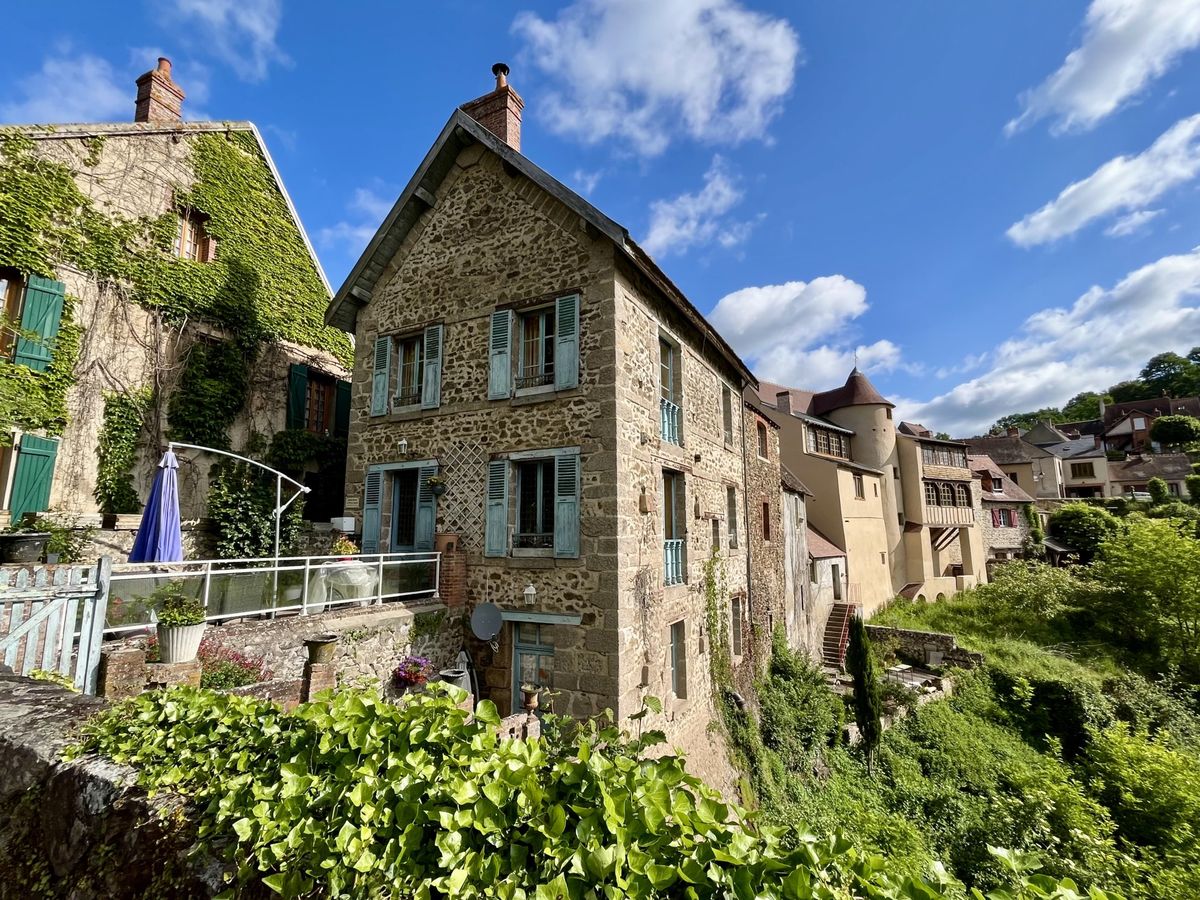
It is a land of hedgerows and pastures where white cows and sometimes reddish ones graze. The winding little roads and sunken lanes bordered by hedges lead to towns and hamlets topped with small tiles, each crowned by churches with pointed spires.

From Vallée-Noire to Gargilesse — in the Creuse valley —, passing through Nohant, Vic, La Châtre and Sarzay, this emerald setting that George Sand loved so much has not lost its mystery, nor its beauty.

Of course, this territory is less populated than in the past, but the nature here is very beautiful, the air is pure and the quiet deep, which makes it an ideal destination to unwind, recharge, go cycling or walk.


George Sand’s Country: A Delight for Hikers and Pilgrims


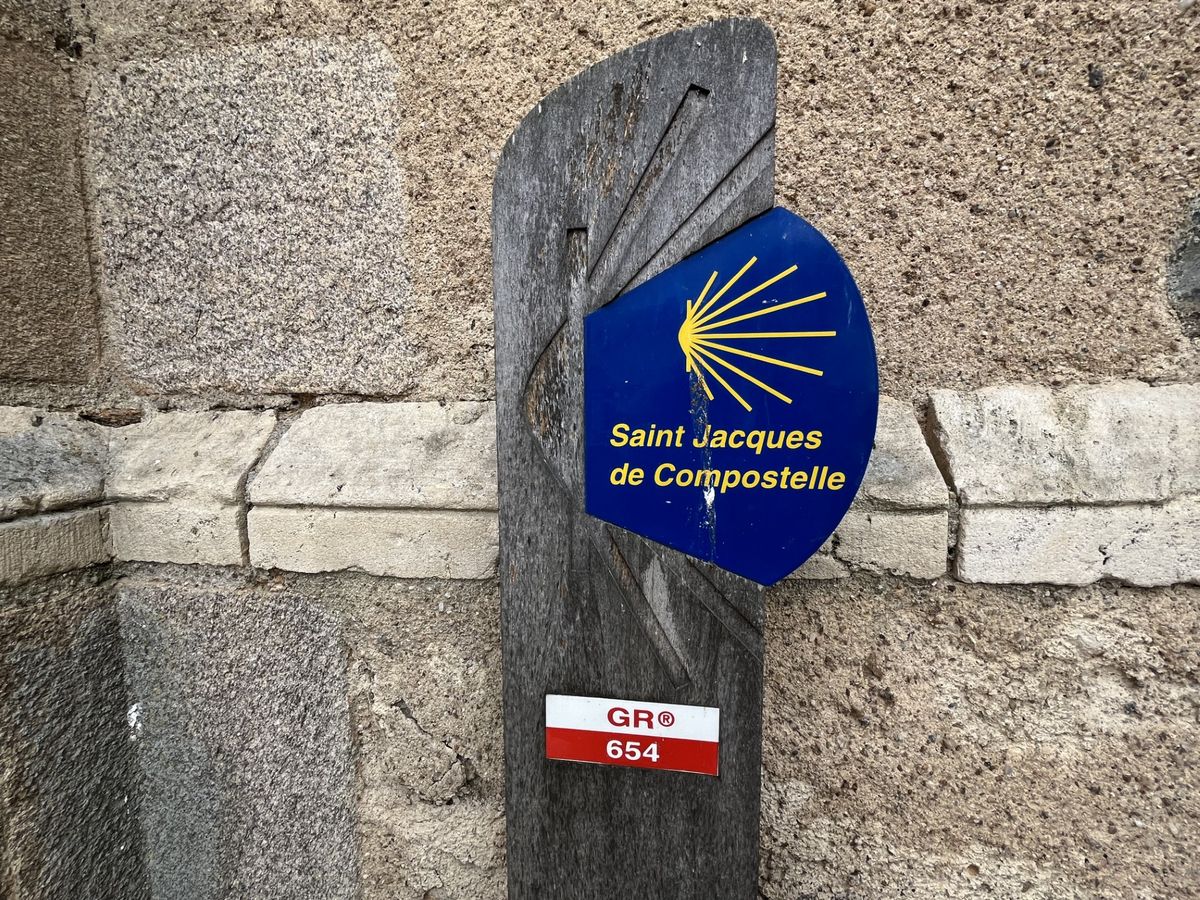
Plusieurs GR passent par le pays de George Sand, notamment le GR 654 (Chemin de Saint-Jacques) - Photo : PB

In this year of high fuel prices, hence less inclined to long trips, there is even more reason to go there since several walking routes — including a Regional Route (GR de Pays) — invite you to follow in the writer’s footsteps.

Added to this, in this 2026 George Sand anniversary year, are theme-based hikes. Check the Berry Province Tourist Office website for details.

The Vézelay Way (GR 654), Saint-Jacques de Compostelle paths also pass through here, with a highlight stop: Neuvy-Saint-Sépulchre, whose collegiate church is UNESCO World Heritage listed precisely as part of the Saint-Jacques routes.

This remarkable edifice comprises a basilica dedicated to James, the Apostle of Galicia, and a three-level rotunda built after the model of Jerusalem’s Holy Sepulchre.

Since 1257, in a reliquary there, three drops of the “Precious Blood of Christ” have been kept, the origin of a pilgrimage on Easter Monday.


The Preserved Home of the Good Lady of Nohant


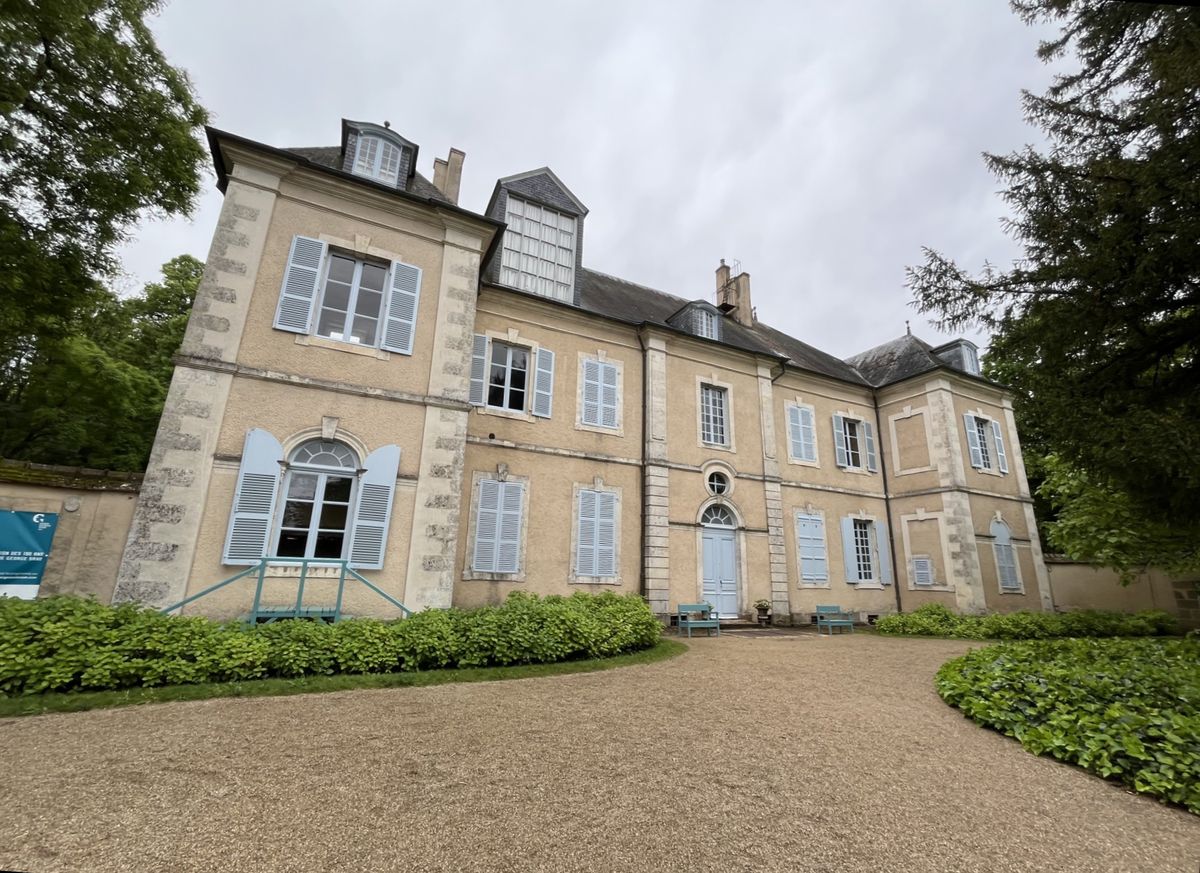
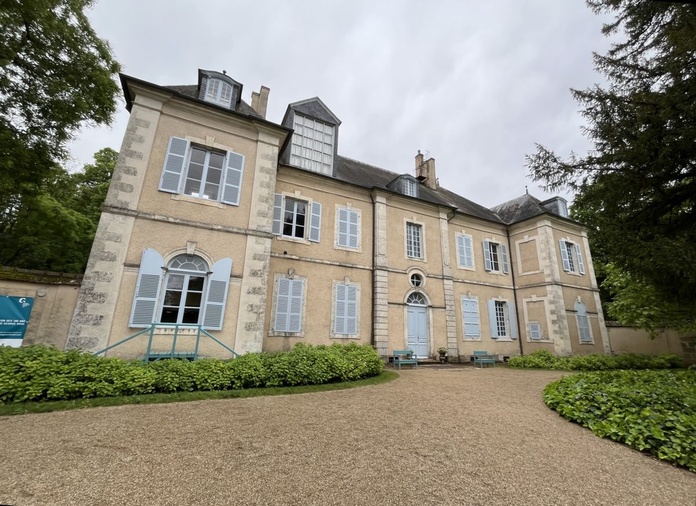
La maison de George Sand est une belle demeure bourgeoise, sise à Nohant dans l'Indre - Photo : PB

Whatever mode you choose to discover this territory, it will surely be an opportunity to step into George Sand’s intimate world.

First stop, the village of Nohant, where she rests among her kin in the small family cemetery, just separated by a fence from the parish church. It lies at the edge of the expansive park where the writer’s house stands, sheltered by high walls.

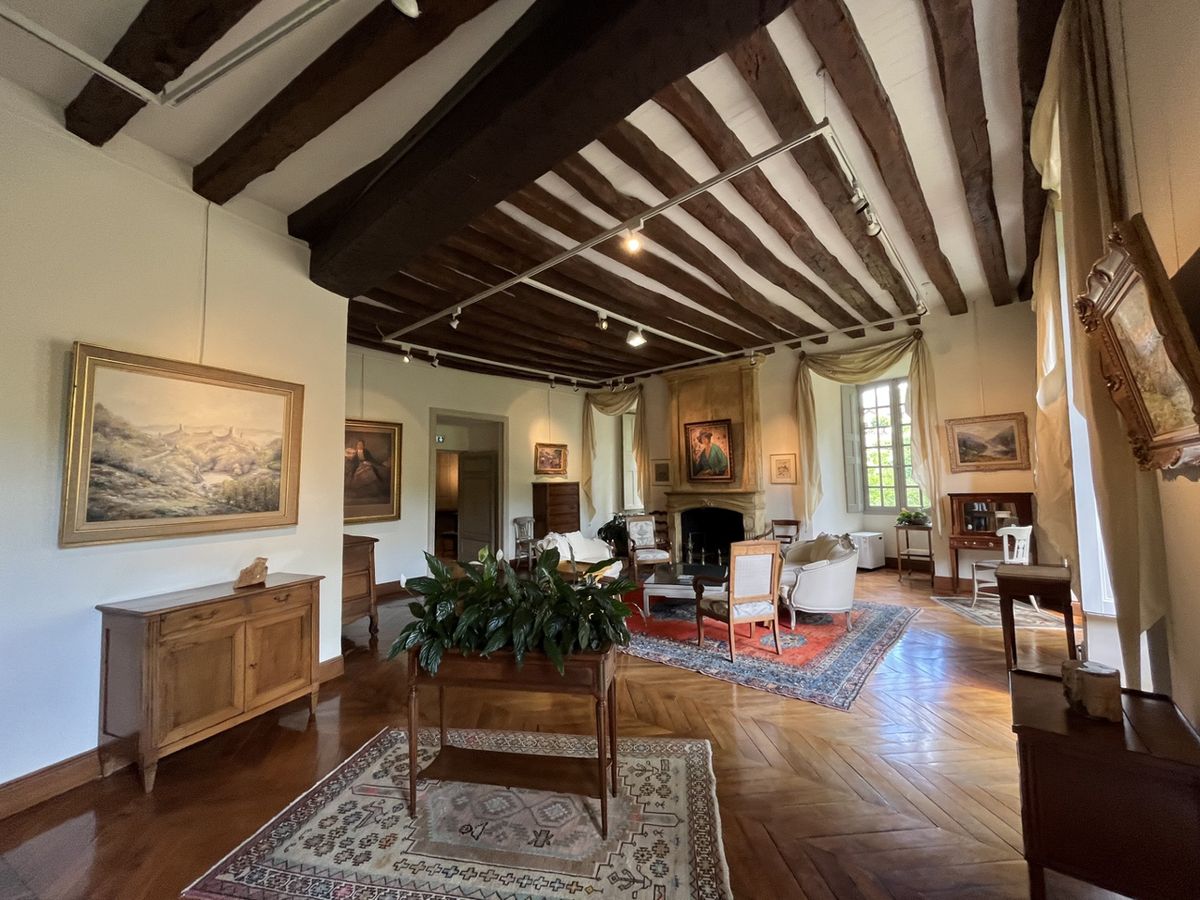
It is not a castle, but still a lovely home. The guided visit (allow about an hour) brings back to life the relatively privileged lifestyle and the complexity of a woman who claimed — and won — her freedom in a century that offered almost nothing to women.

All her life, Aurore Dupin — her real name — was marked by a double heritage: noble on her father’s side, very modest on her mother’s side. It is in Nohant, however, that she grew up, beside a learned paternal grandmother.

Later, she married a failed union with Baron Dudevant, with whom she had two children — Solange and Maurice — and soon separated from him before obtaining, in 1836, a separation of body and property (divorce did not exist at the time).

Thus, she was able to return to her Nohant estate, inherited in 1821 after the death of her grandmother.


An Extraordinary Individual


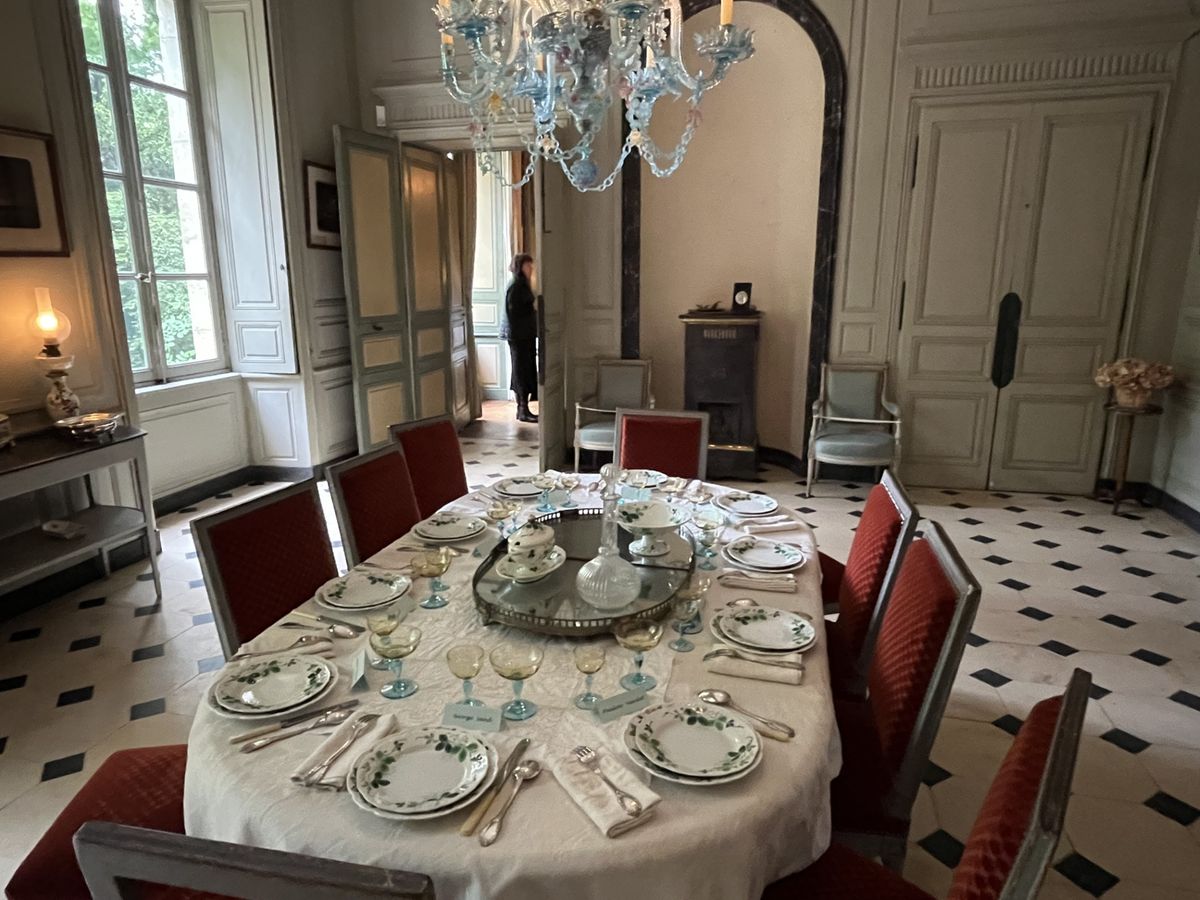
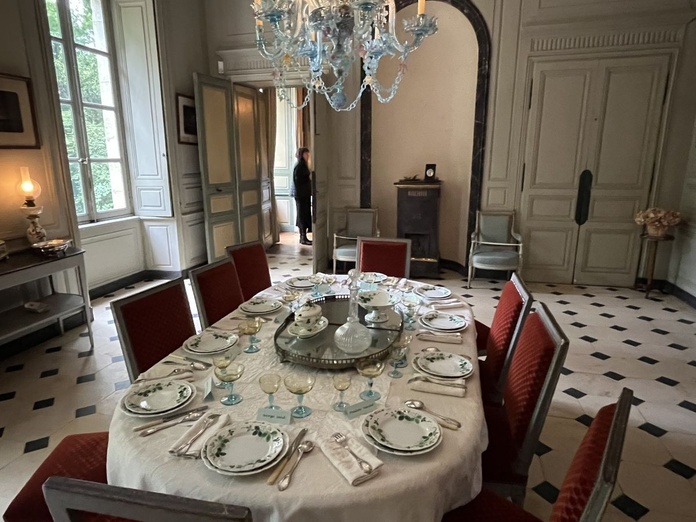
Dans la salle à manger éclairée par un liste de Murano, la table reste dressée avec les désormais célèbres assiettes à motif de fraises de la faïencerie de Creil-Montereau - Photo : Paula Boyer

From then on, as the anecdotes recounted by the guide during tours of the furnished and decoratively time-honored rooms show, this remarkable woman rooted her life here, though it was punctuated by stays in Paris and travels to Italy, Switzerland and Spain.

On site, George Sand lived with several of her lovers, including Chopin who composed a large portion of his work in the upholstered room set up for him.

She also cultivated close friendships with major artists such as Liszt, Musset, Flaubert, Balzac, Théophile Gautier, Fromentin and Delacroix.

In a world shaped by and for men, this woman defied taboos and the prevailing misogyny with her great freedom of conduct and expression, wearing trousers, smoking, cutting her hair short and, to be published, taking a masculine name — George Sand — which has gone down in history.

First woman to live by her pen, she wrote more than 70 novels, but also very political texts, advocating especially for gender and class equality, proclaiming herself “a republican of all devils” and throwing herself into the 1848 Revolution…


A True Passion for the Garden


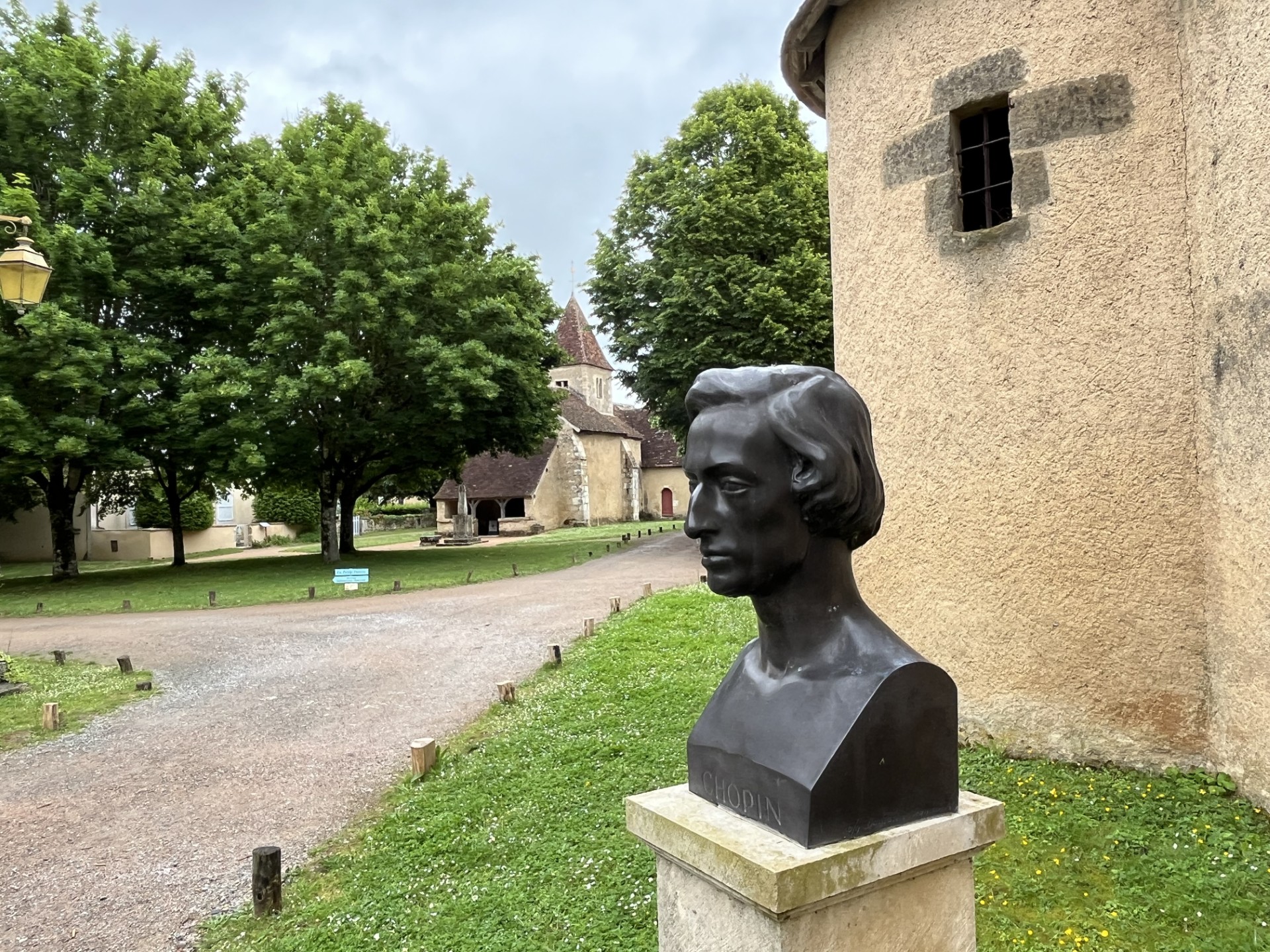
A l'entrée de l'allée qui mène à la place du village et à la maison de George Sand, un buste de Frédéric Chopin - Photo : Paula Boyer,

After the house, take a stroll through the bookshop on the ground floor of the former carriage shed (horse-drawn, of course) and upstairs, where the numerous puppets carved by Maurice, the writer’s son, are exhibited; he adored these shows, but also developed talent in drawing and painting learned in Delacroix’s workshop.

The walk is free in the park, whose layout hasn’t changed since George Sand.

It comprises a rose garden — renovated in 2023 —, a cutting garden, a vegetable garden, an orchard, and a wilder, more romantic space crossed by winding paths and populated with large boxwoods and five remarkable trees — including a vast Japanese Sophora — that the writer knew.

George Sand had a true passion for this garden, dedicating several hours here each day, even managing to grow – with success – pineapples in the small conservatory.

Afterward, a short tour through the village of Nohant, with its low, sturdy houses, lime-washed and topped with slate or small tiles, where little has changed!

On the paved square, the small Romanesque church still seems prepared for the writer’s funeral, announced by a facsimile of her death notice and noted by a Figaro article posted on a panel.

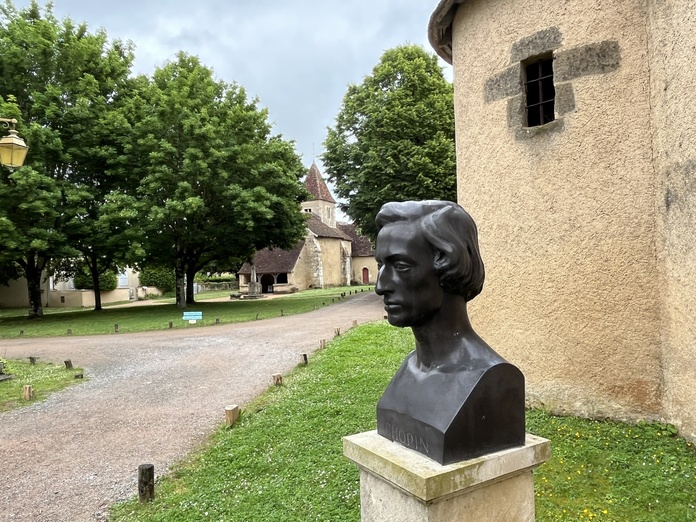
At the end of the street — in the Frédéric Chopin alley — which leads to RD 943, stands a bronze bust of the Polish pianist, who died in 1849, two years after his separation from George Sand.


Sarzay Castle, Medieval Jewel of the Black Valley


Countless Places Featured in Her Novels


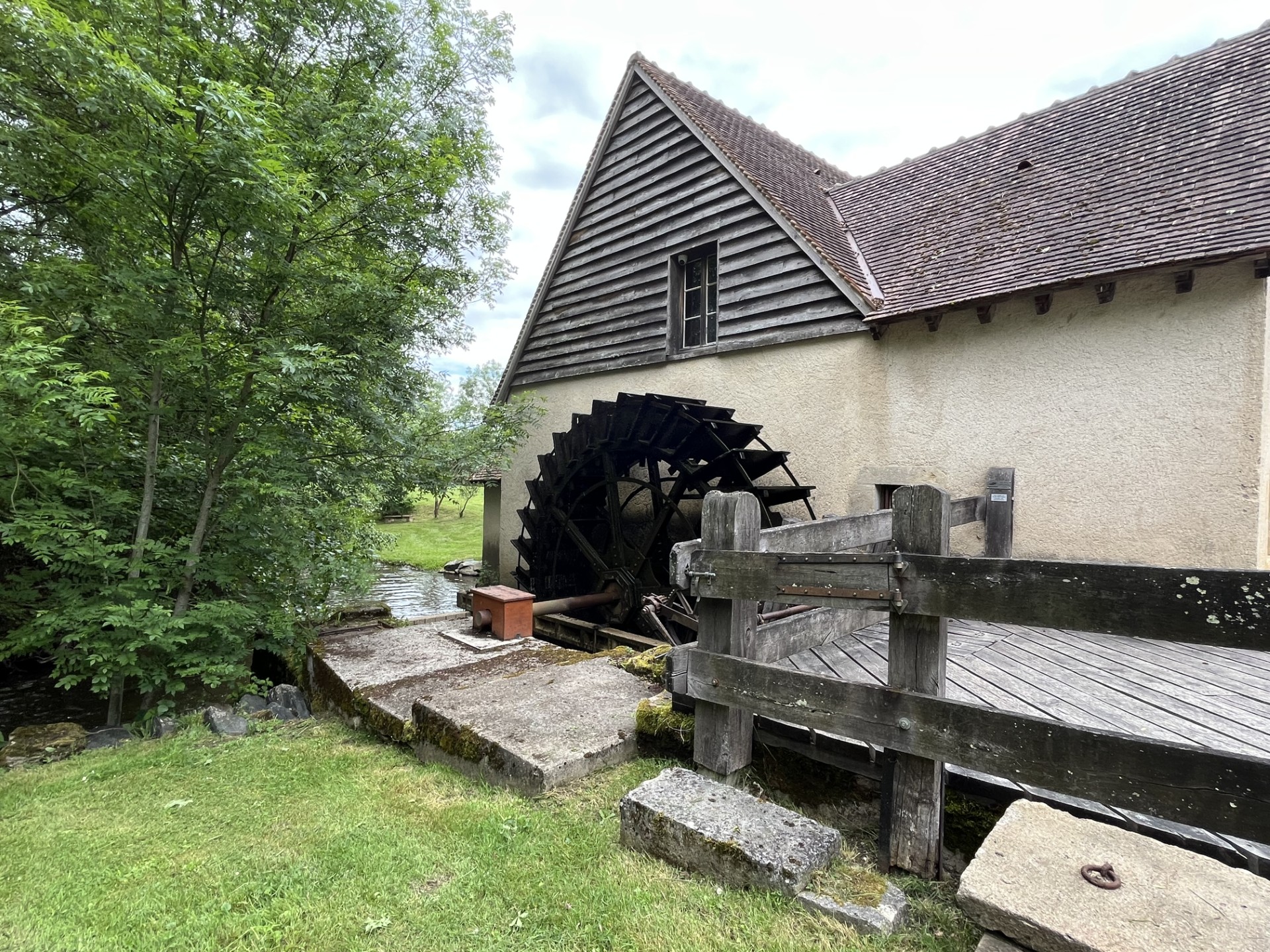
Le Moulin d'Angibault permet de découvrir le fonctionnement d'un moulin à eau de plaine du XVIIIe s - Photo : Paula Boyer

The Sarzay Castle can be visited, just as, not far away, at Montipouret, the mill where George Sand set the plot of her “The Miller of Angibault.”

Bordered by the Vauvre river, now part of a beautiful 7-hectare natural area, this mill renovated in 2016 is the last one in Indre still able to grind.

As you wander there, you better understand why George Sand wrote: “there are places that dispose us to an invincible tenderness…

Just two kilometers away, in Mers-sur-Indre, in the Chanteloube woods, lies the mysterious “Mare au diable” that inspired the famous novel of the same name.

It is a pastoral intrigue in the Berry peasant world that George Sand often portrays with benevolence, not failing to keenly critique its flaws.


In La Châtre, Eating Like George Sand

Next destination, La Châtre. This charming small town nestles along the Indre. Its museum dedicated to George Sand is unfortunately closed for renovations during the anniversary year.

By contrast, the Lion d’Argent hotel offers a “George Sand menu” (60€) but only… on holidays or by order.

Indeed, the dishes of the bourgeois cuisine dear to George Sand require lengthy preparation: Queen Margaux cream, Pistachio chicken quenelles, Sandre with Nantes butter, Beef hash in crust, Soft brioche cake…

This is a venture not undertaken by “La Table de Cérestine,” the excellent Lebanese restaurant in Chassignoles, which nevertheless pays homage to George Sand with a mini-exhibit.


Gargilesse, “the Most Beautiful Village in France”


Gargilesse, "plus beau village de France", abrite aujourd'hui de talentueux potiers et artisans, dont Justin Etre, une filographe qui réalise d'admirables sculptures en fil d'algue - Photo : Paula Boyer

Final stop of this journey through a land home to countless castles, including the Château de la Rose with its elegant guest rooms: Gargilesse. It is one of the “Most Beautiful Villages in France”.

It clings to a slope in the Creuse valley where Armand Guillaumin, Léon Detroy, and also Claude Monet once set up their easels.

Lovers of nature, plants, insects and stones, George Sand and her last companion, the engraver Alexandre Manceau, stayed here several times before, in 1857, falling in love with Gargilesse.

Manceau quickly bought a cottage there, soon named Algira after a butterfly discovered during a walk.

This charming little house — slightly expanded later — furnished with period pieces houses natural history collections and objects belonging to the writer, as well as drawings by her son Maurice.

It is open for visits, in the company of the tireless Catherine Lienard, a friend (and heiress) of Christiane Sand, wife of the adopted son of George Sand’s granddaughter.


“George Sand, the Soul of the Landscapes”


L'exposition "George Sand, l’âme des paysages" est présentée dans les pièces de réception du château de Gargilesse - Photo : Paula Boyer

Set along the route of Saint-Jacques de Compostelle (and on the GR 100), well kept and flowered, Gargilesse (40 inhabitants) naturally has its own George Sand hotel-restaurant. It is a village of potters and artisans and, as Hélène Texier, deputy mayor, insists, “the harp capital.”

Adjacent to a oversized church (in the crypt, fine 12th-century frescoes), its 12th-century fortified castle, rebuilt in the 18th century, hosts from June 6 to September 20, 2026, in partnership with the La Châtre museum, “one of the most important events of the year-long anniversary 2026,” a year that will be marked by more than 110 events.

The purpose of this exhibition titled “George Sand, the Soul of the Landscapes” is — as curator Carine Stahl notes — to show that beyond their influence on her work, the writer’s attachment to the Berry landscapes also reflected her commitment to rural life and to nature.

George Sand, an eco-friendly pioneer before her time? Judging by her writings, it seems quite possible.


PAULA BOYER Published by Paula Boyer Head of the LuxuryTravelMaG section – TourMaG.com
See all articles by Paula Boyer

  • picto Twitter
  • picto Linkedin
  • picto email
Ajoutez TourMaG à votre flux Google Actualités Google Actualités icône


Paris Tourism Barometer: April 2026 Stable Despite Air Travel Dip


Les arrivées aériennes enregistrent une baisse de 2,3% sur le mois d’avril 2026 - DepositPhotoos.com, encrier

CroisiEurope


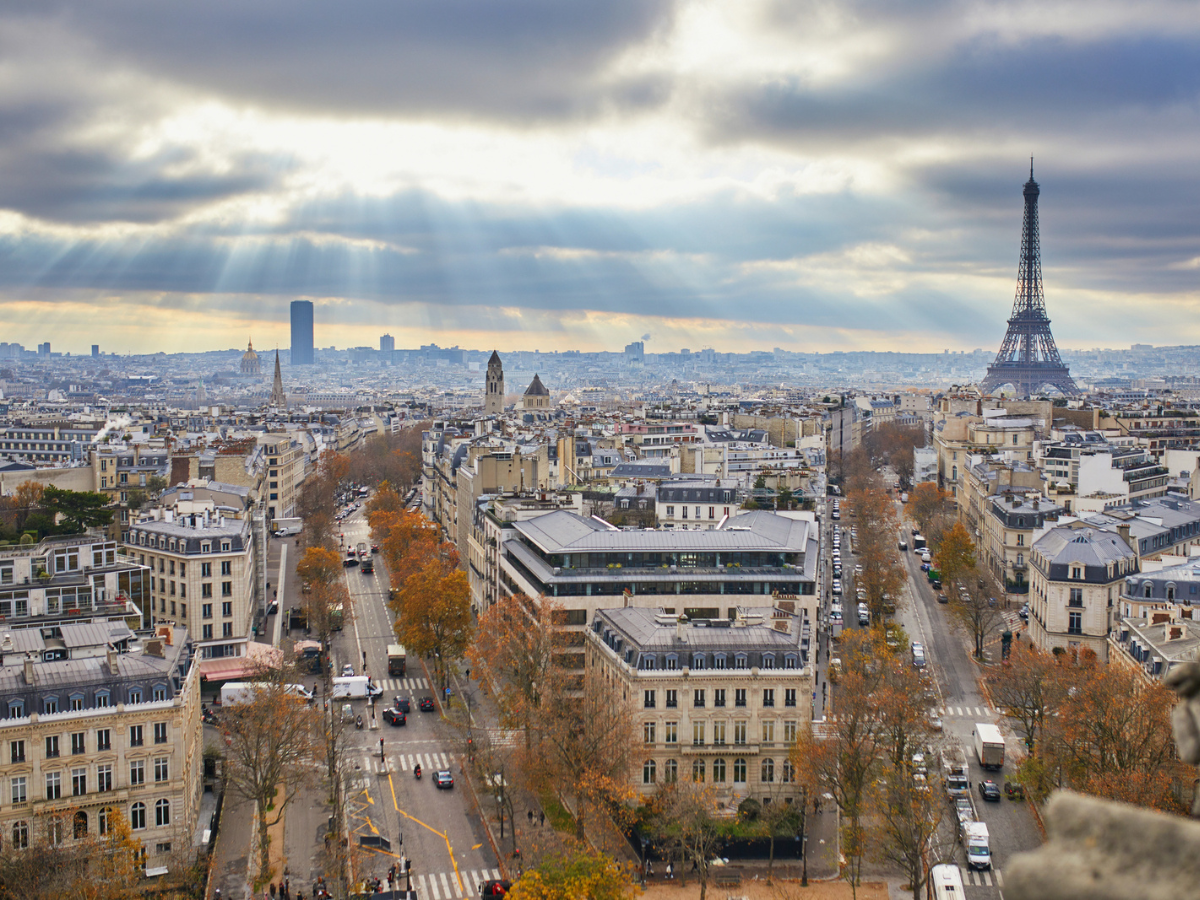
The Paris Tourism Barometer has unveiled its figures for April 2026: 3.4 million visitors arrived in the capital.

The period was notably boosted by the Paris Marathon, the Francophone Diabetes Society Congress, and the Easter long weekend.

Hotel RevPAR, however, advanced compared with 2025 thanks to a slight increase in the average price, even as the occupancy rate fell by 0.3 percentage point.

Air arrivals nonetheless recorded a 2.3% decline for the month of April versus 2025. The business segment rose slightly (+2.7%), while the group travel clientèle dropped by 17.4%.


What about spring?

As for the May Day long weekend, it proved less dynamic than in 2025 with a 8% drop in attendance. Conversely, the May 8 weekend posted a 10.9% rise, notably driven by French visitors.

This trend is also reflected in hotel performances, with a 3.3% decrease in occupancy on the May 1st weekend, versus a 2.6% increase on the May 8 weekend.

Early estimates for the month of June point to a 10.9% decline in air bookings and a predicted 4.3% drop in hotel occupancy.

Several events are expected to support summer activity, notably The Weeknd concerts at the Stade de France in July, Bad Bunny performances at Paris La Défense Arena, and several international congresses held at Paris Expo Porte de Versailles and the Palais des Congrès.

The 2026 European Swimming Championships, staged between Paris and Saint-Denis from July 31 to August 16, should also help bolster tourist attendance during the summer.

Bon Air Club Aims to Create a New Generation of Outdoor Base Camps


Bon Air Club veut inventer une nouvelle génération de « camps de base » outdoor - Photo Bon Air Club

CroisiEurope


Between glamping, sport tourism, and micro-adventure, Bon Air Club seeks to create a new category of tourist accommodation.

The young French company will open its first site in July 2026 in the Alpes Mancelles, with the ambition to roll out five outdoor “base camps” in France within five years.

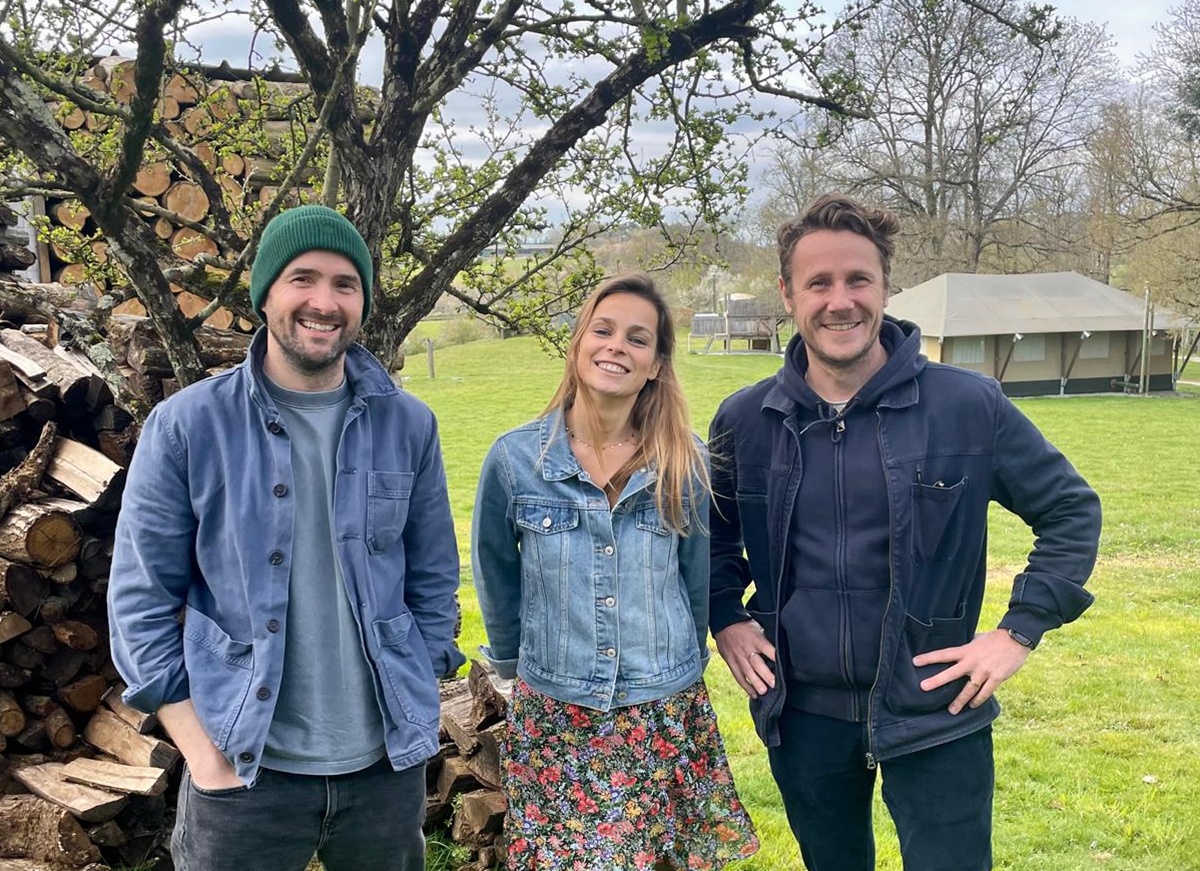
Founded in 2025 by Ségolène Desplanques, Grégory Thibord and Pierre-Yves Le Gal, the company is betting on evolving traveler expectations: “We have seen several trends emerging: the rise of outdoor activities, especially among urban audiences, but also a demand for local travel with greater flexibility,” explains co-founder Ségolène Desplanques.


The concept sits at the crossroads of camping and traditional hoteliering. But the co-founder stresses the distinction from conventional outdoor-hospitality models.

“What we offer is a reconnection to nature through movement. We lean more toward outdoor sport and adventure,” she explains. The first site will eventually include 40 accommodations on eight hectares.

The concept rests on “base camps” that are open nearly year-round and designed for outdoor activities: trail, hiking, gravel biking, kayaking, rock climbing or bivouacking, all within easy reach.


The first establishment will open in Saint-Léonard-des-Bois, in Sarthe


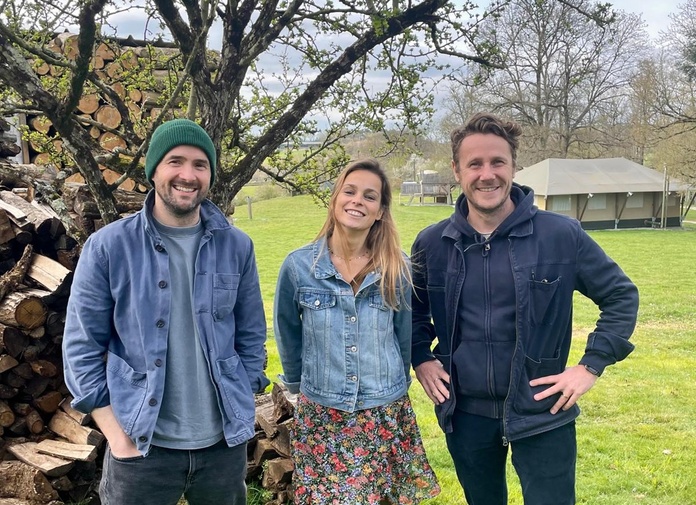
Bon Air Club a été créé en 2025 par Ségolène Desplanques, Grégory Thibord et Pierre-Yves Le Gal - Photo Bon Air Club

The first établissement will open in Saint-Léonard-des-Bois, in the Sarthe department, in the heart of the Alpes Mancelles. Located less than two and a half hours from several major metropolises, the site has been chosen for its potential for outdoor activities.

The project, supported by Sarthe Tourism and the Pays de la Loire region, represents an investment of 6.5 million euros.

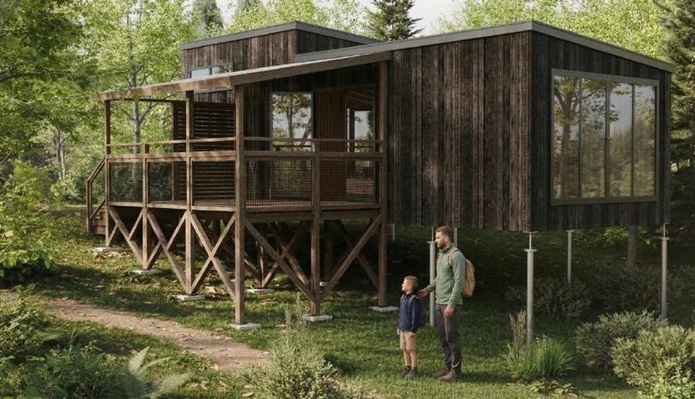
The base camp will include, at opening, 36 accommodations, a central refuge with a restaurant and an indoor climbing wall, a forest spa and several convivial spaces.

To reinforce the outdoor dimension, the site will also offer rental equipment and various gear dedicated to sports activities.

“We have an outdoor center with equipment at disposal, bikes, climbing gear, bivouac kits or gear for heading out even when it rains,” details Ségolène Desplanques.


Funding rounds completed with bank financing.

To finance its development, Bon Air Club has carried out several fundraising rounds, complemented by bank financing.

“We carried out two fundraisings in parallel: one for the holding company and another to fund the first site,” explains Ségolène Desplanques.

According to the co-founder, the financing of the first base camp rests mainly on a banking pool comprising three institutions, supplemented by private investors and regional support.

“The order of magnitude is around 7 million euros of investment per site,” she notes.


One site per year to build a national network of five base camps

Ultimately, Bon Air Club plans to open one site per year to establish a national network of five base camps.

The company favors redeveloping existing sites rather than building on virgin ground, particularly due to constraints linked to zero net artificialization (ZAN).

“Starting from virgin land to launch a tourism offer has become almost impossible today,” says Ségolène Desplanques.

The leader mentions notably taking over former holiday villages or small quirky accommodation facilities facing economic difficulties: “Many project developers struggle to endure over time without scaling up to a size that would allow hiring employees,” she notes.

Institutional Tourism Crisis: Could the Private Sector Be the Solution?


Tourisme institutionnel : un secteur en quête de légitimation... Atout France comme exemple à suivre ? - Depositphotos.com, 3d_generator

CroisiEurope


More than six months after the melodrama that shook institutional tourism with the hypothetical closure of the Val-de-Marne Departmental Tourism Committee, the sector is sinking deeper into crisis.

Admittedly, the structure has not yet closed its doors, but it must operate without the department’s 900 000 euros subsidy, which greatly jeopardizes its future.

And if Val-de-Marne Tourism is still standing, Solutions & Co. is no longer.

The Pays de la Loire Economic Development Agency, which encompassed the Regional Tourism Committee, was liquidated, because the region “does not have the means to maintain such an agency“.

Its president explained to our colleagues at La Tribune that France has entered “the era of exigency, where every public euro must be a useful euro“. Tourism professionals will appreciate being described as useless.

Ce n’est pas tout, car Gironde Tourisme va connaître le même sort.

If the explanation lies in the department’s heavy deficit, the mayor of Lacanau regards the CDT as “useless” and denounces a “millefeuille institutionnel“, unable to “implement a concrete action“.


A sector seeking legitimacy: Atout France as a model to follow?

The politicization of the debate, added to exhausted public finances, seems increasingly to threaten this sphere of the tourism industry.

The presidential deadline should not really reassure the leaders and employees of the various structures, as a disengagement by the State becomes more openly acknowledged.

The crisis is intensifying, because we are now witnessing not only budget cuts but closures as well. The fact is there. Communities have less money.

In this context, and to stem the bleed, the profession should come together and propose measures to rationalize what sometimes resembles an institutional mille-feuille
“, contextualizes Jean Pinard.

It would be possible to better distribute the housing tax. Imagine that in Paris, out of the 120 million euros in revenue from this tax, only 4 million goes back to the tourism office.

We should also question private players: how to mobilize Club Med, Belambra and all those actors who keep the destinations alive
.”

While some operators struggle to justify their budgets and their missions, faced with the rise of artificial intelligence, networks and the omnipresence of OTAs, public authorities have a free hand to cut budgets, or even eliminate levels.

Among these bad news, there are nonetheless solutions, as notably demonstrated by Atout France’s GIE.

Founded in 2009, the group of economic interest (GIE) enables governance and financing of the agency to include not only the French administration but also private players.


Private funding: the Dordogne Périgord Tourism case

Atout France is not the only case study, a CDT has also taken this turn.

You have to go to the Southwest, to a territory of character offering visitors caves, castles and a plethora of the most beautiful villages in France.

It is in Dordogne that we go. In this territory, tourism is omnipresent. It represents just over one billion euros in turnover and consumption in the department each year, for 19 million overnight stays.

Volumes higher than 2019, a year when the sector simply weighed 22% of the local GDP.

Post-Covid, with the fall in transfer duties coupled with the collapse of the real estate market, we saw our subsidies begin to drop.
The decrease is 100,000 euros for 2023, 2024 and 2025.
For us, tourism is not just about promotion or marketing; it is also about networking, animation, and support
“, explains Christophe Gravier, director of Dordogne Périgord Tourism.

We therefore created a first club on relationship marketing, where we bring along the offices. This allowed us to pool certain tools, such as the newsletter and a shared database that we manage.
Then, while discussing with on-the-ground operators the financing issue of the CDT and their needs, we realized there was private demand
.”


Dordogne Périgord Tourism: “We rested on the housing tax or subsidies”

The structure thus saw 300,000 euros disappear in total over three years, out of nearly 2 million euros of annual budget. But from faint signals and discussions at events, the operator organized itself.

It launched two clubs, but above all emerged an offer based on new services capable of bringing added value to private players in the region.

This led us to create a somewhat hybrid structure and to reinvent the CDT’s classic economic model. Being a bit provocative, I would say that, for convenience, we had relied for years on the housing tax, additional taxes, or subsidies.
This drop in budget forced us to wake up.

Either we retraced our steps into engineering, or we wanted to maintain an ability to support on the marketing and communications front. In that case, we had to do it differently.

Rather than remaining in a logic of image marketing and notoriety, we considered that this communication would be more relevant if it were invested for the benefit of professionals, in a performance-based logic“, wants to highlight Christophe Gravier.

One of the clubs addresses heritage topics, whether caves, remarkable gardens or castles.

Members pay a membership fee that funds a marketing pool, from which managers of these sites can draw to finance training actions, gain perspective on new technologies, carry out commercial outreach, or launch campaigns on social networks.

We try to deliver a set of services with real added value, while ensuring we do not compete with the work done by tourist offices or the CRT. We operate in a cluster logic“, defines the leader.

Read: Google in AI fashion: what life without clicks or audience?

The second club focuses on iconic sites and products. It brings together the entire excellence chain, including truffles, foie gras, walnut production, as well as 4- and 5-star hospitality.

A third club is expected to be launched in 2026 on nature sports, as Dordogne is a hub for hiking and canoeing, and a fourth is under development around oenotourism.


A beneficial shift for private actors and the CDT budget

This transformation has benefited both private players and the CDT budget. In just two years, 150,000 euros were collected. Moreover, partners contribute funds allowing nearly 50% of the action plan of the organization to be financed.

A change that has not completely questioned Dordogne Périgord Tourism’s role.

We remain the department council’s arm to deploy its tourism policy, that does not change.
Anyway, private operators have the flow, the traffic. Rather than chasing audience or imposing an image that already exists, at least for Dordogne, we come to support them and amplify the impact of their investments.


We are a small team of 15 people. We had to shift our logic to integrate a commercial, representational side into our work, and the need to bring added value. Because if the clubs bring nothing to the business leaders, next year they will not renew the experience.

We are, I think, closer to the ground and to the expectations of the actors


Huttopia Launches Its Vacation Observatory


Huttopia annonce la création de son Observatoire des vacances

CroisiEurope


Huttopia has created the Huttopia Holidays Observatory, launching with a first major survey.  
This research and analysis body, developed with ObSoCo, aims to fill the lack of solid data on this topic.  
Here are a few figures: 
Although it is often said that 40% of French people do not take holidays, the survey shows that the actual rate of non-vacation is 28%. Situations vary: only 4% are truly and permanently excluded from holidays, 11% cannot afford to go this year, but hope to be able to do so soon, and 7% make a financial or time-related choice, preferring to use their money or their time for other things, such as renovations.  
Meanwhile, 6% choose not to travel by preference. However, the study reveals a strong democratization of holidays. Indeed, 74% of 18-24-year-olds used to go on holidays when they were children, compared with only 48% of those aged 65-75.  
 
Another important point of this survey: ecology. The environmental impact is the last criterion for choosing a destination, affecting only 8% of French people.  
Yet, 75% of them express strong interest in holidays centered on the outdoors and nature. Today, the term “ecological” is often seen as a constraint, whereas vacation time is linked to pleasure and freedom.


What is the aim of this survey?

The results of this first edition will be analyzed in the book “The Book of Holidays, and What They Tell Us” (co-authored by Guénaëlle Gault and Jean Viard), which will be published on June 5, 2026 by Éditions de l’Aube. 

 
This survey will be annual to track evolutions over time. All results will be freely available online to feed public debate. 

 
Through this Observatory, the Huttopia Foundation aims to provide a solid database to encourage public and economic actors to support universal access to holidays, through public policies for holiday camps, green classes, or affordable and locally available private offers. 


Bordeaux: Saint-Michel Spire to Reopen to the Public


La flèche Saint-Michel signe son retour après 5 ans de travaux, Nicolas Duffaure

IFTM TourMaG Party


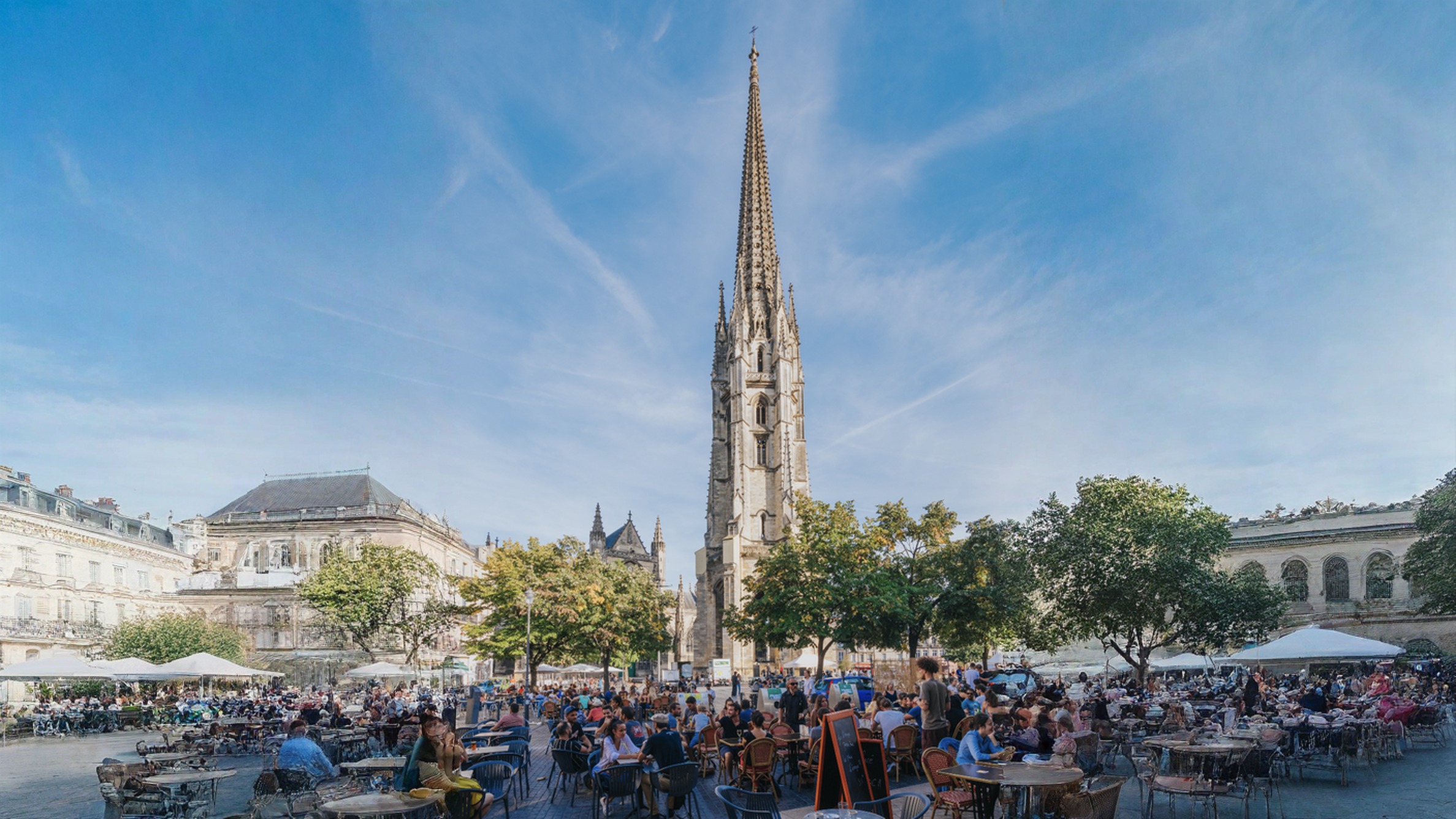
After five years of renovation, the Saint-Michel spire in Bordeaux will soon be reopened to the public.

Residents of Bordeaux and visitors will be able to rediscover it starting from June 13.

They will be able to admire this Gothic-style edifice and its spire, which rises to 114 meters high, making it the fourth tallest church tower in France.

The bravest may also climb its 230 steps to behold Bordeaux from its summit, with a 360-degree panoramic view.


The Saint-Michel Spire: a renovation that took time

Beginning in 2022, the monument underwent a major restoration to repair deteriorated stone, cracks, and weak points in its structure.

The edifice had become considerably deteriorated.

To read: The City of Wine celebrates its 10th anniversary from June 4 to 7, 2026

Over the centuries, since the 15th century, the monument has undergone numerous modifications and renovations that have contributed to its fragility, a situation further intensified by weather-related hazards. It was therefore essential to undertake works to durably protect this heritage.

The project lasted nearly five years, with the spire being closed at the end of 2021 before reopening in June 2026. This duration can be explained by the scale of the mission and the height of the building.

To reach the highest parts, substantial technical means were required to perform precise work:

  • complete restoration of the stone claddings;
  • replacement of damaged stones and joints;
  • bring the lightning protection system up to standard;
  • restoration of the cross located at the very top.